
Imagine a patient walking into your pharmacy, picking up their monthly blood pressure medication, and suddenly stopping their treatment for two weeks because the pill is blue instead of white. It happens more often than you'd think. When a patient sees a different shape or color, they don't see a cost-saving alternative; they see a mistake. This is where patient counseling on generics moves from a regulatory checkbox to a critical clinical intervention. If a patient doesn't trust the pill in their hand, the most evidence-based therapy in the world is useless because it stays in the bottle.
The Legal and Ethical Baseline
Counseling isn't just a professional courtesy; it's a legal mandate. In the U.S., the Omnibus Budget Reconciliation Act of 1990 (OBRA '90) established the foundation for mandatory patient counseling. This federal regulation ensures that pharmacists provide essential education before a patient leaves the store. Beyond the law, organizations like the International Pharmaceutical Federation (FIP) and the World Health Organization (WHO) frame this as a core part of Good Pharmacy Practice. The goal is simple: respond to the patient's needs with evidence-based treatment to prevent therapeutic failure.
While all 50 states require counseling, the way you document it varies. Some states are fine with a general "counseling offered" note, while others, like California, require specific checkboxes confirming the generic substitution was discussed. Regardless of the paperwork, the American Society of Health-System Pharmacists (ASHP) guidelines emphasize that the depth of the conversation should be based on your professional judgment and the specific needs of the person standing in front of you.
What Exactly Should You Discuss?
When you're switching a patient to a generic, you can't just ask, "Do you have any questions?" That's a closed-ended question that usually gets a "no," even if the patient is confused. Instead, you need a structured approach. A reliable framework involves five key points:
- Identity Verification: Confirm you have the right patient and the right medication.
- The "Why" of Substitution: Explain the legal and therapeutic basis for the switch.
- Visual Differences: Be explicit about the appearance. Tell them, "The brand name is a small round white pill, but this generic is an oval blue pill."
- Bioequivalence: Reassure them that while the look is different, the active ingredient and the effect on the body are the same.
- The Teach-Back Method: Ask the patient to explain how they will take the medication and what it is for. This is the only way to verify they actually understand.
According to CMS guidelines, you must cover the drug's name, its intended use, the dosage schedule, and any severe side effects or contraindications. If you're substituting a generic, the conversation must specifically bridge the gap between the brand they expected and the product they're receiving.
| Counseling Element | Brand-Name Focus | Generic-Specific Focus |
|---|---|---|
| Active Ingredient | Standard identification | Emphasis on identical chemical structure |
| Physical Appearance | Standard identification | Explanation of color/shape/size changes |
| Cost & Value | Standard pricing | Highlighting significant cost savings |
| Efficacy Trust | Usually high/accepted | Addressing "less effective" misconceptions |
| Inactive Components | Standard check for allergies | Explaining why fillers/dyes may differ |

Tackling the "Generic Myth"
Many patients carry deep-seated misconceptions about generic drugs. A 2023 survey found that 43% of users believe generics are less effective, and 37% think they cause more side effects. These aren't just random thoughts; they are barriers to adherence. When a patient believes a generic takes longer to work, they might double their dose or stop taking it altogether when they don't feel an immediate effect.
To combat this, you have to be specific. Explain that the FDA (or relevant local authority) requires generics to be bioequivalent. This means the drug delivers the same amount of active ingredient to the bloodstream in the same amount of time as the brand name. When a patient understands that "generic" means the same active ingredient but different inactive fillers, their confidence in the treatment skyrockets. In fact, patients who receive this detailed counseling report significantly higher confidence in their medication's effectiveness compared to those who just get a standard "any questions?" talk.
Overcoming the Time Crunch
Let's be real: the biggest hurdle in community pharmacy is time. With pharmacists often handling over 14 prescriptions per hour, the window for meaningful counseling is tiny. Some data suggests pharmacists average only 1.2 minutes per patient for actual counseling. This is where communication failures happen. The most common errors aren't clinical mistakes-they are failures to explain that a different-looking pill is still the same drug.
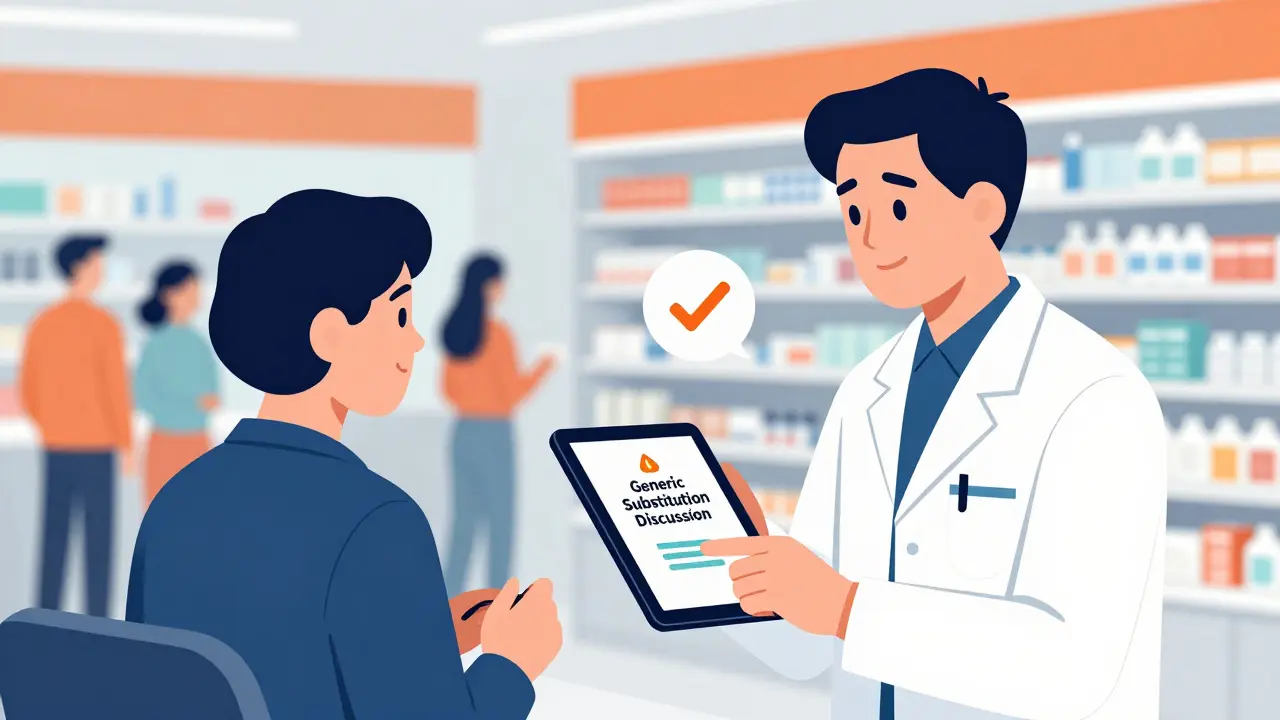
To make this work, integrate technology. Many chains now use electronic prompts that trigger a "Generic Substitution Discussion" alert on the screen. This forces the conversation to happen. Additionally, using visual aids or showing the patient the medication in the bottle can save time and prevent the patient from throwing the medication away once they get home. The goal is to move from a passive process to an active one where the patient is a partner in their care.
Future Trends in Pharmaceutical Care
The landscape of counseling is shifting toward value-based care. We're seeing a trend where evidence of appropriate generic counseling is becoming a quality metric for bonus payments in Medicare Part D. This means the government is starting to put a financial value on the time you spend talking to your patients.
Looking ahead to 2026, AI-assisted tools are expected to help pharmacists identify which patients are most likely to be skeptical of generics based on their history or demographics. Instead of a one-size-fits-all approach, you'll be able to target your counseling efforts toward the patients who need the most reassurance. While the administrative burden of documenting these conversations is increasing, the result is a safer, more cost-effective healthcare system.
What is bioequivalence and how should I explain it to a patient?
Bioequivalence means that the generic drug delivers the same amount of active ingredient into a patient's bloodstream in the same amount of time as the brand-name drug. When explaining this to a patient, avoid jargon. Tell them: "The 'active' part of the medicine that does the work is exactly the same in both pills. Only the 'inactive' parts, like the colors or the fillers, are different, which is why the pill looks different but works the same way."
Do I have to counsel a patient every time they refill a generic?
While mandatory counseling is strictly required for new prescriptions, professional standards like those from the ISBE suggest offering counseling every time a prescription is filled or refilled. At the very least, if the generic manufacturer changes and the pill's appearance changes, you must notify and counsel the patient to prevent them from thinking it is the wrong medication.
Can a pharmacy technician provide generic counseling?
No. While a technician can inform a patient that counseling is available or handle the initial intake, the actual clinical counseling-explaining the drug's use, bioequivalence, and side effects-must be performed by a licensed pharmacist.
What should I do if a patient refuses generic substitution?
Respect the patient's preference, but use it as an opportunity to understand their concern. Ask why they prefer the brand. If it's based on a misconception about efficacy, provide the evidence on bioequivalence. If they still refuse, ensure the prescription is filled as written and document that the generic option was offered and declined.
How do I handle counseling for patients with limited English proficiency (LEP)?
Under Title VI of the Civil Rights Act, pharmacies must provide language assistance. This can involve using a certified medical interpreter or a translation service. It is not sufficient to rely on a family member if it compromises the accuracy of the medical information, especially when explaining the complexities of generic substitution.