
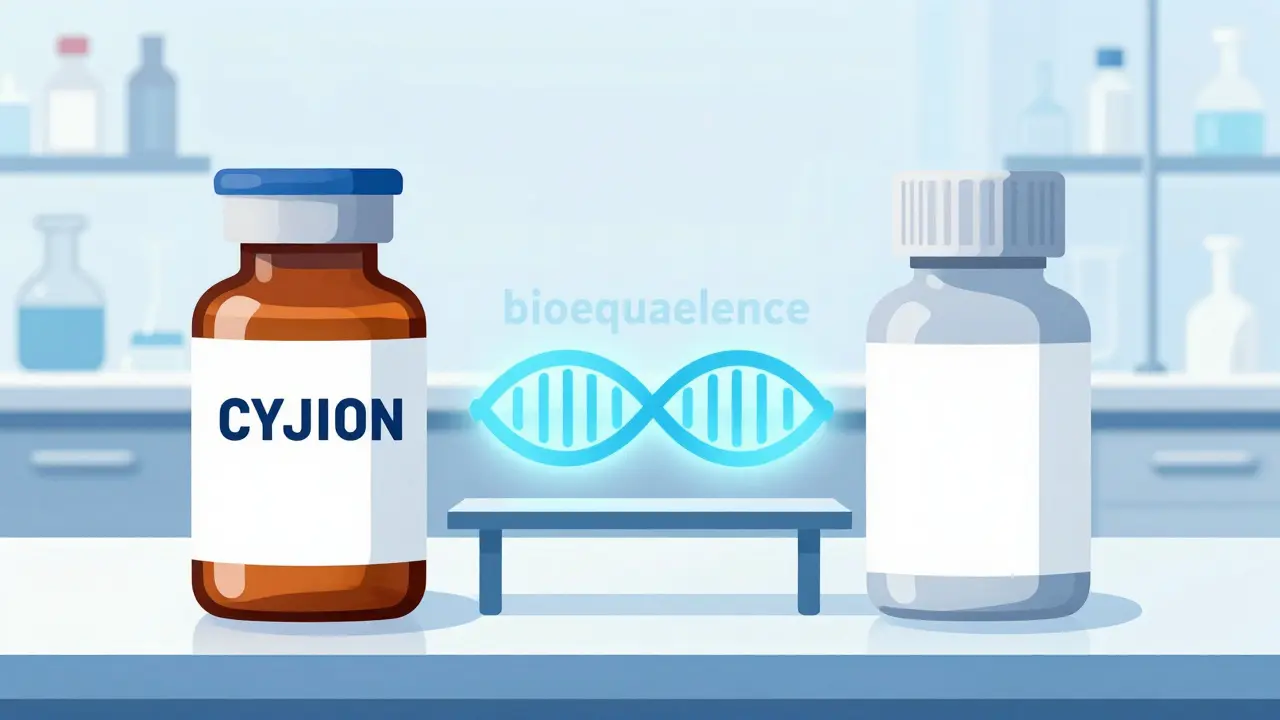
Ever wonder why your pharmacist can swap a pricey brand-name pill for a much cheaper generic version without your doctor needing to run a whole new set of clinical trials? It all comes down to a rigorous process called bioequivalence studies. Essentially, these studies prove that a generic drug delivers the same amount of active ingredient into your bloodstream at the same speed as the original. If the generic version behaves the same way in the body, regulators assume it will have the same effect on the patient.
This isn't just a formality; it's a legal requirement born from the 1984 Hatch-Waxman Act in the US. This law created the abbreviated new drug application (ANDA) pathway, which shifted the focus from proving a drug works (since the brand-name drug already did that) to proving the generic is a mirror image in performance. According to FDA data, these studies are so effective that generic drugs saved the US healthcare system roughly $1.68 trillion between 2010 and 2019.
The Foundation: Choosing the Right Samples
Before any humans are involved, the setup has to be perfect. You can't just grab any bottle of pills off a shelf. The study starts with the Reference Listed Drug (RLD), which is the brand-name version. Regulators usually require a single batch of the RLD to ensure consistency, often choosing the one with the most "average" dissolution profile from three different production lots.
On the other side, the test product-the generic-must be representative of what will actually be sold. It can't be a tiny lab sample; it typically needs to come from a batch that is at least 1/10th the size of a full commercial production run or at least 100,000 units. To make sure they match before the human phase, scientists perform comparative dissolution testing. They use the f2 similarity factor; if the score is above 50 across different pH levels (from 1.2 to 6.8), the products are considered similar enough to proceed to human trials.
Step 1: Designing the Human Trial
Most bioequivalence studies use a Crossover Design. Instead of having two separate groups of people, every participant takes both the brand-name and the generic drug. This is a huge advantage because it removes the "noise" caused by individual biological differences-you are comparing the drug against itself in the same person.
A typical study follows a two-period, two-sequence format. A group of 24 to 32 healthy volunteers is split into two sequences: one group gets the generic first, then the brand; the other group does the reverse. This prevents the order of the drugs from skewing the results. However, for drugs that vary wildly between people (where the coefficient of variation is over 30%), researchers might use a 4-period replicate design with up to 100 subjects to get a cleaner signal.
| Design Type | Best Used For... | Typical Subject Count | Key Characteristic |
|---|---|---|---|
| Two-Period Crossover | Standard systemic drugs | 24-32 | Each person takes both drugs |
| Replicate Crossover | Highly variable drugs | 50-100 | Multiple doses of each drug |
| Parallel Study | Drugs with half-lives > 2 weeks | Varies | Separate groups for test vs reference |
| Multiple-Dose | Modified-release formulas | Varies | Tests steady-state concentration |
Step 2: The Administration and Washout
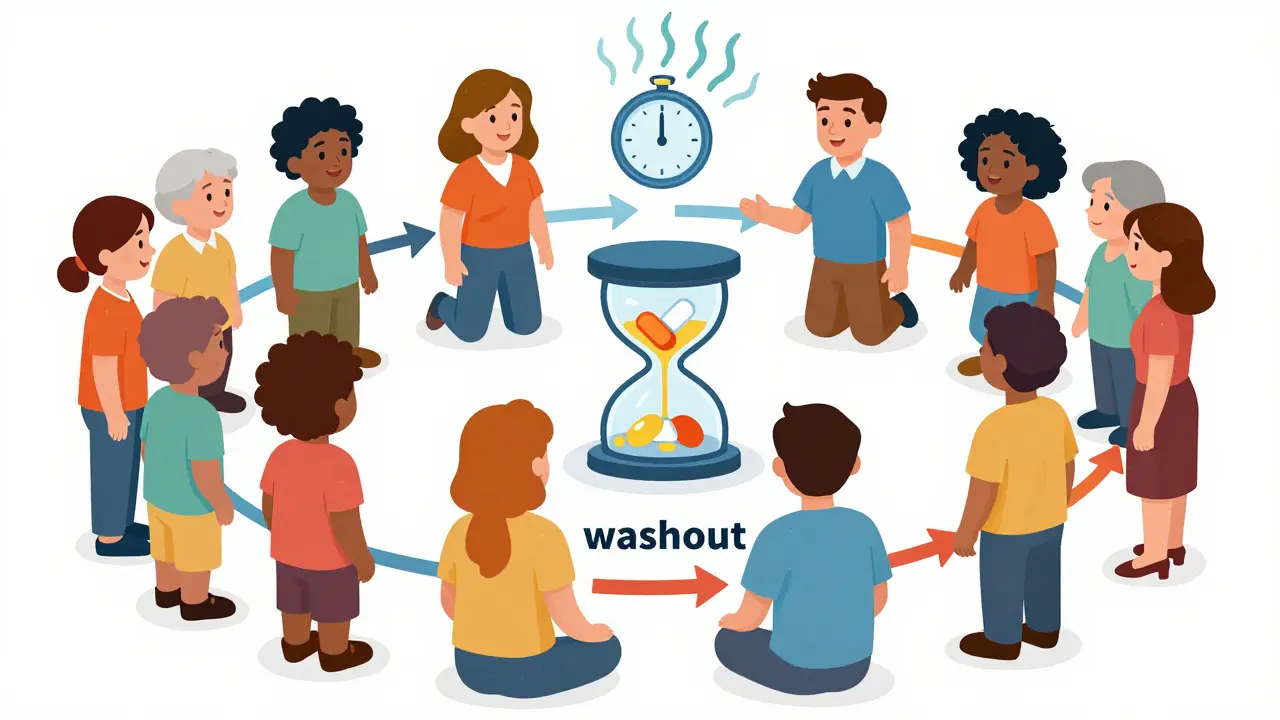
Timing is everything. Once the first drug is administered, the team enters the "washout period." This is the gap between the first dose and the second. If the washout is too short, the first drug could still be in the patient's system, contaminating the results of the second dose. The rule of thumb is to wait at least five elimination half-lives.
Get this wrong, and you're in trouble. Industry professionals on PharmaGuru forums have shared horror stories of CROs underestimating the washout for drugs with long half-lives, leading to failed studies that cost hundreds of thousands of dollars and months of wasted time. It's why many experts insist on a pilot study-a small-scale "practice run"-to verify how the drug actually behaves before committing to the full pivotal study.
Step 3: Blood Sampling and Bioanalysis
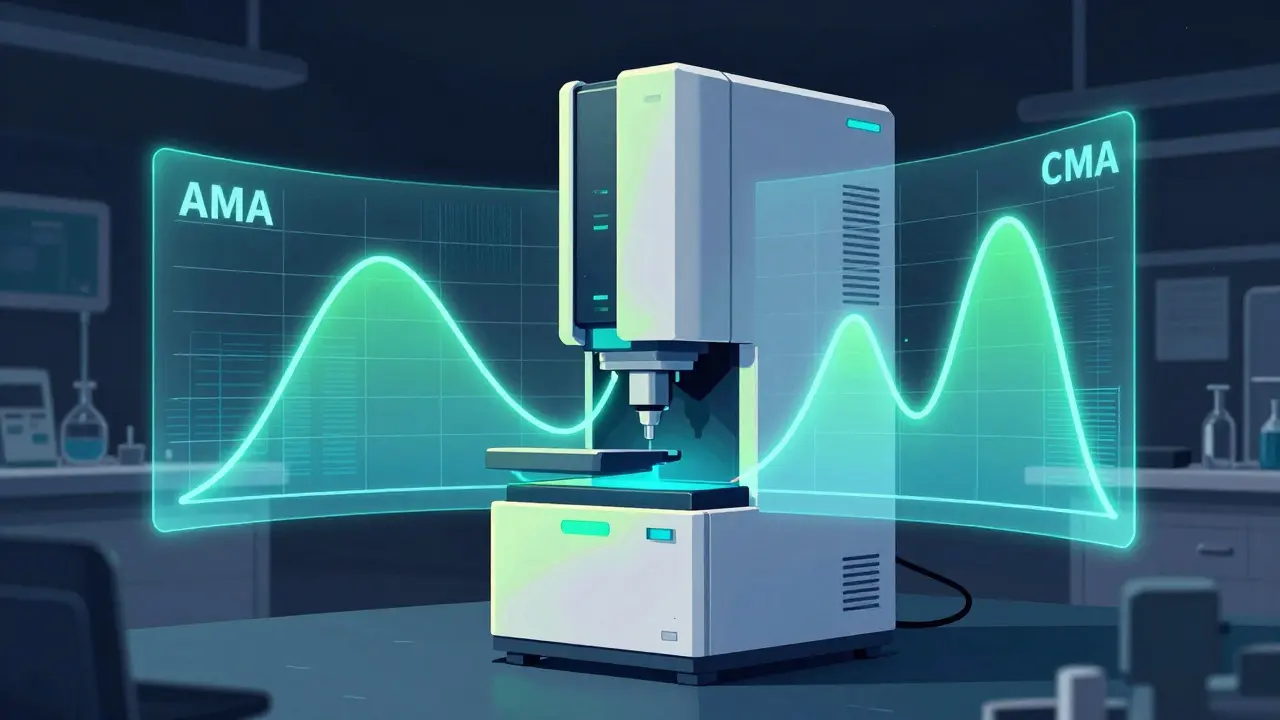
While the participants are recovering, the clinical team is busy drawing blood. They don't just take one sample; they need a full profile. This usually involves at least seven time points: one before the dose, one before the peak concentration is reached, two around the peak, and three during the elimination phase. They keep sampling until the measured area under the curve represents at least 80% of the total predicted area.
These samples are then sent to the lab for LC-MS/MS (Liquid Chromatography-Tandem Mass Spectrometry) analysis. This is the gold standard for measuring drug concentration because it's incredibly sensitive and precise. The analysis must be validated to be within ±15% precision. If the lab's method isn't perfectly validated, the entire study can be thrown out, regardless of how well the drug performed.
Step 4: Calculating the PK Parameters
Once the lab results are in, biostatisticians look at two primary Pharmacokinetic (PK) parameters:
- Cmax: The maximum concentration of the drug in the blood. This tells us how "strong" the peak is and how quickly the drug is absorbed.
- AUC (Area Under the Curve): This represents the total exposure of the body to the drug over time. If the AUC is the same, the total amount of drug absorbed is the same.
These aren't just compared as simple averages. The data undergoes logarithmic transformation and is analyzed using an ANOVA (Analysis of Variance) model. The goal is to find the 90% confidence interval (CI) for the geometric mean ratio of the generic drug compared to the brand name.
Step 5: The Verdict (Acceptance Criteria)
The final step is the "pass/fail" test. For a generic to be approved, the 90% confidence intervals for both Cmax and AUC must fall between 80.00% and 125.00%. If the interval is 82% to 118%, the drug is bioequivalent. If it dips to 78% or climbs to 126%, it fails.
Some drugs have "Narrow Therapeutic Index" (NTI) labels, meaning a tiny change in dose can be dangerous or ineffective. For these, the regulators are much stricter, often requiring a tighter window of 90.00% to 111.11%. This ensures that there is virtually no difference between the brand and the generic.
Alternative Paths to Approval
Not every drug can be tested via blood samples. For some, the FDA and EMA allow other methods:
- Pharmacodynamic (PD) Studies: Instead of measuring the drug in the blood, they measure the drug's effect. For example, with warfarin, they measure how long it takes for blood to clot.
- Clinical Endpoint Studies: For things like topical creams, blood levels don't matter. Instead, they measure the actual healing of a skin condition.
- Biowaivers: Certain highly soluble drugs (BCS Class I) can skip human BE studies entirely if they can prove the drug dissolves almost instantly in a lab setting.
Why is the 80-125% range used for bioequivalence?
This range was established based on the understanding that most brand-name drugs themselves vary by about 20% between different batches. By allowing a range of 80% to 125%, regulators ensure that the generic is as consistent as the brand-name product it is replacing without requiring impossible levels of precision.
Can a bioequivalent drug be less effective?
In almost all cases, no. If the Cmax and AUC are bioequivalent, the drug is delivering the same amount of active ingredient to the target site. While some patients report "perceived" differences, FDA meta-analyses of over 1,200 generics have shown no significant safety or efficacy signals compared to brand names.
What happens if a study fails?
A failure usually leads to a formulation change. The company might adjust the fillers (excipients) or the manufacturing process to change how the drug dissolves. They then repeat the BE study. Many companies use pilot studies to avoid this, as failure rates can drop from 35% to under 10% when pilot data is used to refine the formula.
Who participates in these studies?
Most BE studies use healthy volunteers rather than patients. This is because healthy people have more predictable biological responses, which makes it easier to see if the drugs are different. Using patients would introduce too many variables (like varying degrees of illness) that could mask the drug's actual performance.
How long does it take to get a generic drug approved?
Once the bioequivalence data is submitted, the median review time for a first-cycle approval by the FDA is about 10.2 months, though this can vary depending on the complexity of the drug and the quality of the submission.




3 Comments
It is really great to see how much money is saved by using generics. It helps a lot of people who can't afford the expensive brand names. 💊😊
Everyone knows that Cmax is just the basic part. The real trick is in the LC-MS/MS validation because if the lab messes up the precision, the whole study is trash. Most people don't get that the biostatisticians are the ones actually deciding if it passes, not the doctors.
80% to 125% is a huge gap. Big Pharma just wants a loophole. Trust nothing.