
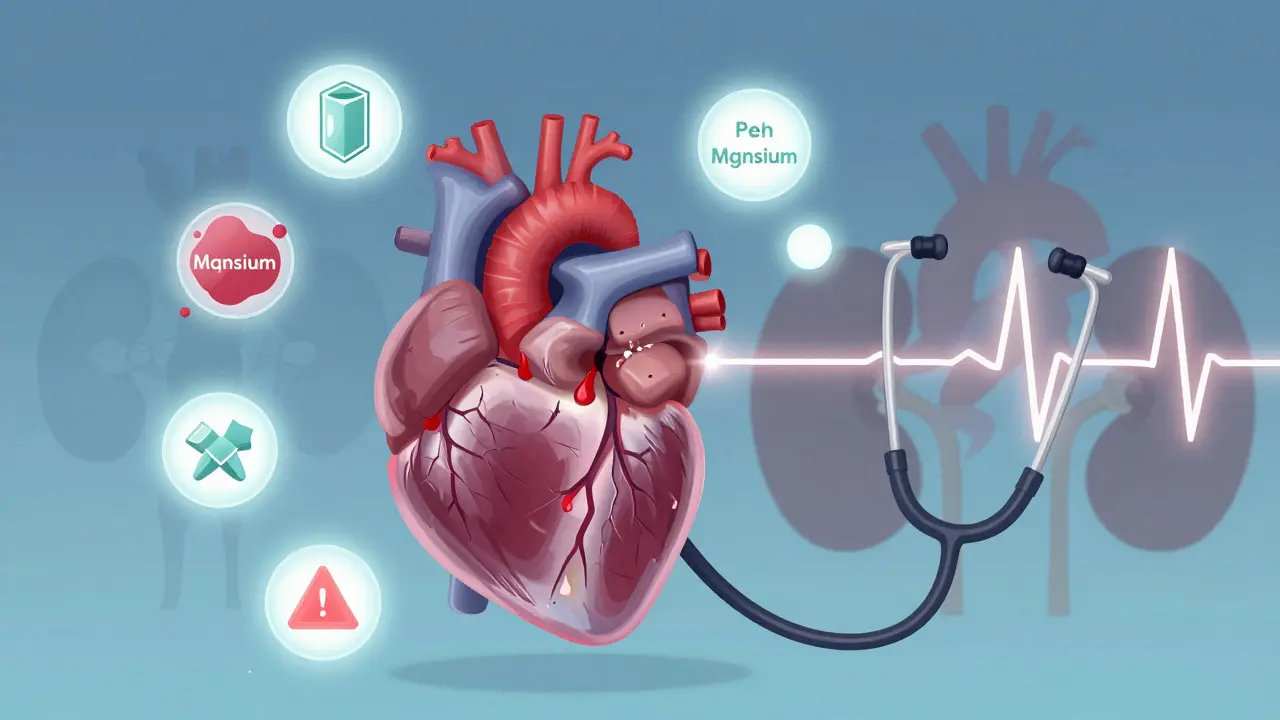
When your body’s electrolytes go out of balance, it doesn’t just cause a little discomfort-it can stop your heart. Electrolyte imbalances involving potassium, phosphate, and magnesium are silent threats, especially for people with kidney issues, diabetes, or those on diuretics. These aren’t just lab numbers; they’re life-or-death signals. Too little potassium? You could develop dangerous heart rhythms. Too much magnesium? Your breathing might slow to a stop. And phosphate? Low levels can leave you unable to breathe on your own. The good news? These imbalances are predictable, preventable, and treatable-if you know what to look for and when to act.
Why These Three Electrolytes Matter
Potassium, phosphate, and magnesium aren’t just minerals you get from bananas or supplements. They’re the backbone of how your cells work. Potassium controls your heartbeat and muscle contractions. Magnesium drives over 300 enzyme reactions, including how your body makes energy. Phosphate is the currency of cellular energy-ATP-and it’s critical for bone strength and nerve signaling.
Normal ranges aren’t arbitrary. Potassium should sit between 3.2 and 5.0 mEq/L. Below 3.0? That’s a red flag. Above 6.5? That’s an emergency. Magnesium levels need to stay between 1.7 and 2.2 mg/dL. Below 1.0? You’re at risk for seizures and arrhythmias. Phosphate should be 2.5-4.5 mg/dL. Below 1.0? Your lungs can fail. These numbers aren’t just textbook facts-they’re the thresholds that separate stable patients from those in critical care.
How Imbalances Happen
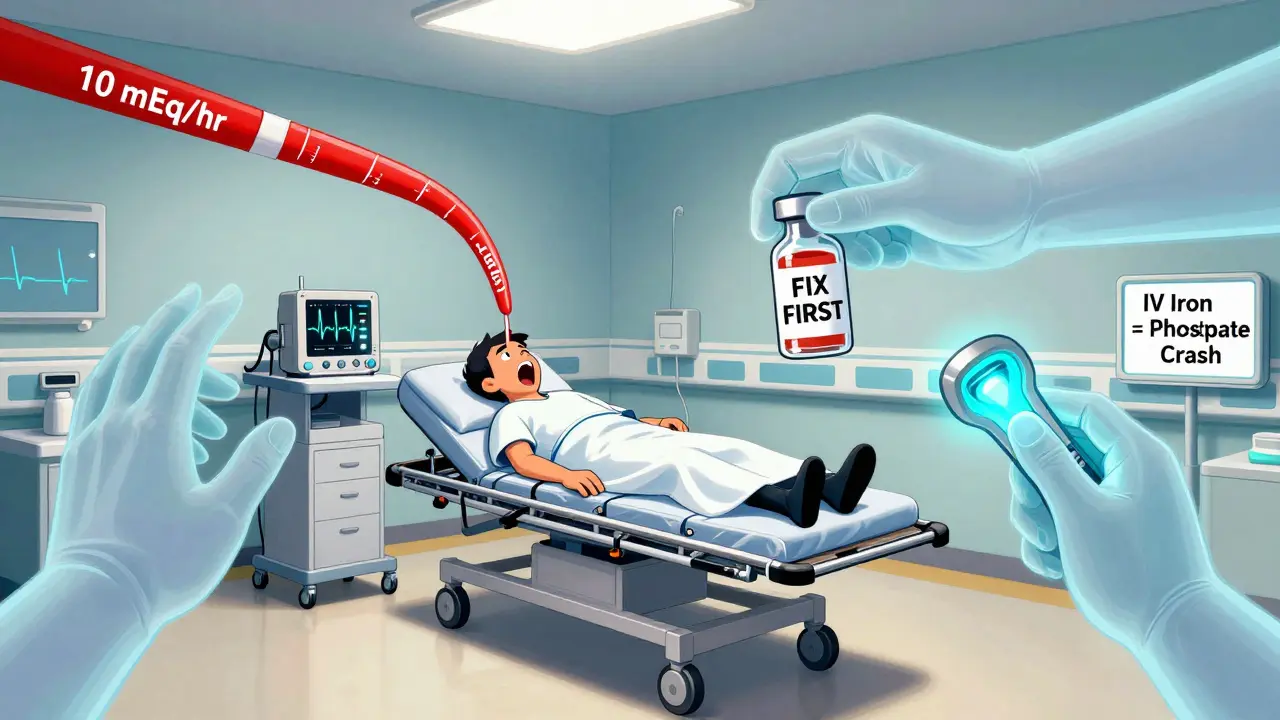
Most people think electrolyte problems come from poor diet. But in real clinical practice, it’s usually something else. Diuretics like furosemide? They flush out potassium and magnesium. ACE inhibitors? They can spike potassium. People with chronic kidney disease? Their kidneys can’t clear excess potassium or phosphate. And here’s the hidden trigger: intravenous iron therapy. Since the FDA issued a safety alert in 2020, we’ve known that ferric carboxymaltose-a common treatment for anemia in kidney patients-can crash phosphate levels so hard that patients end up in the ICU.
Refeeding syndrome is another silent killer. When someone who’s been malnourished starts eating again-especially after surgery or prolonged fasting-phosphate gets pulled into cells to make energy. Blood levels plummet. That’s why ICU teams now check phosphate before feeding patients who haven’t eaten in days.
And then there’s the magnesium-potassium loop. If magnesium is low, your kidneys can’t hold onto potassium, no matter how much you give. You can give 100 mEq of potassium IV, and it still won’t fix the problem-because magnesium is missing. This isn’t theory. It’s why Vanderbilt’s protocol insists: check magnesium before you even touch potassium.
Life-Threatening Signs You Can’t Ignore
Low potassium (hypokalemia) doesn’t always cause symptoms. But when it does, it’s brutal: muscle weakness, cramps, constipation, and irregular heartbeats. The real danger? When low potassium teams up with low magnesium. Together, they create a perfect storm for torsades de pointes-a type of heart rhythm that can turn fatal in minutes.
High potassium (hyperkalemia) is even scarier. It doesn’t cause pain. It just quietly messes with your heart’s electrical system. On an ECG, you might see tall, peaked T-waves. Then the QRS complex widens. Then the heart stops. A potassium level over 7 mEq/L with these changes? You have 15 minutes before cardiac arrest. That’s not a guess. That’s what the American Heart Association’s 2023 guidelines say.
Low phosphate? You might not feel sick at first. But when levels drop below 1.0 mg/dL, your diaphragm-the main muscle for breathing-starts to fail. Patients gasp for air, even if they’re not on a ventilator. And here’s the twist: giving too much phosphate too fast can cause calcium to crash, leading to tetany or even heart failure.
High magnesium? Rare, but deadly. It blocks nerve signals. You get sleepy. Then you stop breathing. Then your blood pressure drops. It’s often seen in people with kidney failure who get too much magnesium from laxatives or antacids. In the ER, we treat it like an overdose-calcium gluconate, IV fluids, and sometimes dialysis.
The Treatment Rules You Must Follow
Treating these imbalances isn’t about guessing. It’s about following a strict, step-by-step plan.
For severe hyperkalemia (>7 mEq/L with ECG changes):
- Give calcium gluconate 10% (10-20 mL IV) immediately. It doesn’t lower potassium, but it protects the heart.
- Give insulin (10 units) with 50g of dextrose over 15-30 minutes. This shifts potassium into cells within 15 minutes.
- Use a potassium binder like patiromer or sodium zirconium cyclosilicate. These are newer, safer than old-school kayexalate, and approved by NICE since January 2023.
- If the patient has kidney failure or levels stay high, start dialysis. No delays.
For hypokalemia:
- Never give potassium faster than 10 mEq/hour through a peripheral IV. Faster? You risk vein damage and cardiac arrest.
- Check magnesium first. If it’s below 1.7 mg/dL, replace it before potassium.
- Oral replacement is safer. Use 20-40 mEq of potassium chloride, split into doses. IV is for emergencies only.
For hypophosphatemia:
- Severe cases (<1.0 mg/dL) need IV phosphate: 7.5 mmol in 250 mL of D5W over 4-6 hours. Never push it fast.
- Oral phosphate (8 mmol tablets) works for mild cases. But avoid phosphate binders if the patient already has low levels.
- Watch calcium. Giving phosphate can drop calcium. Check levels every 4-6 hours during repletion.
For hypomagnesemia:
- Give 4 grams of magnesium sulfate in 100 mL of fluid over 30-60 minutes. That’s one piggyback.
- Recheck magnesium in 6-12 hours. It often drops again.
- Don’t forget: if you’re giving insulin for hyperkalemia, you’ll likely make magnesium worse. Monitor it.
Monitoring: Timing Is Everything
You can’t just check electrolytes once and call it done. Timing saves lives.
After treating hyperkalemia, check potassium at 1 hour, 2 hours, 4 hours, 6 hours, and 24 hours. Why? Because insulin shifts potassium into cells-but then it leaks back out. If you don’t monitor, you’ll think you fixed it, only to have the patient crash hours later.
For phosphate, check before and after repletion, and again at 6 and 12 hours. Rebound hyperphosphatemia happens. It’s rare, but it can cause calcium to crash.
And magnesium? Check before you start potassium replacement. Check again 12 hours after replacement. It’s not optional-it’s mandatory.
Recent studies from Annals of Emergency Medicine (2023) show that point-of-care testing in ERs cuts time-to-treatment by 37 minutes. That’s not just efficiency. That’s survival.
The Big Picture: Prevention Beats Correction
The best treatment? Never needing treatment. That’s why hospitals now use clinical decision support tools. If a patient is on a diuretic and an ACE inhibitor? The system flags them for weekly electrolyte checks. If they’re getting IV iron? Phosphate gets checked before and after. If they’re fasting for surgery? They get a phosphate level before refeeding.
Since 2021, teaching hospitals that adopted these protocols cut electrolyte-related adverse events by 22.4%. That’s not luck. That’s systematic care.
And the future? Personalized medicine is coming. Phase 3 trials are testing whether genetic tests can predict who’s likely to lose potassium or magnesium. Imagine a future where your DNA tells your doctor exactly how much potassium you need-no trial and error.
What You Need to Remember
- Low potassium + low magnesium = high risk for deadly heart rhythms. Always check both.
- Never give potassium faster than 10 mEq/hour peripherally. It’s not worth the risk.
- Always check magnesium before replacing potassium. If it’s low, fix it first.
- IV iron therapy can cause dangerous phosphate drops. Monitor closely.
- Hyperkalemia with ECG changes? Calcium first. Then insulin. Then binders. Then dialysis.
- Monitoring isn’t optional. Check potassium at 1, 2, 4, 6, and 24 hours after treatment.
These aren’t just guidelines. They’re the difference between a patient going home-and a patient not making it.





10 Comments
Let me tell you something. I saw a guy code a diabetic ketoacidosis case in the ER last year. Potassium dropped to 2.1. We gave 40 mEq IV. He coded 3 minutes later. No one checked magnesium. It was 0.9. We didn’t even think to look. That’s not negligence. That’s the system. And now I won’t touch a K+ order without a Mg++ result in hand. No exceptions. Ever.
This is one of the clearest summaries I’ve read on electrolyte management. I work in a rural hospital where we don’t always have rapid labs. The point about checking magnesium before potassium is gold. We’ve had a few near-misses where we assumed the K+ was the issue, but the real culprit was hypomagnesemia. This should be mandatory reading for all med students and residents.
I’m a nurse in a dialysis unit, and I see this every week. Patients come in with potassium at 6.8, no symptoms, and we’re scrambling. The ECG changes don’t lie. But what no one talks about is how much stress this puts on families. A husband doesn’t understand why his wife can’t have her banana smoothie anymore. We need better patient education-not just clinical protocols. This isn’t just about numbers. It’s about dignity.
Interesting. But let’s be real-how many of these ‘life-threatening’ thresholds are based on outdated studies from the 90s? The AHA guidelines changed the QRS width definition last year, but nobody updated the textbooks. And why are we still using calcium gluconate instead of calcium chloride in non-critical cases? It’s all tradition, not evidence. I’ve seen patients stabilized with just fluids and observation.
Thank you for this meticulously detailed and clinically grounded exposition. The precision with which you articulate the physiological interplay between potassium, magnesium, and phosphate is both scientifically rigorous and deeply humane. It is rare to encounter such a synthesis of empirical knowledge and practical wisdom in clinical discourse. This deserves to be archived as a reference standard.
They told you this was about electrolytes. But it’s not. It’s about the pharmaceutical industry. Ferric carboxymaltose? FDA alert? That’s a cover. They knew it caused phosphate crashes. They pushed it because it’s profitable. And now every hospital is forced to use it because insurance won’t cover alternatives. Dialysis centers? They’re getting kickbacks. Wake up. This isn’t medicine-it’s a financial engineered crisis.
Oh wow, so we’re supposed to believe that ‘refeeding syndrome’ is just a coincidence? That malnourished patients suddenly stop breathing when they eat? Maybe it’s because their bodies are trying to tell us something. Like maybe we’ve been force-feeding them processed carbs and sugar for years. Or maybe the real problem is that we treat symptoms instead of causes. Oh wait-we’re too busy checking lab values to ask why they got sick in the first place.
This post is a game-changer. I’ve been teaching med students for 12 years, and this is the cleanest breakdown I’ve ever seen. I’m sharing this with every team I work with. If you’re in a hospital and you’re not checking magnesium before potassium-you’re playing Russian roulette with a patient’s heart. Don’t wait for someone to die to learn this. Start today. Your next patient could be your sibling. Or your child.
Just wanted to say thank you for this incredibly thoughtful and well-researched piece. The way you connect the pathophysiology to real-world clinical decision-making is both educational and deeply moving. I’ve printed this out and posted it above my desk. It’s now my daily reminder of why we do this work. 🙏
While the clinical framework presented is superficially coherent, it remains fundamentally reductionist. The algorithmic approach to electrolyte correction neglects the systemic dysregulation inherent in modern metabolic syndrome. You’re treating biomarkers as endpoints rather than symptoms of a deeper homeostatic collapse-namely, insulin resistance, gut microbiome depletion, and mitochondrial dysfunction. The real intervention isn’t IV magnesium-it’s dietary reprogramming, circadian alignment, and elimination of ultra-processed foods. Everything else is palliative band-aiding. The system is broken. You’re just optimizing the scaffolding.