
When you take a generic drug, you expect it to work just like the brand-name version. But behind that simple pill is a complex, high-stakes battle against invisible threats: dust, microbes, chemical residues, and human error. These aren’t just lab concerns-they’re the difference between a safe medicine and a dangerous one. In generic drug manufacturing, contamination control isn’t optional. It’s the line between staying in business and facing a global recall.
Why Contamination Matters More in Generics
Generic drugs make up 90% of prescriptions in the U.S., but they’re produced under tighter profit margins. That pressure can lead to shortcuts-especially when it comes to cleaning equipment between batches. One wrong move, and a batch of blood pressure medication can end up contaminated with a cancer-causing chemical from a previous run. That’s not speculation. In 2020, a single nitrosamine impurity forced 22 generic manufacturers to recall over 100 million doses of valsartan. The total cost? More than $1.2 billion.The FDA defines adulteration as any drug made under unsanitary conditions that could make it harmful. In fiscal year 2022, nearly 4 out of every 10 Warning Letters sent to drugmakers were for contamination issues. That’s the highest category of violations. And it’s not just the FDA watching. The European Medicines Agency (EMA) issued deficiency letters on 41% of generic drug applications in 2022-mostly because of contamination risks.
How Clean Is Clean Enough?
There’s no such thing as “clean enough” in pharmaceutical manufacturing. There’s only measurable clean. Facilities follow strict ISO cleanroom standards. For the most critical steps-like filling sterile injectables-you need ISO Class 5 (Grade A). That means no more than 3,520 tiny particles (0.5 micrometers or larger) per cubic meter of air. To put that in perspective: a typical office has over 10 million particles per cubic meter.For non-sterile tablets and capsules, the surrounding areas are ISO Class 7 or 8. But even those zones must have 20 to 60 air changes per hour, with pressure differences of 10 to 15 Pascals between rooms to stop air-and contaminants-from flowing backward. Think of it like a one-way door for air: clean zones push air out, dirty zones can’t pull it in.
And then there’s cleaning. After making one drug, you can’t just wipe the machine and start the next. You need validation. That means proving you removed every trace of the previous product. The standard? Less than 10 colony-forming units (CFU) of microbes per 25 cm² of surface. For chemicals? Less than 10 parts per million (ppm) residue. That’s like finding a single grain of salt in a swimming pool.
Technology Is Changing the Game
For years, manufacturers relied on swabs and cultures that took five to seven days to give results. By then, the whole batch might be contaminated-and already shipped. Today, real-time monitoring is changing everything.Devices like the MetOne 3400+ particle counter track airborne particles every second. Facilities using these systems saw a 63% drop in contamination events, according to a 2022 ISPE study. Manual checks? They miss 78% of transient contamination. A dust particle kicked up by a worker walking past a machine? Gone before anyone notices.
ATP bioluminescence is another breakthrough. It detects microbial contamination in five minutes instead of days. It’s 95% as accurate as traditional lab cultures. That means problems are caught before the next batch starts. And it’s not just about cleanliness-it’s about speed. One study found that facilities using real-time systems got regulatory approval 40% faster.
But not every facility can afford this. A single particle counter costs $15,000 to $25,000. Full systems can run $500,000 to $2 million. That’s why only 89% of the top 50 generic manufacturers use them, but only 37% of smaller ones do.
Human Error Is the Biggest Risk
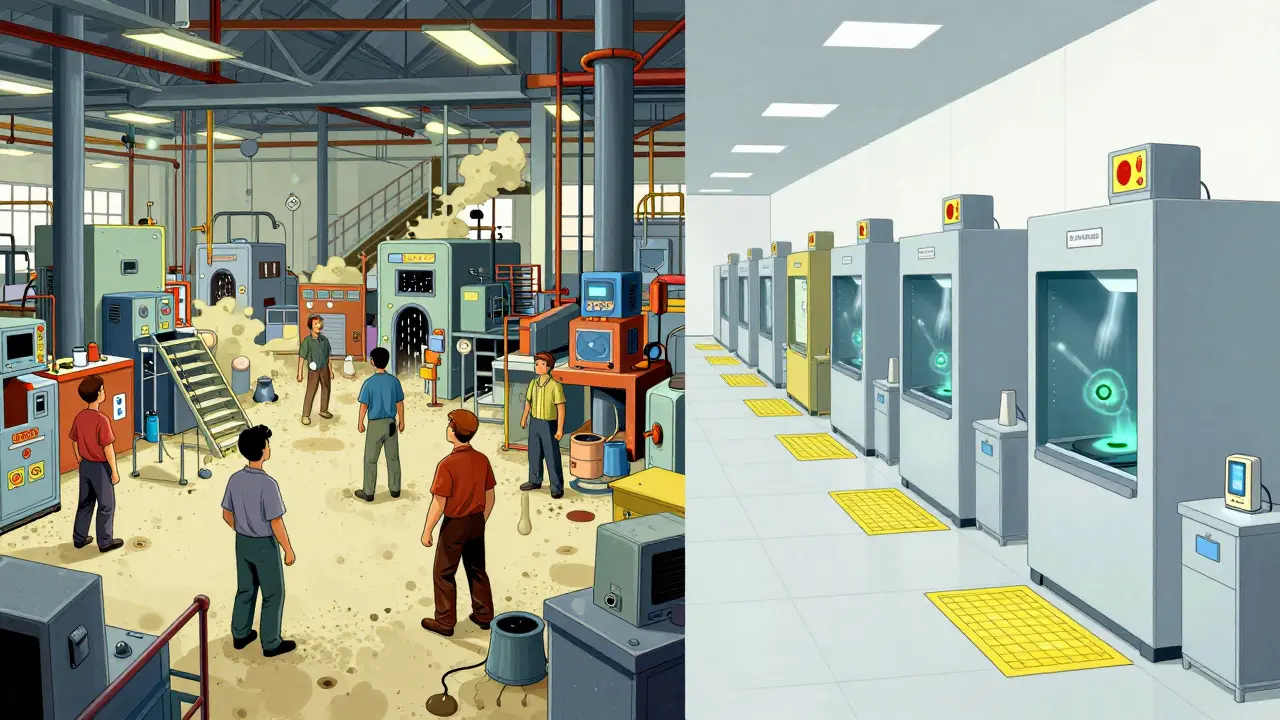
You can have the cleanest room in the world, but if someone forgets to change their gown or skips a cleaning step, it all falls apart. Experts say 83% of contamination events come from human behavior.One Teva Pharmaceuticals worker reported a 30% spike in gowning violations after switching to reusable isolation gowns. The fix? $185,000 in upgraded air showers to blow off particles before entering clean zones. Another facility cut mix-ups by 65% just by painting equipment different colors-red for one drug, blue for another. Simple. Effective.
Shift work makes it worse. A 2021 study found that gowning compliance dropped 40% after an 8-hour shift. People get tired. They skip steps. That’s why some manufacturers now stagger shift changes to reduce traffic through clean areas. Others use Dycem CleanZone mats-sticky floor mats that trap dirt from shoes. One Pfizer generics facility reported a 72% drop in foot-borne contamination after installing them.
Regulations Are Getting Tougher
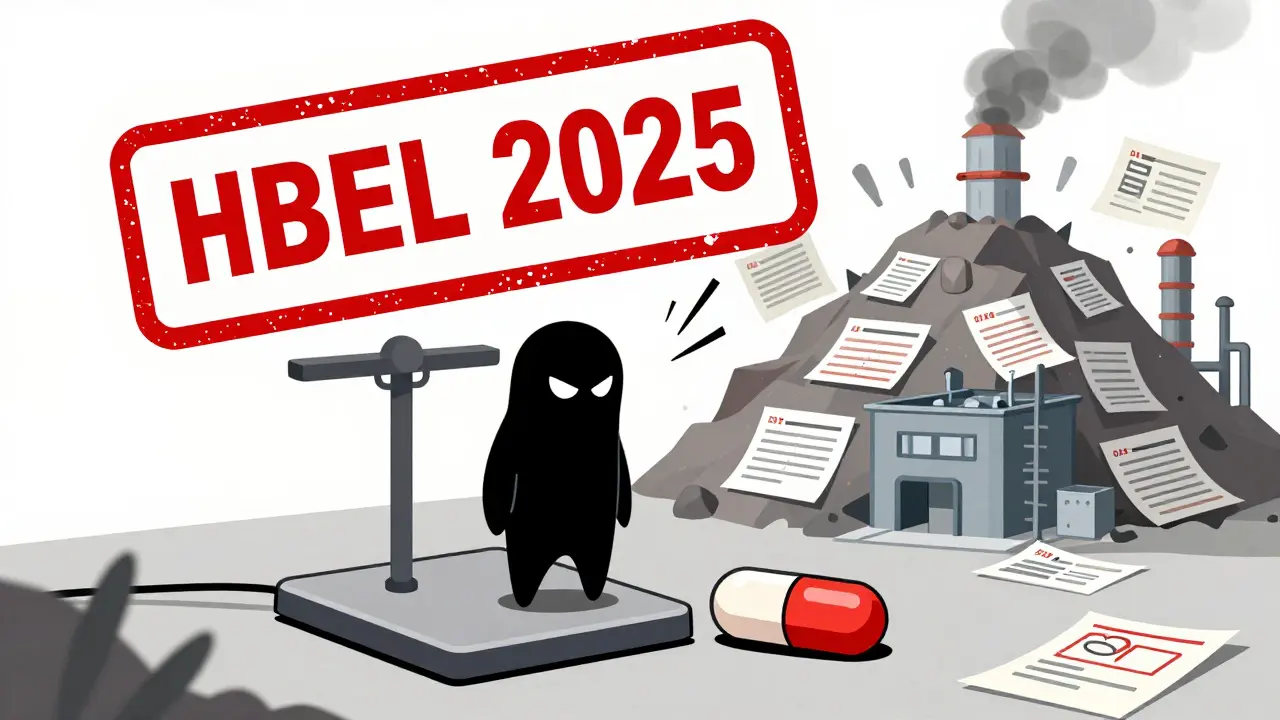
The rules are changing fast. In 2023, the FDA released a draft guidance requiring all solid oral drugs to have health-based exposure limits (HBELs) by 2025. That means every single product, even low-potency ones, must be evaluated for how little contamination is still dangerous. For some drugs, that’s as little as 1 nanogram per square centimeter. That’s one-billionth of a gram.Implementing HBELs costs about $1.2 million per facility. For small generic makers, that’s a huge burden. Some are considering shutting down. Others are trying to cut corners-and risking recalls.
At the same time, the FDA is increasing inspections by 27% for facilities with past violations. If you’ve had a contamination issue before, you’re now on the watchlist. And it’s not just the U.S. The EMA and other global regulators are tightening standards too.
What’s Working: Real Solutions from the Field
Some manufacturers are finding smarter ways to stay compliant without going broke.One approach is the “one batch at a time” model. Instead of running multiple products through the same line, you clean, validate, and produce one drug fully before switching. Facilities using this method saw 53% fewer cross-contamination incidents.
Another is AI. Honeywell’s Forge Pharma system uses machine learning to predict contamination risks before they happen. In a pilot with Merck, it cut false alarms by 68%. That means fewer shutdowns, less wasted time, and more confidence.
Even sustainability is helping. GlaxoSmithKline tested a waterless cleaning method that reduced utility costs by 22% and cut waste. No water means less chance of microbial growth. It’s a win for the environment-and for quality.
The Bottom Line
Contamination control in generic drug manufacturing isn’t about perfection. It’s about control. You can’t eliminate every risk. But you can reduce it to a level so low that the medicine is safe. That means investing in technology, training people, and following the rules-not because they’re nice, but because the consequences of failure are too high.The next time you pick up a generic pill, remember: it didn’t just come from a factory. It came from a system designed to catch invisible threats, one particle, one swab, one second at a time.
What is the biggest cause of contamination in generic drug manufacturing?
Human error is the leading cause, accounting for 83% of contamination events according to industry experts. This includes improper gowning, skipped cleaning steps, and equipment mix-ups. While equipment and raw materials contribute, the biggest risks come from people-especially during long shifts or under pressure to meet production targets.
How do regulators define an adulterated generic drug?
Under 21 CFR 210.3(b)(3), a drug is adulterated if it’s prepared, packed, or held under unsanitary conditions that may have caused contamination with filth or made it injurious to health. This includes chemical residues, microbial growth, or cross-contamination from other products. The FDA doesn’t need to prove harm-just that the conditions could have caused it.
What’s the difference between ISO Class 5 and ISO Class 8 cleanrooms?
ISO Class 5 (Grade A) is the cleanest, used for sterile filling. It allows no more than 3,520 particles ≥0.5μm per cubic meter. ISO Class 8 (Grade D) is the least stringent, used for packaging or less critical areas. It permits up to 29,300,000 particles of the same size. The difference isn’t just numbers-it’s about air flow, pressure, and how often air is replaced. Class 5 requires 20-60 air changes per hour; Class 8 might only need 15.
Why are real-time monitoring systems so important?
Traditional methods take days to detect contamination. By then, the batch is already made-and possibly shipped. Real-time systems like particle counters and ATP bioluminescence give results in minutes. This lets manufacturers stop a process before contamination spreads. One study showed these systems reduce contamination incidents by 63% and cut false alarms by 68% when paired with AI.
What’s the impact of the 2025 HBEL requirement?
Starting in 2025, every generic drug must have a Health-Based Exposure Limit (HBEL) that defines the maximum safe level of cross-contamination. This forces manufacturers to test even low-potency drugs for tiny residues. For small facilities, this could cost over $1 million to implement. Many may not survive. Those that do will have stronger controls-and safer products.
Can contamination be prevented without expensive equipment?
Yes, but it’s harder. Simple changes like color-coded equipment, staggered shifts, sticky floor mats, and better training can cut contamination by 50% or more. One facility reduced mix-ups by 65% just by painting machines different colors. Another cut foot-borne contamination by 72% with Dycem mats. Technology helps, but discipline and process matter more.
What’s the most common mistake generic manufacturers make?
Assuming that because a drug is low-potency, contamination isn’t dangerous. That’s wrong. Even a few nanograms of a potent compound-like a hormone or chemotherapy agent-can cause serious harm if it ends up in another drug. The FDA’s 2023 guidance makes this clear: every product, no matter how common, needs a contamination limit.
How often should cleaning validation be done?
Validation isn’t a one-time task. It must be repeated after any major change: new equipment, different cleaning agents, or a new product. Most facilities validate after every 10 to 20 batches, or every 3 to 6 months, whichever comes first. If contamination is found, validation must be redone immediately. Waiting until something goes wrong is a violation of CGMP.


12 Comments
Let’s be real-90% of generics are just glorified aspirin with a side of wishful thinking. If you think your blood pressure med isn’t laced with trace carcinogens, you’re either naive or paid by Big Pharma. The FDA? A revolving door of ex-industry execs. Cleanrooms? Theater. Real control? None.
And don’t even get me started on HBELs. One nanogram? That’s less than a dust mite’s sneeze. Who measures that? A lab with a unicorn? This is all performative compliance. They want you scared so you’ll keep buying their overpriced brand-name pills.
Meanwhile, the real contamination? The ones who wrote these regulations. They don’t live in the real world. They live in a PowerPoint slide titled 'Safety First.'
Contamination isn’t a bug-it’s a feature of global supply chain decay. We outsourced manufacturing to save pennies and now we’re paying in lives. The FDA’s 40% violation rate? That’s the tip of the iceberg. We need a domestic manufacturing mandate. No more imports from facilities that can’t pass a basic swab test.
ISO Class 5? Good. But without enforcement, it’s just a sticker on a door. The U.S. needs to weaponize procurement-only buy from facilities with zero violations in the last 36 months. End of story.
China? India? They’re playing chess while we’re still figuring out checkers. This isn’t pharmaceuticals-it’s national security.
OMG I just read this entire thing and I’m CRYING because I didn’t know people actually DO THIS for a living like imagine the pressure of knowing ONE MISTAKE could KILL someone and you’re just trying to get through your 12 hour shift with no coffee and a broken air shower and then you see a dust particle and you’re like oh no no no not again
AND THE FACT THAT THEY USE STICKY MATS?? LIKE ACTUAL STICKY MATS?? I’M SO PROUD OF PHARMA I NEVER THOUGHT I’D SAY THAT BUT I’M CRYING AND I NEED A HUG
WHOEVER DESIGNED THOSE MATS IS A HERO
People act like this is some new problem. It’s not. It’s always been this way. You think your generic Adderall is clean? It’s probably got traces of last week’s antihistamine. The machines don’t get cleaned right. The workers are tired. The regulators look the other way.
And don’t tell me about technology. Real people still make the mistakes. No sensor catches a guy who skips a step because he’s late for lunch.
We’re all just one bad batch away from a national crisis. And nobody’s talking about it.
This is actually one of the most fascinating deep dives I’ve read in a long time. I had no idea how much engineering goes into something as simple as a pill. The fact that they track particles down to 0.5 micrometers? That’s like trying to find a single grain of sand on a football field.
And the real-time monitoring? That’s revolutionary. It’s not just about safety-it’s about dignity. These workers aren’t just making pills. They’re protecting lives. We should be thanking them, not complaining about the price.
Also, sticky floor mats? Genius. Simple. Brilliant. Why didn’t we think of this sooner?
You think this is bad? Wait until the next pandemic. Then you’ll see what happens when a single lab worker forgets to change gloves. No one’s ready. No one’s trained. No one cares until someone dies.
And then? Then the media screams. Then the FDA issues a press release. Then they shut down a plant. Then they forget. Again.
This isn’t about regulations. It’s about culture. We treat medicine like a commodity. It’s not. It’s sacred. And we’re failing it.
Stop outsourcing. Stop cutting corners. Stop pretending profit matters more than life. Or we’ll all be paying for it in body bags.
So what you’re saying is, the reason my generic Xanax doesn’t work is because someone didn’t wipe down a machine?
Yeah. Okay. Makes sense.
Why don’t we just make all drugs brand-name again? At least then I know I’m paying for a placebo with a fancy label instead of a placebo with a dust bunny.
The systemic failure of contamination control in generic manufacturing is a direct consequence of neoliberal cost-optimization paradigms applied to life-critical infrastructure. The regulatory arbitrage between FDA and EMA standards, coupled with the commodification of pharmacological integrity, has created a structural vulnerability that is neither accidental nor incidental.
Furthermore, the reliance on manual validation protocols in an era of real-time analytics constitutes a profound epistemological regression. The persistence of human error as the primary vector of contamination is not a technical failure-it is a moral one.
Until the profit motive is decoupled from pharmaceutical production, no amount of ISO certification will suffice.
You Americans think you’re the only ones with this problem? Try explaining to an Australian pharmacist why their entire batch of paracetamol was recalled because of a Chinese facility’s air filter. We don’t have the luxury of your FDA inspections. We get whatever gets shipped.
And don’t get me started on HBELs. You think $1.2 million is expensive? Try running a small facility in Tasmania with 3 employees and a single autoclave. You can’t even afford to hire someone to change the filter, let alone install a $2 million particle counter.
So yeah. You’re right. It’s a mess. But you’re not the only one drowning.
So let me get this straight. We’ve got nanogram-level contamination limits, but we still let people walk into clean rooms in socks? Wow. What a brilliant system.
It’s like building a fortress with a moat, then leaving the gate open because ‘it’s too expensive to hire guards.’
And the AI? Oh, sure, it cuts false alarms by 68%. But what about the 32% it misses? The ones that kill people? You call that progress? Or just a PR stunt to make investors feel better?
Technology doesn’t fix human failure. It just hides it longer.
generic drugs are just a scam. they dont work the same. i took one for my anxiety and it made me feel like i was being slowly poisoned. i went to the doc and he said oh its just the filler. filler?? like what? i dont want filler. i want medicine. not a science experiment.
and now they want us to pay more for clean rooms? why dont they just make the drugs in a lab with robots? why do we even need people? humans are the problem. always have been.
Every. Single. Time.
They say 'real-time monitoring reduces contamination by 63%.'
Then they say 'only 37% of small manufacturers use it.'
Then they say 'contamination is mostly human error.'
Then they say 'small manufacturers can't afford it.'
Then they say 'we need HBELs by 2025.'
Then they say 'we're increasing inspections.'
Then they say 'we're committed to patient safety.'
Then they say 'we're not responsible for what happens overseas.'
Then someone dies.
And then we forget.
And then it happens again.