
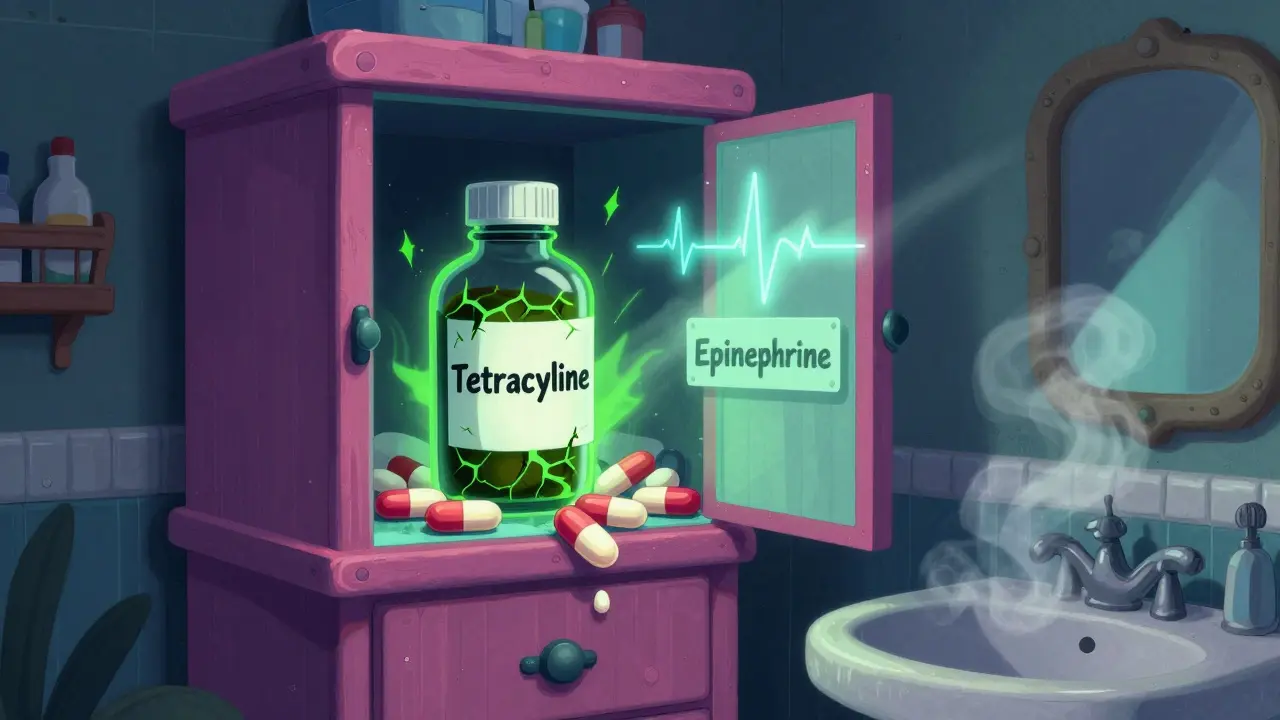
Most people think expired medicine is just weak - maybe it won’t work as well, but it’s not harmful. That’s not always true. While the vast majority of expired pills and capsules are safe to take, a small group of medications can turn dangerous after their expiration date. And if you’re relying on them for something serious - like a heart attack, an allergic reaction, or an infection - that difference could be life-or-death.
What Expiration Dates Actually Mean
The expiration date on your medicine isn’t a random date stamped by the manufacturer to push you to buy more. It’s the last day the company guarantees the drug will work as intended and remain safe under proper storage conditions. This requirement has been federal law in the U.S. since 1979, based on stability testing the manufacturer must complete before selling the product.
Here’s the twist: most drugs don’t suddenly turn toxic on that date. In fact, the FDA’s own Shelf Life Extension Program - a decades-long study with the Department of Defense - found that 90% of over 100 medications tested were still effective 5 to 15 years past their expiration date when stored correctly. That means your old ibuprofen or blood pressure pill might still work just fine. But that’s not the whole story.
The Real Danger: When Chemistry Turns Against You
Not all drugs degrade the same way. Some lose strength slowly. Others break down into harmful chemicals. The most well-documented case happened in 1963, when three people developed kidney damage after taking expired tetracycline. The degraded form, called epitetracycline, is toxic to the kidneys. It’s the only confirmed case of toxicity from expired antibiotics in over 60 years - but it’s enough to make experts cautious.
Other medications follow similar dangerous paths:
- Nitroglycerin - used for chest pain - breaks down into unstable nitrogen oxides. A 2019 study from the Cleveland Clinic found it loses half its potency within three months of expiration. If you’re having a heart attack and your nitroglycerin doesn’t work, you’re not just out of luck - you’re in real danger.
- Insulin - a life-saving drug for diabetics - forms clumps and fibers over time. After one year past expiration, it can lose 20-30% of its effectiveness. That means higher blood sugar, more complications, and potentially diabetic ketoacidosis.
- Liquid antibiotics like amoxicillin-clavulanate can grow bacteria or form allergenic compounds after expiration. One parent reported their child developed severe diarrhea after taking a liquid antibiotic just three days past its date.
- Epinephrine auto-injectors (EpiPens) are critical for anaphylaxis. A 2017 study showed they lose 85% of their potency after one year past expiration. If you’re having a life-threatening allergic reaction and your EpiPen fails, there’s no backup.
- Aspirin breaks down into acetic acid (vinegar) and salicylic acid. After two years past expiration, it becomes more likely to irritate your stomach - not because it’s poisonous, but because it’s more acidic.
Storage Matters More Than You Think
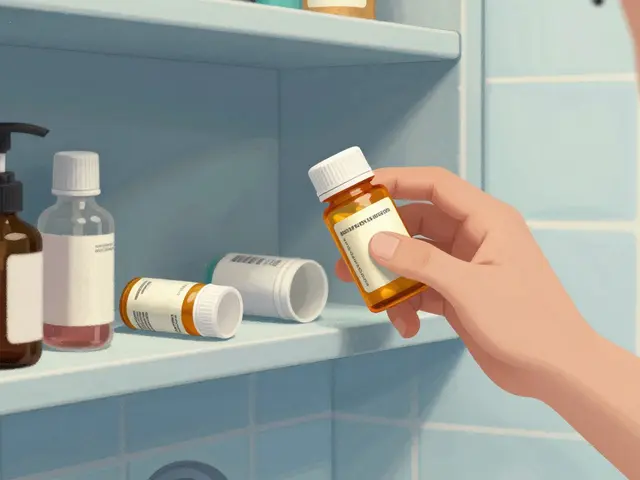
Where you keep your medicine has a bigger impact than when it expired. Heat, moisture, and light speed up degradation. A bathroom cabinet is one of the worst places to store pills. Temperatures there average 32°C (90°F) with 80% humidity - way above the FDA’s recommended 15-25°C (59-77°F) and 35-45% humidity.
Here’s what actually works:
- Keep pills in their original bottle - the child-resistant cap and dark glass protect them from light and moisture.
- Store in a cool, dry place like a bedroom drawer or kitchen cabinet away from the stove or sink.
- Insulin should be refrigerated until opened, then kept at room temperature for up to 28 days.
- Nitroglycerin tablets must stay in their original glass bottle with the cap tightly sealed. Plastic containers let in moisture and ruin the drug.
Studies show that proper storage can extend potency by years. A 2022 UCSF guide found that nitroglycerin in the right container kept 85% potency six months past expiration - but degraded completely in plastic.

What’s Safe? What’s Not?
Not all expired drugs are equal. Here’s a quick guide based on real data:
| Medication Type | Risk After Expiration | Potency After 1 Year |
|---|---|---|
| Insulin | High - treatment failure can be fatal | 70-80% |
| Nitroglycerin | High - may not stop a heart attack | 50-60% |
| Epinephrine (EpiPen) | Very High - could fail during anaphylaxis | 15-20% |
| Liquid antibiotics | Medium - risk of bacterial growth, allergic reactions | 40-60% |
| Aspirin | Low - becomes more irritating, not toxic | 85-90% |
| Antihistamines, antidepressants, blood pressure pills | Very Low - mostly lose strength, not safety | 70-90% |
The FDA, CDC, and DEA all say: don’t use expired meds. But the real experts - pharmacists, toxicologists, and researchers - say it’s not that simple. The American Pharmacists Association points out that the evidence shows almost no harm from most expired pills. The NIH estimates that the current system wastes $3.5 billion a year in unused but still-effective drugs.
When It’s Worth the Risk - and When It’s Not
If you’re out of your regular blood pressure pill and the pharmacy is closed? Taking a 6-month-old tablet is probably fine. It might not be 100% effective, but it’s unlikely to hurt you.
But if you’re in a remote area, your EpiPen expired last month, and you’re allergic to peanuts? Don’t risk it. Same with insulin, nitroglycerin, or antibiotics for a child with a serious infection. These aren’t the kind of drugs you gamble with.
Here’s the rule of thumb:
- If it’s for a life-threatening condition - don’t use it past expiration.
- If it’s for a minor issue - like a headache or runny nose - and it’s only a few months past the date, it’s probably okay.
- If it’s a liquid, eye drop, or injectable - treat expiration like a hard stop.
- If it smells strange, looks discolored, or is crumbly - throw it out.

What to Do With Expired Medicine
Don’t flush it. Don’t toss it in the trash where kids or pets might find it. Don’t give it to someone else.
The safest way? Use a drug take-back program. In 2023, the DEA’s National Prescription Drug Take-Back Day collected over 930,000 pounds of unused and expired medications from thousands of collection sites. Walgreens, CVS, and many police stations offer year-round drop-off bins.
If no take-back option is available, mix pills with coffee grounds or cat litter, seal them in a plastic bag, and throw them in the trash. Remove labels to protect your privacy.
What’s Changing? The Future of Expiration Dates
Experts agree: the current system is outdated. The FDA is testing a pilot program to extend expiration dates for 20 critical drugs based on real-time stability data. Companies like Pfizer and Merck are investing hundreds of millions in smart packaging that tracks temperature, humidity, and actual degradation - not just a printed date.
By 2027, the American Society of Health-System Pharmacists predicts 30% of prescriptions will have dynamic expiration dates - meaning your medicine’s "use by" date could change based on how you stored it. Imagine a pill bottle that says: "Use by: June 2026 - unless kept above 30°C, then use by: March 2026."
For now, the best advice is simple: know what you have, store it right, and when in doubt - throw it out. Especially if it’s something you can’t afford to fail.
Why This Matters
The real danger isn’t that expired medicine poisons you. It’s that it stops working when you need it most. A 2023 editorial in JAMA Internal Medicine put it best: "The tragedy isn’t poisoned patients - it’s the untreated heart attack because expired nitroglycerin didn’t work when needed most."
Medications are powerful tools. Treat them like one.


11 Comments
Been a pharmacist for 18 years. I’ve seen people take expired insulin in rural clinics and live to tell the story. But I’ve also seen the ones who didn’t. The math isn’t hard: if your life depends on it, don’t gamble. That EpiPen? If it’s expired, buy a new one. No excuses. Your kid’s life isn’t a budget spreadsheet.
It is of considerable philosophical interest to observe how societal attitudes toward pharmaceutical expiration dates reflect a broader cultural predisposition toward commodification and disposability. The notion that a substance’s utility is strictly bound by an arbitrary temporal marker-imposed not by nature, but by regulatory and commercial frameworks-reveals a profound epistemological dissonance. One might argue that the true expiration date is not printed on the label, but rather inscribed in the collective negligence of the populace.
People are dumb. The FDA says don’t do it. End of story. If you’re taking expired meds, you’re just asking for trouble. No one cares about your ‘maybe it’s fine’ stories. You’re not a scientist. You’re a guy who didn’t want to drive to the pharmacy.
Just had to refill my EpiPen last week. The cost was $300. I cried. Not because I’m dramatic - because the system is broken. 🤕💊
Look, I get it - you’re broke, you’re in the middle of nowhere, your blood pressure pill is 8 months old. Chill. It’s probably fine. But if you’re holding a liquid antibiotic that’s past its date and your toddler’s fever won’t break? Throw it. Don’t be the parent who says ‘it was just a little expired.’ That’s not courage - that’s negligence wrapped in denial. You don’t get a do-over when your kid’s lungs fill with fluid.
And for the love of all that’s holy, stop storing meds in the bathroom. It’s not a spa. It’s a steam room for chemical decay.
Proper storage = extended life. Simple. Cheap. Life-saving.
Also - if your aspirin smells like vinegar? That’s not a sign it’s ‘natural.’ That’s your chemistry textbook screaming at you.
Take-back programs exist for a reason. Use them. Don’t flush it. Don’t toss it. Don’t be the reason your neighbor’s dog dies.
And if you’re still reading this? You’re the kind of person who needs to hear it. Good on you.
Oh wow, so now we’re supposed to believe that the government’s not just lying to us about expiration dates so drug companies can sell more? 🤡
I mean, I get it. You want us to panic about our EpiPens. But what about the fact that the FDA’s own study showed 90% of drugs still work after 15 years? Hmm. Coincidence? Or corporate greed in a white coat?
Next they’ll tell us bread expires too.
EVERYTHING IS A LIE. The FDA, the DEA, the pharmacists - they’re all in on it. The real reason meds expire is because they’re secretly radioactive. That’s why they say ‘store in dark place.’ They’re trying to hide the glow.
My neighbor’s cat took expired Tylenol and turned into a lizard. I saw it. The vet confirmed it. They won’t tell you because they’re scared of the truth.
Also, the government uses expiration dates to track us. Your pill bottle has a chip. I read it on a forum.
Actually, the 90% FDA study? That was on drugs stored in military vaults at 20°C with 40% humidity. You think your bathroom cabinet counts? No. It doesn’t. You’re not a lab. You’re a human who leaves shampoo next to the toilet.
And don’t even get me started on people who say ‘it still looks fine.’ Look? That’s not how chemistry works. You don’t see mold on insulin until it’s too late.
Also - aspirin turning to vinegar? That’s not ‘more acidic’ - that’s acetic acid forming. You think that’s safe for your stomach lining? It’s like drinking vinegar and calling it medicine.
Stop being reckless. You’re not a hero. You’re just lucky.