

Medication Reformulation Checker
Check Your Medication
Reformulation Analysis
Reformulation Status
No Reformulation DetectedNo known reformulations for this medication
Bioequivalence Check
Bioequivalent formulations maintain same therapeutic effect
Potential Red Flags
- If pill appearance changed significantly
- If you experience new side effects
- If NDC code changed after refills
What You Should Do
- Always check pill appearance with your pharmacist
- Ask if the reformulated version is bioequivalent
- Report changes in side effects to your doctor
Have you ever picked up your prescription and noticed the pill looks different? Maybe it’s a different color, shape, or even a new name on the label? You might think it’s a mistake - or worse, a counterfeit. But more often than not, it’s a medication reformulation. Companies don’t change drugs just to confuse patients. They do it to make them work better, be easier to take, or last longer on the market. And while some of these changes matter a lot, others? Not so much.
What Exactly Is a Medication Reformulation?
A medication reformulation means the active ingredient - the part that actually treats your condition - stays the same. But everything else? It might be different. The tablet could now dissolve slower. The capsule might be turned into a liquid. The flavor could be changed so kids will actually swallow it. Even the coating, fillers, or binders inside the pill might be swapped out.
This isn’t about making a new drug. It’s about tweaking an old one. Think of it like upgrading your phone’s software without changing the hardware. The core function - calling, texting, browsing - stays the same. But now it runs faster, uses less battery, or has a better screen.
The FDA created a special pathway in the 1980s called 505(b)(2) to make this easier. It lets companies use existing safety and effectiveness data from the original drug. That cuts years off development time and saves millions. Instead of running full clinical trials from scratch, they just need to prove the new version works the same way in the body - called bioequivalence.
Why Do Companies Do This?
There are real patient benefits. Many reformulations are designed to fix problems people actually have with their meds.
- Switching from an injectable to a pill makes life easier for someone with chronic pain or diabetes.
- Changing a pill that needs to be taken three times a day to one that’s taken once daily improves adherence - especially for older adults or people managing multiple conditions.
- Removing a dye or gluten that causes reactions helps patients with allergies or sensitivities.
- For rare diseases, reformulating an orphan drug into a more stable form can mean the difference between availability and scarcity.
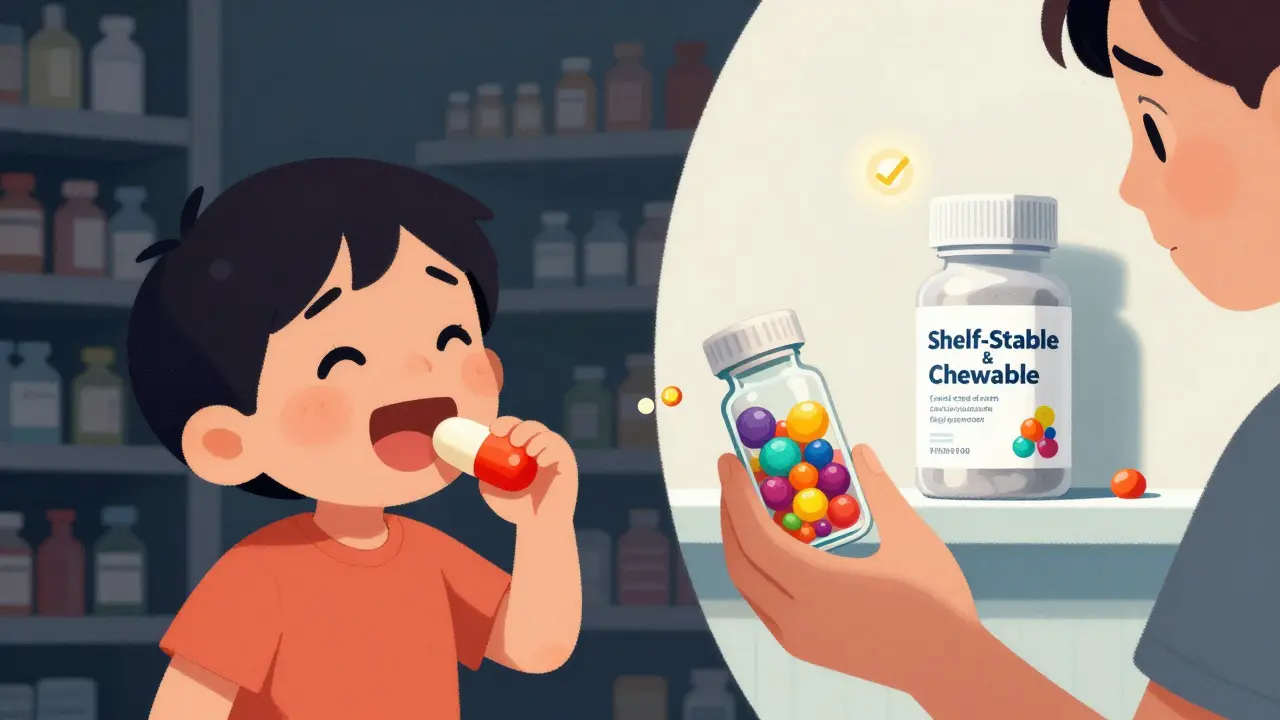
One case from 2022 involved a mid-sized company that reformulated an orphan drug for a rare childhood disorder. The original version required refrigeration and had a short shelf life. The new version was shelf-stable, easier to transport, and came in a chewable form. Compliance jumped by 40% in the first year.
But let’s be honest - not every change is about patient care. Some companies use reformulation to extend patent life. When a drug’s original patent expires, generics flood the market and profits drop. A minor tweak - say, changing the release time from 8 to 12 hours - can trigger a new patent. This is called “evergreening.” Critics say it’s a loophole that keeps prices high without real benefits. The FDA has cracked down on some of these practices, but they still happen.
How Do Reformulations Affect You?
If you’re taking a drug that’s been reformulated, you might not notice anything. But sometimes, you do.
Some patients report side effects that weren’t there before. Why? Because even small changes in inactive ingredients can affect how the drug is absorbed. A change in coating might make the pill break down too fast in the stomach, causing nausea. Or a new filler might interfere with absorption in people with certain gut conditions.
There’s also the issue of switching brands. If your doctor prescribed a brand-name drug and now you’re getting a generic version that’s been reformulated, you might feel different. It’s not always the generic’s fault - sometimes the reformulation itself is the issue.
Here’s what you can do:
- Always check the pill’s appearance with your pharmacist when you get a refill.
- If you feel worse after a switch, tell your doctor. Don’t assume it’s “all in your head.”
- Ask if the new version is bioequivalent to the old one. If it is, it should work the same.
Most reformulations are safe and helpful. But you’re the one taking the pill. You deserve to know what changed - and why.
Reformulation vs. New Drug: The Numbers Don’t Lie
Developing a brand-new drug costs about $2.6 billion and takes 10 to 15 years. Success rate? Around 10%.
Reformulating an existing drug? Around $50-100 million. Three to five years. Success rate? About 30%.
That’s why the pharmaceutical industry leans heavily on reformulation. It’s smarter, faster, and cheaper. In fact, about 27% of all new drug applications submitted to the FDA each year are reformulations.
And it’s not just big pharma doing it. Smaller companies are jumping in too, especially for niche markets like orphan drugs. These are conditions that affect fewer than 200,000 people in the U.S. - too small for massive R&D budgets. But with reformulation, a company can take an old, off-patent drug and make it work better for a rare disease. That’s how treatments for conditions like Fabry disease or Wilson’s disease are still being improved today.
What’s Changing in the Future?
The next wave of reformulation isn’t just about pills. It’s about smarter delivery.
Researchers are now testing:
- Pills that release medicine only when your body needs it - based on glucose levels, pH, or even your circadian rhythm.
- Transdermal patches that deliver drugs through the skin with no pills or injections.
- Oral liquids that taste like candy but deliver precise doses for kids or elderly patients with swallowing issues.
The FDA released new guidance in 2022 to make it easier to approve these kinds of innovations. They’re recognizing that patient needs have changed. People want less frequent dosing. Less side effects. More convenience.
And with advances in 3D printing and personalized medicine, we might soon see pills printed at the pharmacy with your exact dose - no more cutting pills in half or guessing how many to take.
Who’s Responsible for Making Sure Reformulations Are Safe?
The FDA doesn’t just approve reformulations and walk away. They require:
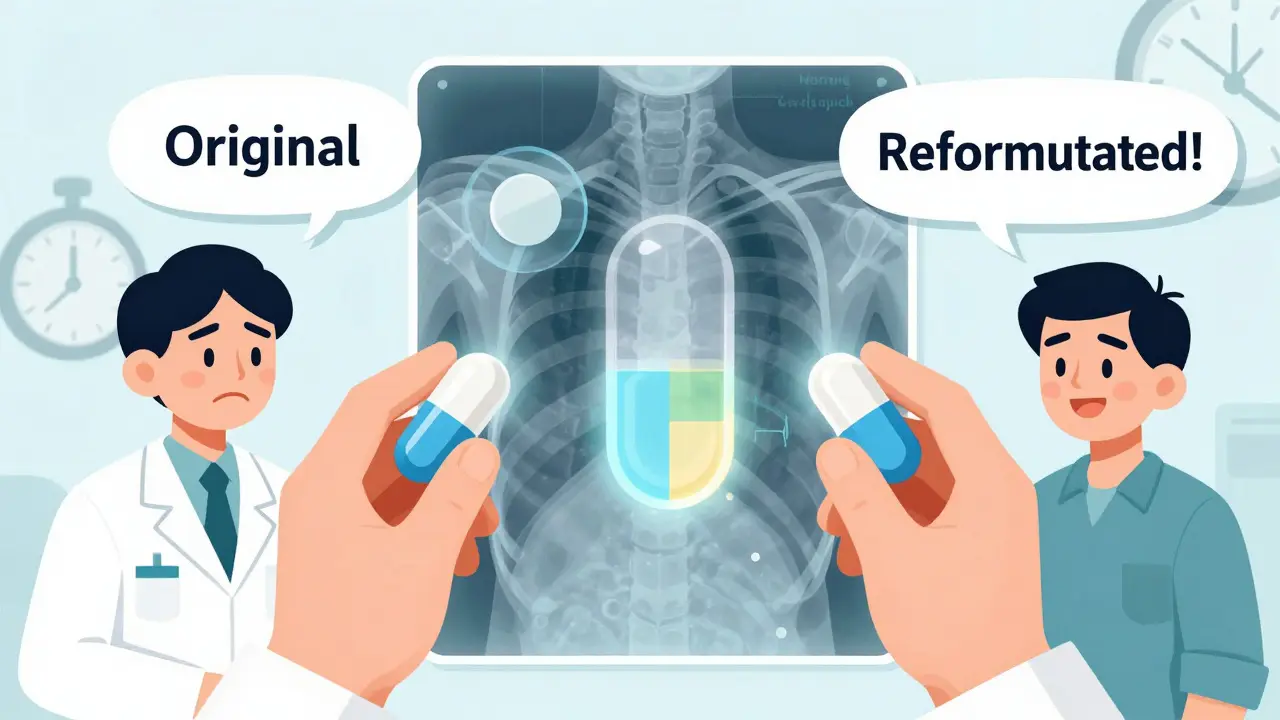
- Proof the drug behaves the same in the body (bioequivalence studies).
- Testing for stability - will it last on the shelf?
- Validation of manufacturing processes - every batch must be identical.
- Changes to labeling - if the new version has different warnings, that must be clear.
But the burden doesn’t fall only on regulators. Pharmacists play a key role. When you pick up a reformulated drug, your pharmacist should know the difference. They’re trained to spot changes and flag potential issues.
And if you’re unsure? Ask. “Is this the same as what I was taking before?” is a perfectly valid question. You’re not being difficult. You’re being informed.
Final Thoughts: Change Isn’t Always Bad
Medication reformulation isn’t a conspiracy. It’s science meeting real-world needs. Many of the drugs we rely on today are better because they were improved after years of use. A pill that used to cause stomach upset? Now it’s enteric-coated. A shot you had to give yourself daily? Now it’s a monthly injection.
But vigilance matters. Not every change is meaningful. Some are just business moves dressed up as innovation.
The key is to stay aware. Know your meds. Ask questions. And if something feels off - speak up. Your body knows the difference before you do.
Are reformulated drugs the same as generics?
Not always. Generics are exact copies of brand-name drugs after the patent expires. Reformulations are modified versions of existing drugs - sometimes brand-name, sometimes generic. A reformulation might be a new patent-protected version of a drug, even if a generic already exists. So while all generics are technically reformulations of the original, not all reformulations are generics.
Can reformulation make a drug less effective?
It’s rare, but possible. If the new formulation changes how quickly the drug is absorbed - say, from slow-release to immediate-release - it could lead to lower effectiveness or more side effects. That’s why bioequivalence testing is required. But if you notice a change in how you feel after switching, talk to your doctor. Your experience matters.
Why do reformulated drugs sometimes cost more?
Because they’re often still under patent. If a company makes a meaningful change - like a new delivery system - they can get a new patent. That lets them charge brand-name prices even if the active ingredient is old. This is common with “me-too” reformulations designed to block generics, not improve care.
How can I tell if my drug has been reformulated?
Check the pill’s imprint, color, shape, or size. Compare it to your last prescription. If it looks different, ask your pharmacist. They can tell you if it’s the same formulation or a new version. You can also look up the drug’s National Drug Code (NDC) on the FDA’s website - different NDCs mean different formulations.
Do doctors know when a drug is reformulated?
Sometimes. Many doctors rely on pharmacy substitutions and may not be notified unless a patient reports a change. That’s why it’s important to speak up if you notice differences. Your doctor can check the formulation details and request the original version if needed.
Reformulation is here to stay. It’s one of the quietest, most powerful forces shaping modern medicine. Used right, it saves lives. Used wrong, it profits at the expense of trust. The choice isn’t just up to the companies - it’s up to you, too.




14 Comments
i got switched to a new version of my thyroid med last month and i swear i felt like a zombie for two weeks. no one told me it changed. my pharmacist just handed it over like it was nothing. i had to google the pill imprint to even know it was different. dumb.
US pharma is the best in the world. if you can't handle a pill changing color, maybe you shouldn't be taking medicine at all. we're not in India where people still believe in miracle powders.
My dad’s on 5 different meds and he’s always asking if the pills look right. He’s 78 and he remembers every pill he’s ever taken. I think we should all be that careful. It’s not paranoia-it’s self-advocacy.
While I appreciate the technical breakdown, I think the deeper issue is systemic: patients are treated as passive recipients rather than partners in care. Reformulations are not inherently bad, but the lack of transparent communication from prescribers and pharmacists turns a scientific adjustment into a trust crisis. We need standardized patient alerts-not just ‘check the pill’.
Wow. A 27% reformulation rate? And you’re surprised people are angry? Of course they are. It’s pharma’s favorite magic trick: change the wrapper, keep the same poison, charge brand prices. Congrats, you just turned medicine into a cereal box.
People who complain about pill changes are the same ones who think gluten is a conspiracy and cry when their Starbucks latte doesn’t come with oat milk. Wake up. The FDA tests this stuff. If you feel weird, maybe it’s your anxiety-or your 3 a.m. TikTok scroll.
My mom died because they switched her heart med to a "bioequivalent" version. She didn’t know. The doctor didn’t know. The pharmacist didn’t care. Now I check every pill. Every. Single. One. 💔
It is imperative to acknowledge that the 505(b)(2) regulatory pathway, while statistically efficient, introduces non-trivial pharmacokinetic variability in subpopulations with altered gastrointestinal motility, hepatic metabolism, or renal clearance-factors frequently underrepresented in bioequivalence cohorts. Thus, the assumption of therapeutic equivalence is, in many clinical contexts, epistemologically precarious.
My sister has epilepsy and they switched her generic seizure med once-she had a seizure at school. The new version was technically bioequivalent, but her body reacted differently. She’s been on the same brand since. I don’t care if it costs more. I care that she’s alive.
Just because it’s the same active ingredient doesn’t mean it’s the same medicine. My body knows. I don’t need a PhD to feel the difference. If it feels off, it is off. Trust yourself.
OMG YES!!! I had to go back to my old pill after my anxiety went through the roof 😭 The new one was "the same" but my brain was like NOPE. Pharmacist said "it's fine" but my body knew better 💪❤️
Reformulations are necessary for patient adherence. The shift from thrice-daily to once-daily dosing for antihypertensives has demonstrably improved outcomes in elderly populations. The key is consistent labeling and pharmacist counseling-not panic.
i was in india and my blood pressure med changed color and i thought it was fake. i almost didn’t take it. then i asked the pharmacist and he said "oh yes, new version, same thing". i felt dumb but also glad i asked. never assume.
This is why America’s healthcare system is a dumpster fire wrapped in a patent. Companies aren’t curing diseases-they’re playing Monopoly with pills. They take a $0.10 generic, slap on a new coating, call it "innovative," and charge $300. And we sit here arguing about pill colors while they cash checks. 🤡💊