
2 Dec |
14:30 PM
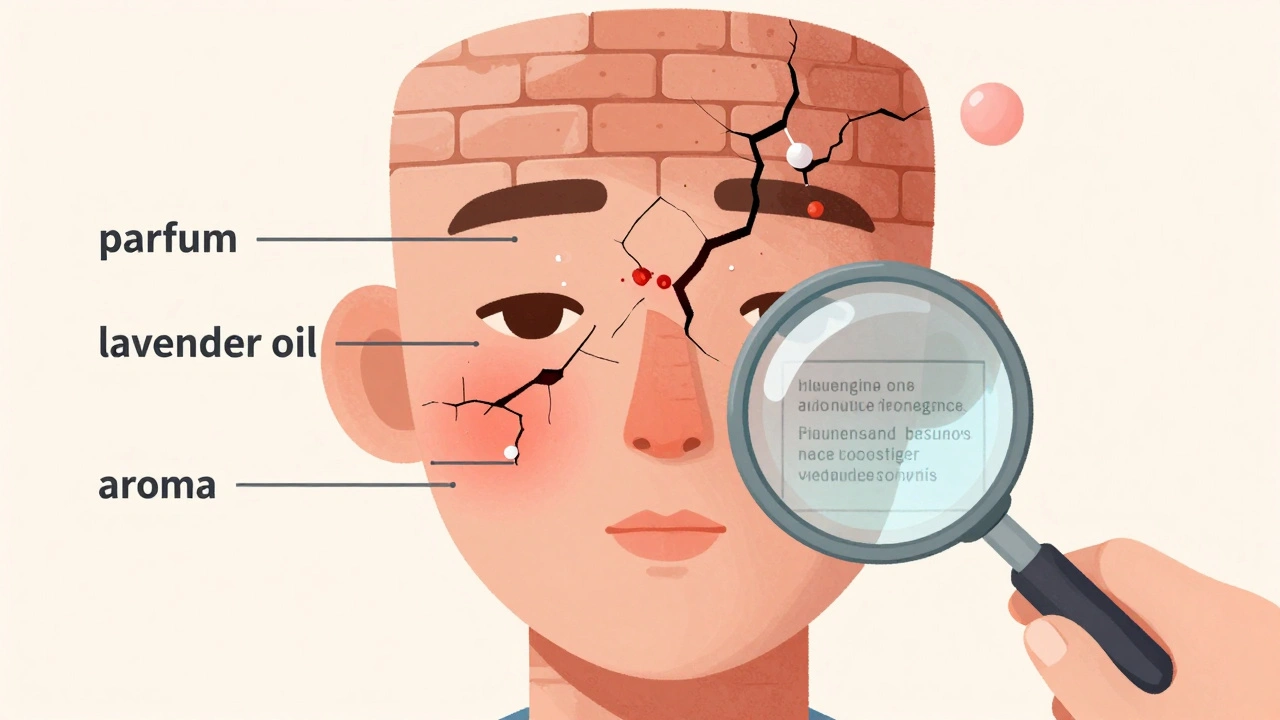
If your skin stings when you apply moisturizer, turns red after using a new cleanser, or breaks out without obvious reason, you’re not alone. Millions of people deal with sensitive skin every day - and many of them are reacting to something hidden in their products: fragrance.
Why Fragrance Is the Hidden Culprit
Fragrance isn’t just about scent. It’s a chemical cocktail. On ingredient lists, it’s often labeled as “fragrance” or “parfum,” hiding dozens of compounds - some synthetic, some from essential oils like lavender, citrus, or tea tree. Even if a product says “natural” or “gentle,” it can still contain these irritants. Dermatologists agree: fragrance is one of the top triggers for skin irritation. The American Contact Dermatitis Society found that fragrance compounds cause 30-45% of all allergic reactions from skincare. In clinical practice, dermatologist Dr. Whitney Bowe reports that fragrance triggers nearly 38% of allergic contact dermatitis cases she sees. And here’s the surprise: essential oils aren’t safer. Studies show they cause reactions in 22% of sensitive skin users - same as synthetic scents. Your skin’s barrier is like a brick wall. When it’s weak, irritants slip through. Fragrance molecules are small and penetrate easily. Once inside, they spark inflammation, redness, itching, and dryness. This isn’t just discomfort - it’s your skin signaling it’s under attack.What “Fragrance-Free” Really Means
Not all “fragrance-free” labels are equal. There’s a big difference between “fragrance-free” and “unscented.” - Fragrance-free means no added scent ingredients - not even natural ones. No essential oils. No masking agents. Zero fragrance compounds. - Unscented means the product has a scent, but it’s covered up with another chemical. That masking agent? Often just another irritant. A 2023 analysis by Pretty Farm Girl found that 68% of products labeled “natural” still contain hidden fragrance. Even some “hypoallergenic” brands slip in fragrance under vague terms like “aroma” or “essential oil blend.” To know for sure, check the ingredient list. If you see any of these, avoid it:- Fragrance
- Parfum
- Aroma
- Essential oil (lavender, eucalyptus, citrus, etc.)
- Flavor
- Perfume
The Three-Step Fragrance-Free Routine
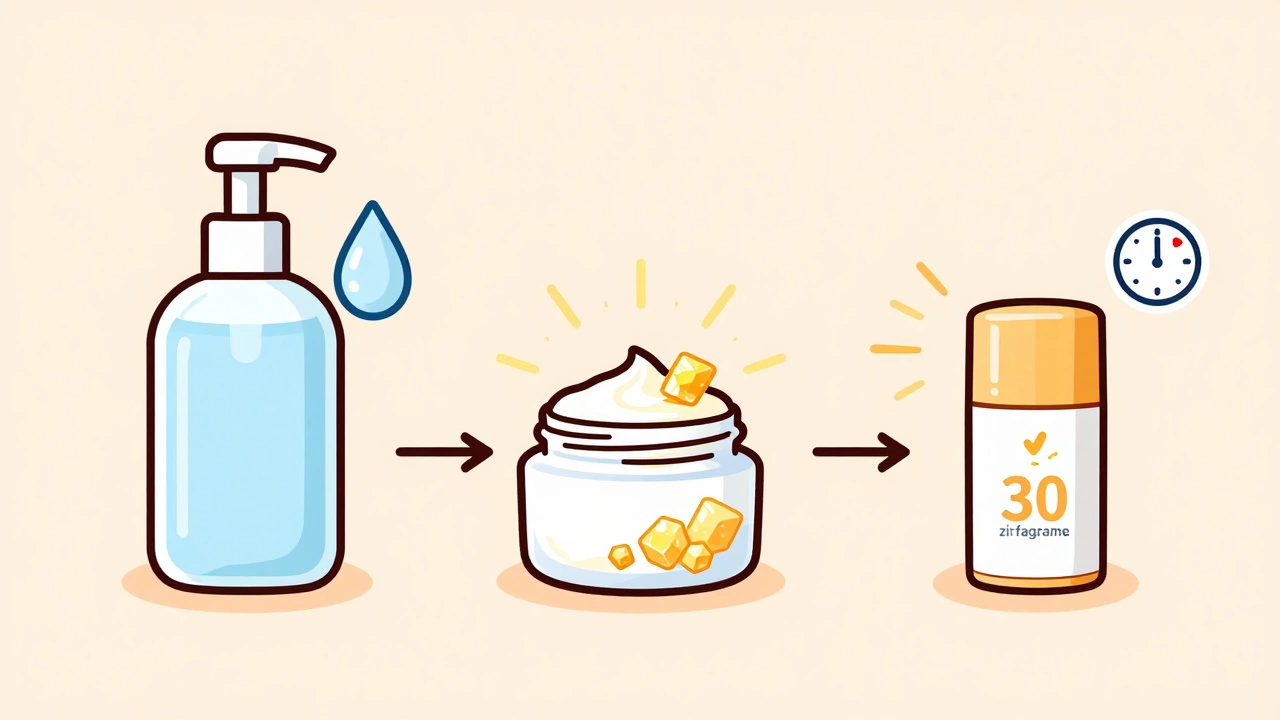
You don’t need 10 products. You need three. That’s it.- Fragrance-free cleanser - Use once a day, preferably at night. Water-based cleansers with glycerin or squalane are ideal. Avoid foaming formulas - they strip your barrier. CeraVe Hydrating Cleanser, for example, maintains transepidermal water loss (TEWL) at 8.2 g/m²/h, far better than the average 14.7 g/m²/h of scented cleansers.
- Fragrance-free moisturizer - Apply within 30 seconds of cleansing, while skin is still damp. Look for ceramides (0.5-3%), hyaluronic acid (0.5-2%), and glycerin (3-10%). Vanicream Moisturizing Cream has been shown to retain 42% more hydration over 8 hours than scented alternatives.
- Fragrance-free mineral sunscreen - Use every morning. Zinc oxide is the gold standard. It sits on top of the skin, deflecting UV rays without being absorbed. Avoid chemical sunscreens like oxybenzone - they’re more likely to trigger reactions. Look for SPF 30 or higher, with no added scent.
How to Test a New Product (Without Ruining Your Skin)
Never apply a new product to your face right away. Always patch test. Here’s how dermatologists recommend doing it:- Wash and dry a small area behind your ear.
- Apply a pea-sized amount of the product.
- Leave it on for 72 hours. Don’t wash it off.
- Watch for redness, itching, burning, or swelling.
What Works - and What Doesn’t
Fragrance-free routines shine in three areas:- Eczema and rosacea - The National Eczema Association reports a 76% reduction in flare-ups when switching to fragrance-free products.
- Post-procedure care - After laser treatments or chemical peels, dermatologists see 89% fewer complications with fragrance-free regimens.
- Chemical sensitivities - People with multiple chemical sensitivities often find relief only when they eliminate all fragrance - even from laundry detergent.
Cost, Convenience, and the Trade-Offs
Yes, fragrance-free products cost more. On average, they’re $28.50 compared to $22.75 for scented ones. But think of it this way: how much have you spent on products that made your skin worse? How many bottles of moisturizer have you thrown away after a reaction? The trade-off is sensory. Many users say fragrance-free products feel “clinical,” “bland,” or “uninspiring.” That’s because they lack the sweet, floral, or citrusy scents we associate with pampering. But here’s the thing: you can still enjoy scent - just not on your face. A hack used by many in the SkincareAddiction Reddit community (1.2 million members) is the “wrist perfume method.” Apply your favorite perfume or essential oil to your wrist, then rub your hands together before applying moisturizer. The scent transfers to your skin without touching your face. 68% of testers report this works well.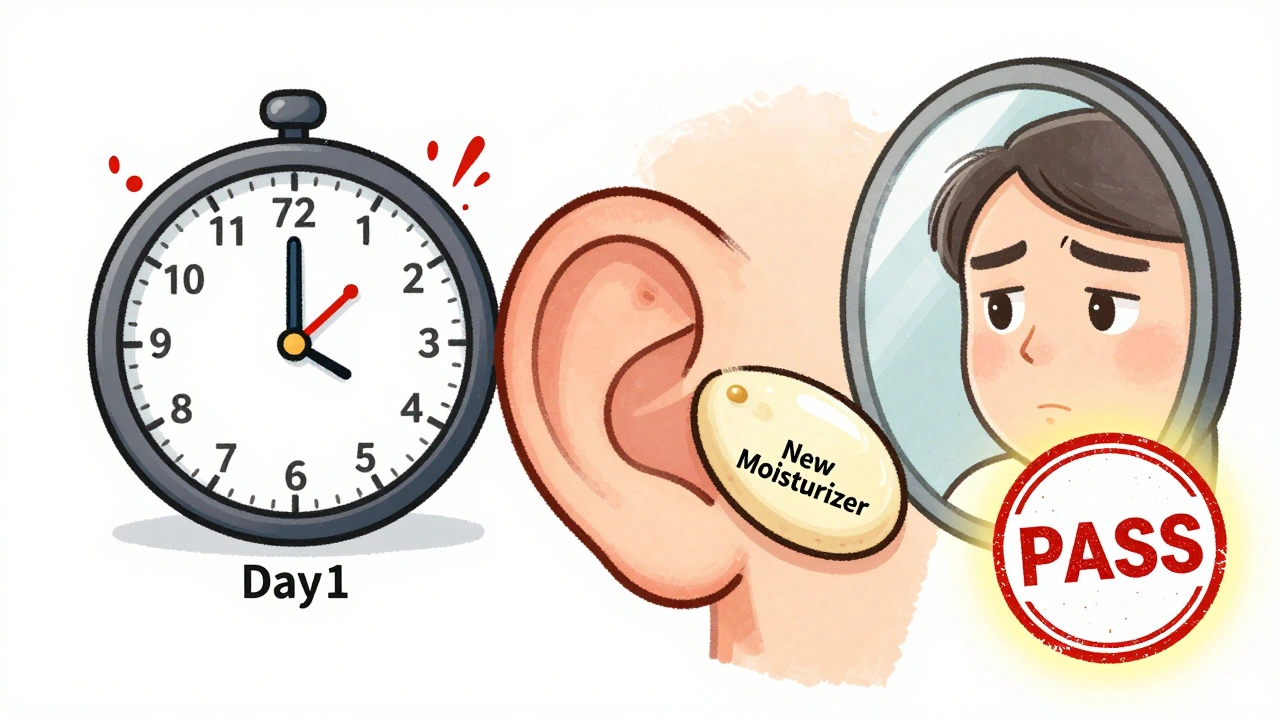
How to Find Trustworthy Products
Not every brand that says “for sensitive skin” is safe. The FDA doesn’t regulate the term “hypoallergenic.” Look for these trusted sources:- National Eczema Association (NEA) Seal - Over 1,200 products are certified. You can search their database or use their free app.
- Dermstore’s Fragrance-Free Certification - Products are tested by independent labs to confirm zero fragrance compounds.
- Cleure’s Ingredient Verification Program - Their products are tested to ensure zero parts per million of fragrance.
The Bigger Picture
The fragrance-free skincare market is growing fast - up 17% in 2023, hitting $3.8 billion globally. Why? Because people are learning the truth: your skin doesn’t need to smell good to be healthy. More than 41% of users have a diagnosed condition like eczema or rosacea. The other 59%? They just know their skin reacts. And they’re tired of guessing. Regulations are catching up. The EU requires disclosure of 26 common fragrance allergens. In the U.S., the proposed CARES Act and California’s Fragrance Ingredient Transparency Act could soon force full ingredient disclosure - meaning “fragrance” might soon become a thing of the past.Final Thought: Less Is More
Your skin isn’t broken. It’s just overwhelmed. Fragrance-free routines aren’t about restriction - they’re about respect. Respect for your skin’s natural balance. Respect for its ability to heal when you stop attacking it. Start with three products. Patch test everything. Give it six weeks. If your skin stops stinging, stops turning red, and stops feeling tight - you’ve found your answer. No magic. No expensive serums. Just clean, simple care.And that’s worth more than any scent.





14 Comments
I tried every fancy serum under the sun-retinol, niacinamide, vitamin C cocktails-and my face looked like a tomato after a heatwave. Then I switched to just CeraVe and Vanicream. No scent. No drama. Just skin that doesn’t scream at me every morning. I didn’t need magic. I needed silence.
OMG YES 😭 I used to think fragrance-free meant ‘boring’ until my eczema stopped bleeding. Now I smear Vanicream on my face like it’s holy water. And the wrist perfume trick? Genius. I spray my favorite lavender oil on my wrists, rub ‘em together, then pat my cheeks. Smells like spa day, but my skin doesn’t revolt. Thank you for this post!! 🙏🌸
While the general premise is sound, the article exhibits significant methodological bias. The cited 68% statistic from 'Pretty Farm Girl' is not peer-reviewed; it is a blog post with no disclosed methodology. Furthermore, the claim that essential oils cause reactions in 22% of users conflates self-reported irritation with clinically verified contact dermatitis. The American Contact Dermatitis Society does not publish such statistics without controlled patch testing protocols, which are absent here. Additionally, the recommendation to avoid all essential oils ignores the fact that many are chemically identical to synthetic compounds-yet the article selectively vilifies them. This is pseudoscience dressed in clinical language.
i’ve been doing the 3 step thing for 6 weeks now and… my skin just feels… calm? like, not tight or itchy after washing. i didn’t even realize how bad it was until it stopped being bad. also, patch testing behind the ear saved me from a disaster with a ‘natural’ toner that had ‘lavender oil’ in it. oops. lol. thanks for the reminder to check ingredients. i’m still bad at reading tiny print though 😅
One thing often overlooked: fragrance-free doesn't mean preservative-free. Many of these minimalist products use alternative preservatives like potassium sorbate or sodium benzoate, which can also irritate. If you're reacting to a 'fragrance-free' product, don't assume it's safe-check the full INCI list. Also, water-based cleansers are great, but if you're in a dry climate, consider adding a squalane oil before moisturizer. It mimics skin lipids and helps lock in hydration without clogging pores.
STOP. JUST STOP. You’re telling people to avoid essential oils, but you’re recommending CeraVe-which contains PEG-100 stearate, a known irritant for many. And Vanicream? It has cetyl alcohol-which is NOT an alcohol like ethanol, but people with sensitive skin still react to it. You’re giving blanket advice without acknowledging that ‘fragrance-free’ doesn’t mean ‘hypoallergenic.’ You’re not helping-you’re misleading people into thinking they’re safe when they’re not. I’ve seen this pattern over and over. It’s dangerous.
Why do people care so much about this? I just wash my face with soap and call it a day. If it stings, stop using it. Done. Why do you need a whole 1500-word essay about scent? Also, sunscreen? I just use my brother’s SPF 50 from the gym. Works fine. No idea what’s in it. Don’t care. My skin’s fine.
YOU CAN DO THIS. I was skeptical too. I thought I’d miss the lavender smell, but honestly? My skin is happier than I am. I used to cry after applying moisturizer. Now I just wake up and my face doesn’t feel like sandpaper. Start with the cleanser. Just one. Wait a week. Then add the moisturizer. You got this. And if you’re worried about cost-buy the 8oz size, not the mini. It lasts longer. You’re worth it.
This whole thing is a marketing scam. Fragrance-free products cost more because they’re cheaper to make. No scent = less ingredients = lower production cost. Companies charge double because they know people with sensitive skin are desperate. And the ‘patch test’? That’s just a way to make you feel like you’re doing something productive while you wait 72 hours to be disappointed. The real solution? Don’t use anything. Let your skin breathe. It’s been fine for 100,000 years without your ‘routine’.
you people in usa think you are so smart with your 'fragrance-free' nonsense. in india we use turmeric and neem since ancient times. no need for your fancy creams. your skin is weak because you eat too much sugar and sit in air conditioning all day. stop blaming products, blame your lifestyle. also why you waste money on 'ceramides'? we use ghee. cheaper and works better. you need to go back to nature, not buy more bottles.
Can I ask-what do you recommend for someone who’s allergic to *everything*? Even the ‘fragrance-free’ brands sometimes have preservatives or emulsifiers that break me out. I’ve tried 30+ products. I’m down to just plain white petrolatum and water. Is that too extreme? Also, does anyone know if the NEA seal includes testing for emulsifiers like cetearyl alcohol? I can’t find that info anywhere.
Why are we letting a bunch of bloggers dictate skincare? This isn’t science-it’s influencer culture. The EU mandates disclosure of 26 allergens? Great. But the U.S. lets companies hide ‘fragrance’ under a blanket term. That’s not regulation-that’s corporate negligence. And you’re telling people to trust ‘Dermstore’s certification’? Who funds them? Who audits them? This is the same system that told us talcum powder was safe. Don’t be fooled. Your skin is a battleground. And you’re being sold a lie.
my mom used to rub olive oil on her face and say ‘it’s what grandma did’-and honestly? it worked better than half the stuff i bought. i tried the vanicream after reading this and my skin stopped burning. but i still use olive oil on my elbows and knees. why do we think ‘clinical’ is better than ‘natural’? maybe we just need to stop overthinking. also, i use the wrist perfume trick too. i spray my dad’s cologne on my wrists and pretend i’m a grown-up. lol
So let me get this straight. The government doesn’t regulate ‘fragrance’ on labels, but we’re supposed to trust a blog that says ‘CeraVe is safe’? What if CeraVe’s parent company is secretly owned by the same conglomerate that makes all the scented products? What if ‘fragrance-free’ is just a new marketing gimmick to sell you overpriced jars? I’ve been following this for years. Every time someone says ‘trust the science,’ it’s always a company with a patent. I’m not buying it.