

The U.S. Food and Drug Administration doesn’t wait for a public health crisis to act. When manufacturers cut corners, mislabel products, or skip safety checks, the FDA responds with one of its most powerful tools: the FDA warning letter. These aren’t gentle reminders. They’re formal notices that a company is breaking the law-and if they don’t fix it fast, the consequences get serious.
What Exactly Is an FDA Warning Letter?
An FDA warning letter is the agency’s first official step in enforcing the Federal Food, Drug, and Cosmetic Act. It’s not a fine. It’s not a shutdown. But it’s the line in the sand. Issued when inspectors find violations of significant regulatory standards, these letters list specific problems-like dirty equipment, false advertising, or unapproved drug ingredients-and demand a response within 15 business days.These letters come from the top. Since early 2023, under Commissioner Robert Califf, warning letters are now signed by directors of the Center for Drug Evaluation and Research (CDER) or the Center for Biologics Evaluation and Research (CBER)-not junior reviewers. That change signals something: the FDA is treating these violations as serious threats to public safety, not administrative oversights.
For example, in 2025, the FDA sent 58 warning letters to compounding pharmacies and telehealth companies selling unapproved versions of weight-loss drugs like semaglutide and tirzepatide. These letters didn’t just say, “Please stop.” They cited specific sections of the law-Sections 502(a) and 502(bb)-and accused companies of misbranding. The message was clear: selling fake or unapproved versions of popular medications is a direct violation of federal law.
How the FDA Builds Its Case
Before a warning letter lands on a manufacturer’s desk, there’s usually an inspection. FDA inspectors show up-sometimes unannounced-and document what they find on FDA Form 483. This form lists observations: dirty floors, missing records, failed quality tests. It’s not a violation notice yet, but it’s the first red flag.If the issues are serious enough, the FDA follows up with a warning letter. This document doesn’t just list problems-it demands action. Companies must respond with a detailed plan: what they’ll fix, how they’ll fix it, and when. The FDA doesn’t accept vague promises. They want timelines, test results, and proof of training.
And here’s the catch: if a company ignores the letter or submits a weak response, the FDA doesn’t wait. It escalates. That could mean a recall, import detention, civil penalties of up to $1 million per violation, or even criminal charges. Under Section 303(f) of the FDCA, delaying or denying an inspection can lead to jail time.
Import Alerts and Border Enforcement
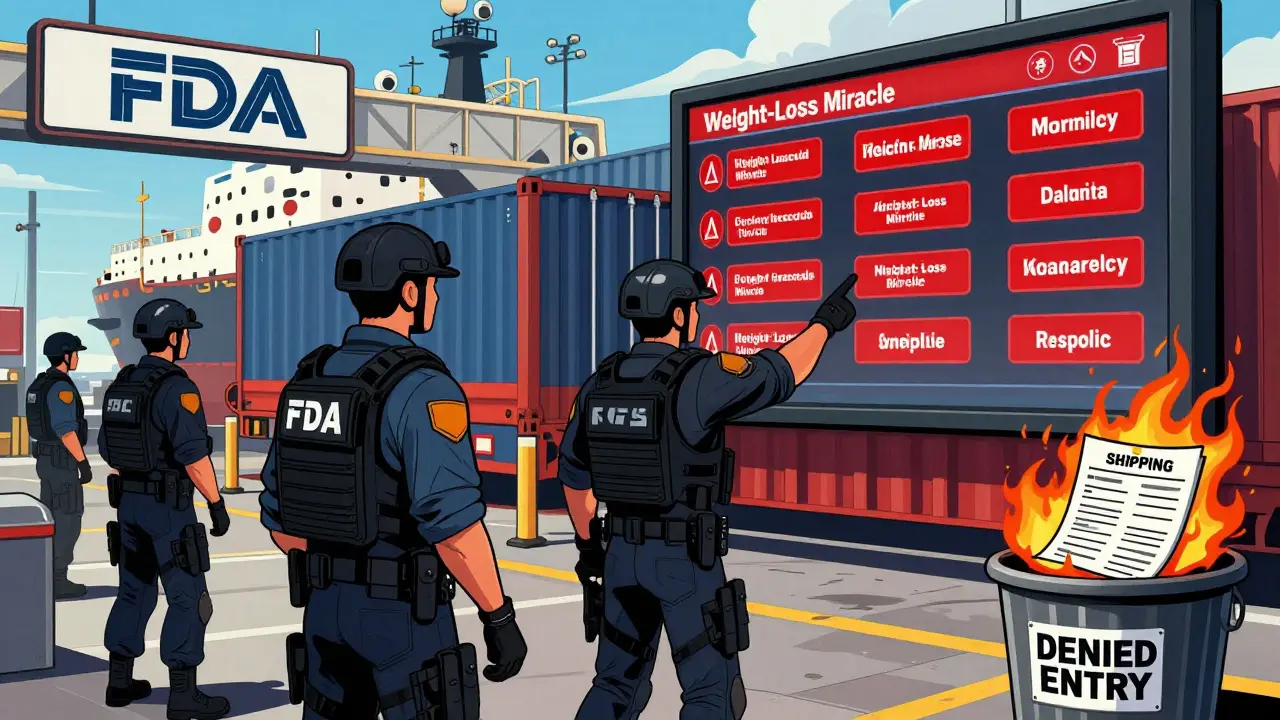
The FDA doesn’t just watch U.S. factories. It’s stationed at ports of entry. If a shipment of supplements, medical devices, or drugs arrives with violations-like unapproved ingredients or false claims-it gets detained. No waiting. No second chance.Importers get a Notice of FDA Action explaining the violation. They have 30 days to prove the product is safe and compliant. If they can’t, the product is refused entry. This is especially common for products from overseas manufacturers that skip cGMP (Current Good Manufacturing Practices). In 2024, over 1,200 shipments were detained at U.S. borders because of FDA violations.
One major target: dietary supplements labeled as “natural” but containing hidden pharmaceuticals. The FDA has issued dozens of import alerts for these products, and they’re not going away. In 2025, more than 30% of all import alerts targeted products sold as weight-loss aids or sexual enhancement supplements.
Tobacco and Food: Two Other Fronts
The FDA’s warning power isn’t limited to drugs. In the tobacco sector, the agency has issued over 700 warning letters since 2021 targeting unauthorized e-cigarettes and flavored nicotine products. Many of these were marketed to teens with cartoon packaging and sweet flavors-exactly what the FDA’s 2025 enforcement strategy was designed to stop.Food manufacturers aren’t safe either. In 2024, the FDA issued 149 warning letters to human food facilities and 37 to animal food producers. Most cited violations of the Food Safety Modernization Act (FSMA), specifically failure to implement Hazard Analysis and Risk-Based Preventive Controls. That means companies didn’t properly assess risks like contamination, allergens, or pathogens. One company was cited for storing raw meat next to ready-to-eat meals. Another didn’t test for Listeria in its processing environment.
These aren’t old-school hygiene issues. The FDA now expects food makers to use science-based risk models. If you’re not doing that, you’re violating the law.
What Happens If You Don’t Respond?
Ignoring a warning letter is like ignoring a court summons. The FDA doesn’t send a second letter. It moves to the next step.First: Civil Monetary Penalties. These can range from $10,000 to $1 million per violation. For a company selling a popular drug, that could mean millions in fines.
Second: Product Recall. The FDA can force a company to pull its product from shelves. In 2025, a compounding pharmacy was ordered to recall over 12,000 vials of mislabeled semaglutide after failing to respond to its warning letter.
Third: Withdrawal of Approval. For drugs, this means the product can no longer be legally sold. For medical devices, it means the device can no longer be marketed. Once approval is withdrawn, the company must reapply-and that process can take years.
Fourth: Criminal Charges. In extreme cases, company executives can be personally prosecuted. The FDA has increased its collaboration with the Department of Justice to pursue individuals who knowingly falsify records or obstruct inspections.
Why the FDA Is Getting Tougher
The shift in enforcement isn’t random. It’s strategic. In 2023, the FDA announced it was returning to the “1990s paradigm” of issuing hundreds of warning letters per year. That’s up from just 150-200 in the early 2020s.Why? Because the market changed. Telehealth companies started selling compounded drugs online. Overseas factories began flooding the U.S. with unapproved supplements. Social media influencers promoted unregulated weight-loss products. The old system of slow, reactive enforcement wasn’t enough.
Now, the FDA is proactive. It’s using unannounced inspections at foreign facilities-a tool it barely used before. It’s targeting digital marketing. It’s training inspectors to spot misleading claims on Instagram and TikTok. And it’s increasing its budget by $50 million in FY2026 to expand these efforts.
What Manufacturers Should Do
If you’re a manufacturer, don’t wait for a warning letter. Build compliance into your operations.- Train staff on cGMP, FSMA, and labeling rules every year.
- Keep records clean and accessible-no redacted documents.
- Test products for contaminants and verify ingredient claims.
- Review marketing materials with legal counsel before posting.
- Designate a compliance officer who reports directly to leadership.
When a warning letter arrives, treat it like a crisis. Don’t send a generic reply. Hire an FDA lawyer. As regulatory experts at Ropes Gray LLP say, “A warning letter is a de facto regulatory emergency.”
The FDA isn’t trying to shut down honest businesses. It’s trying to stop those who put profits before safety. If you’re following the rules, you have nothing to fear. If you’re cutting corners, the warning letter is just the first step in a much longer, costlier process.
What happens if I ignore an FDA warning letter?
Ignoring an FDA warning letter leads to immediate escalation. The agency may issue a recall, detain your imports, impose civil penalties of up to $1 million per violation, or withdraw product approval. In severe cases, company executives can face criminal charges for obstructing inspections or falsifying records.
How long do I have to respond to an FDA warning letter?
You typically have 15 business days to respond. The FDA may extend or shorten this deadline based on the severity of the violation. Your response must include specific corrective actions, timelines, and evidence of implementation-vague promises are not accepted.
Can the FDA inspect my facility without warning?
Yes. Since 2025, the FDA has significantly increased unannounced inspections, especially for foreign manufacturers. These inspections are legal under the FDCA and are used to catch violations that might be hidden during scheduled visits. Refusing entry or delaying inspectors can lead to criminal penalties.
What’s the difference between a warning letter and an Untitled Letter?
A warning letter addresses violations of regulatory significance and requires a formal response. An Untitled Letter is used for minor or less serious issues, like misleading advertising that doesn’t rise to the level of a legal violation. Untitled Letters are not legally binding, but they’re still documented and can lead to warning letters if ignored.
Are FDA warning letters public?
Yes. All FDA warning letters are posted on the agency’s public website. They’re searchable by company name, product, or date. This transparency is intentional-it alerts the public, investors, and competitors to compliance issues.
Can the FDA shut down my business?
The FDA doesn’t have direct authority to shut down a business. But it can achieve the same result by withdrawing product approval, seizing inventory, or obtaining a court injunction. Once a product can’t be legally sold, most businesses can’t survive. In practice, this is a de facto shutdown.
What should I do if I receive a warning letter?
Immediately assemble a cross-functional team: regulatory affairs, quality control, legal counsel, and senior management. Don’t respond alone. Hire an FDA specialist. Your response must be detailed, evidence-based, and submitted before the deadline. Treat this as a top-priority crisis-not a paperwork task.


13 Comments
Wow. This is the kind of clarity we need in public health. No more playing nice with companies that put profits over people. The FDA’s finally acting like the guardian it’s supposed to be.
15 business days to fix violations? That’s generous. In India, regulators would’ve shut you down on day one.
Wait, so if I sell a supplement with ashwagandha and someone claims it’s ‘like semaglutide,’ that’s a warning letter? That’s absurd. The FDA’s gone full authoritarian.
Let’s be real-this isn’t about safety. It’s about control. The FDA’s using ‘public health’ as a pretext to crush small businesses and consolidate power. The 1990s paradigm? More like the 1990s dictatorship. They don’t want compliance-they want submission.
And don’t get me started on ‘import alerts.’ You’re telling me a guy in Bangalore making turmeric capsules gets detained because his label says ‘natural’? That’s not regulation. That’s economic warfare.
The real crime here? The FDA’s own labs are understaffed, yet they’re micromanaging every supplement brand on Amazon. Where’s the accountability for *their* failures?
And now they’re scanning Instagram? Next they’ll be subpoenaing your DMs. Welcome to the surveillance state, where your vitamin order is a federal offense.
This isn’t enforcement. It’s ideological purging disguised as science.
Actually, the data doesn’t support the claim that warning letters are increasing in effectiveness. A 2023 GAO report showed only 38% of companies fully remediate violations within 6 months. The rest just game the system with boilerplate responses. So this whole ‘tougher stance’ is theater. The FDA’s just posting more letters to look busy.
And don’t even get me started on the $50M budget increase. That’s taxpayer money spent on legal notices, not actual inspections. The real issue? They’re not hiring enough inspectors. They’re just sending more PDFs.
Look, I get the frustration. But let’s not lose sight of the bigger picture. These warning letters? They’ve saved lives. Remember the 2019 vaping crisis? Or the 2021 melamine in baby formula? None of that would’ve been caught without the FDA’s boots on the ground and the teeth to follow up.
Yes, some companies are overregulated. But the ones getting hit? They’re the ones selling fake Ozempic online, or putting lead in their ‘natural’ supplements. That’s not a small business-it’s a poison factory.
And yeah, the FDA’s got bureaucracy. But if you’re running a legitimate operation, compliance isn’t a burden-it’s your shield. It’s your proof that you’re not part of the problem.
Let’s not confuse frustration with principle. The FDA isn’t the enemy. The people exploiting the system are.
And if you’re reading this and thinking, ‘I’m just a small guy,’ then you’re probably not the one they’re after. The ones getting letters? They know exactly what they’re doing.
There’s a deeper truth here we’re avoiding. The FDA’s escalation isn’t just about drugs or supplements-it’s about trust. People used to trust institutions. Now they don’t. And when trust evaporates, regulation becomes performative.
What’s the point of a warning letter if no one believes the agency has the power-or the will-to follow through? That’s why they’re signing them at the director level now. It’s not about law. It’s about perception.
But here’s the irony: the more they scream ‘we’re serious,’ the more people tune them out. The real solution isn’t more letters. It’s transparency, consistency, and humility.
Imagine if the FDA published a monthly video from inspectors showing real inspections-no edits, no PR spin. Show the dirty floors. Show the clean ones. Let people see the difference.
That’s how you rebuild trust. Not by threatening. By showing up.
Oh please. The FDA is a cartel. They don’t care about safety-they care about protecting Big Pharma’s monopoly. Ever wonder why every generic drug takes 10 years to get approved? Because the FDA *wants* you to buy the $1,000 version. Warning letters? That’s how they kill competition.
And let’s not forget: the same agency that shut down a mom-and-pop compounding pharmacy for selling semaglutide? They let Novo Nordisk sell Ozempic at $1,000 a month while ignoring the patent cliffs. Hypocrisy? That’s the FDA’s middle name.
They’re not protecting public health. They’re protecting profits. Just ask any independent pharmacist who’s been squeezed out of the market.
Anyone who thinks this is ‘overreach’ hasn’t read the FDCA. Section 502(bb) exists for a reason. If you’re labeling a product as ‘weight loss’ and it contains unapproved pharmaceuticals, you’re not a victim-you’re a criminal. There is no moral high ground here.
And yes, the FDA has flaws. But your outrage is misplaced. The real villains are the influencers selling ‘miracle’ pills on TikTok, the Chinese factories pumping out counterfeit drugs, and the consumers who think ‘natural’ means ‘safe.’
Stop blaming the enforcers. Start blaming the enablers.
OK but like… imagine if your Instagram DMs got flagged because you said ‘I lost 20 lbs with this tea’ 😭 FDA is now the internet police 🚨💔 #FDAwatch #NotMyFDA
To every manufacturer reading this: Compliance isn’t optional. It’s the foundation of your legacy. Every record you keep, every test you run, every training you conduct-it’s not bureaucracy. It’s your armor. The FDA isn’t coming for you if you’re doing it right. They’re coming for the ones who think shortcuts are sustainable.
Build your compliance culture like you build your product-meticulously, intentionally, and with pride. Because when the letter comes, you won’t be scrambling. You’ll be ready.
This isn’t fear. It’s foresight.
Let’s not turn this into a war. The FDA has power, yes. But so do we-the public, the consumers, the small businesses. We can demand better oversight, not just more letters. We can push for clearer guidelines, faster appeals, and real dialogue.
Maybe the answer isn’t more enforcement. Maybe it’s more collaboration. What if the FDA hosted quarterly town halls with manufacturers? What if they published plain-language guides instead of legalese?
Power doesn’t have to be punitive. It can be partnership.
Let’s not just react to warning letters. Let’s design a system where they’re rare.
And just to add-this whole ‘FDA is authoritarian’ narrative? It’s a distraction. The real problem is that we’ve outsourced our responsibility. We buy supplements from random websites because they’re cheap. We trust influencers over scientists. We don’t ask questions.
Until we demand better-not just from regulators, but from ourselves-we’ll keep getting the system we tolerate.
It’s not the FDA that’s broken. It’s our collective apathy.