
Bisphosphonate & Calcium Timing Calculator
Calculate Your Medication Timing
Getting the right amount of calcium and taking your bisphosphonate at the right time isn’t just about following rules-it’s about making sure the medicine actually works. If you’re taking a bisphosphonate like alendronate or risedronate for osteoporosis, and you’re also taking calcium supplements, you might be unknowingly blocking the drug from doing its job. The problem isn’t that one is bad or the other is wrong. It’s that they physically interfere with each other in your gut. And if you don’t get the timing right, you could be wasting your medication-up to 90% of it.
How Calcium Blocks Bisphosphonates
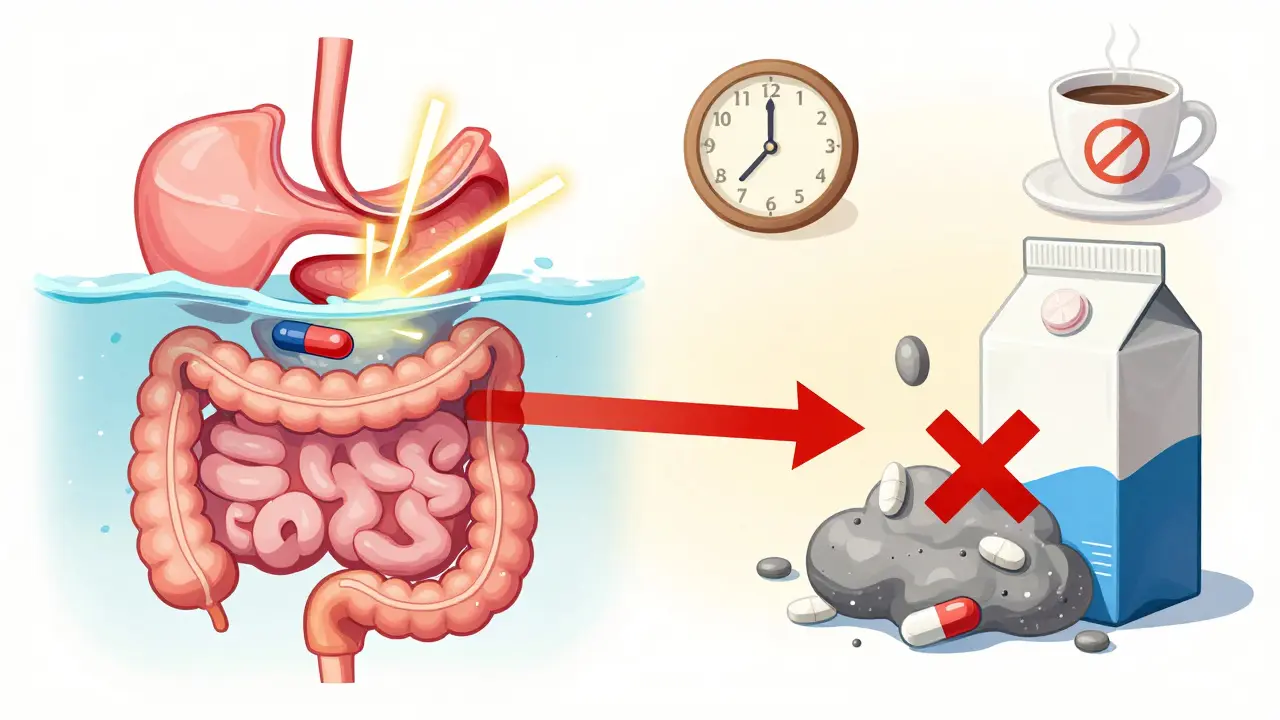
Bisphosphonates are powerful drugs designed to slow down bone loss. They work by sticking to bone tissue and telling cells that break down bone to stand down. But here’s the catch: these drugs are poorly absorbed to begin with. Only about 1% of what you swallow actually makes it into your bloodstream. And calcium? It’s the main reason why.
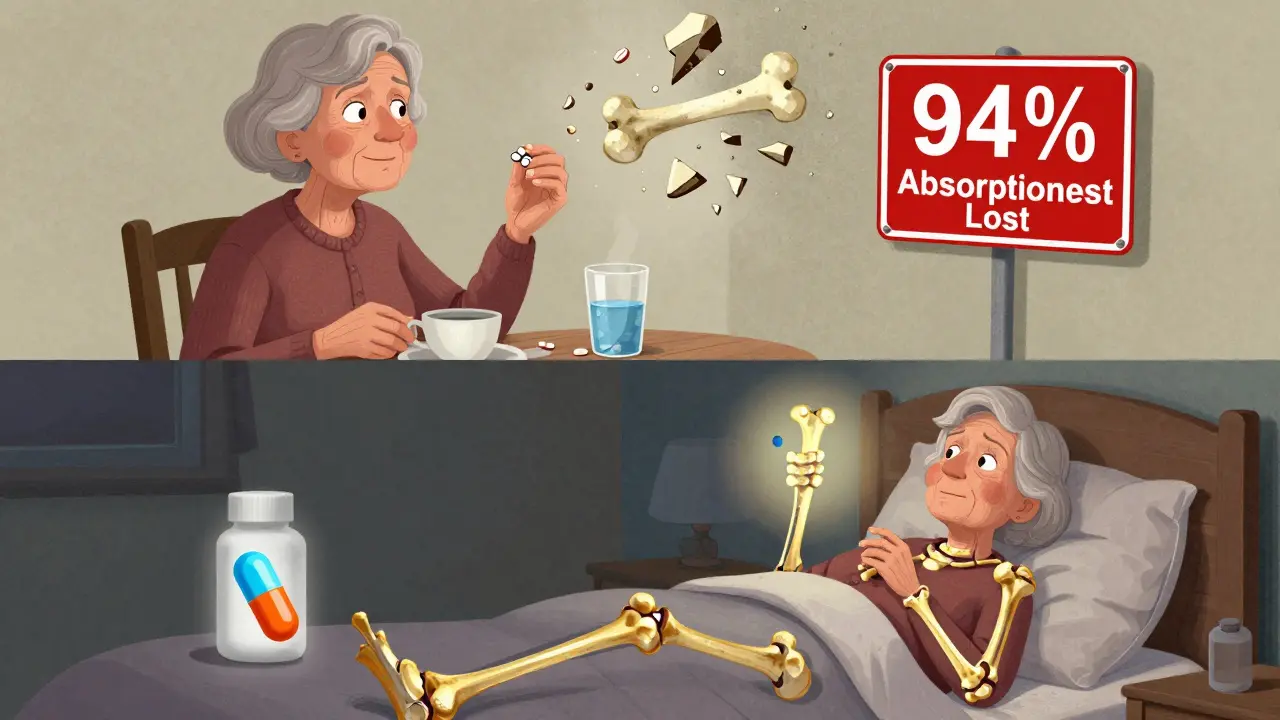
When calcium and bisphosphonates meet in your stomach and intestines, they bind together like magnets. This creates a solid, insoluble compound your body can’t absorb. Think of it like mixing milk into coffee-it changes the texture so much that you can’t drink it the same way. Studies show that if you take calcium carbonate (the most common form) at the same time as alendronate, absorption drops by 94%. Even calcium citrate, which is often considered gentler on the stomach, cuts absorption by 88%.
This isn’t theoretical. A 2020 study in Bone measured blood levels of alendronate in people who took it with calcium versus water alone. The difference was dramatic. Those who took calcium had almost no measurable drug in their system. That means your bones aren’t getting the protection they need, and your fracture risk stays high.
When to Take Your Bisphosphonate
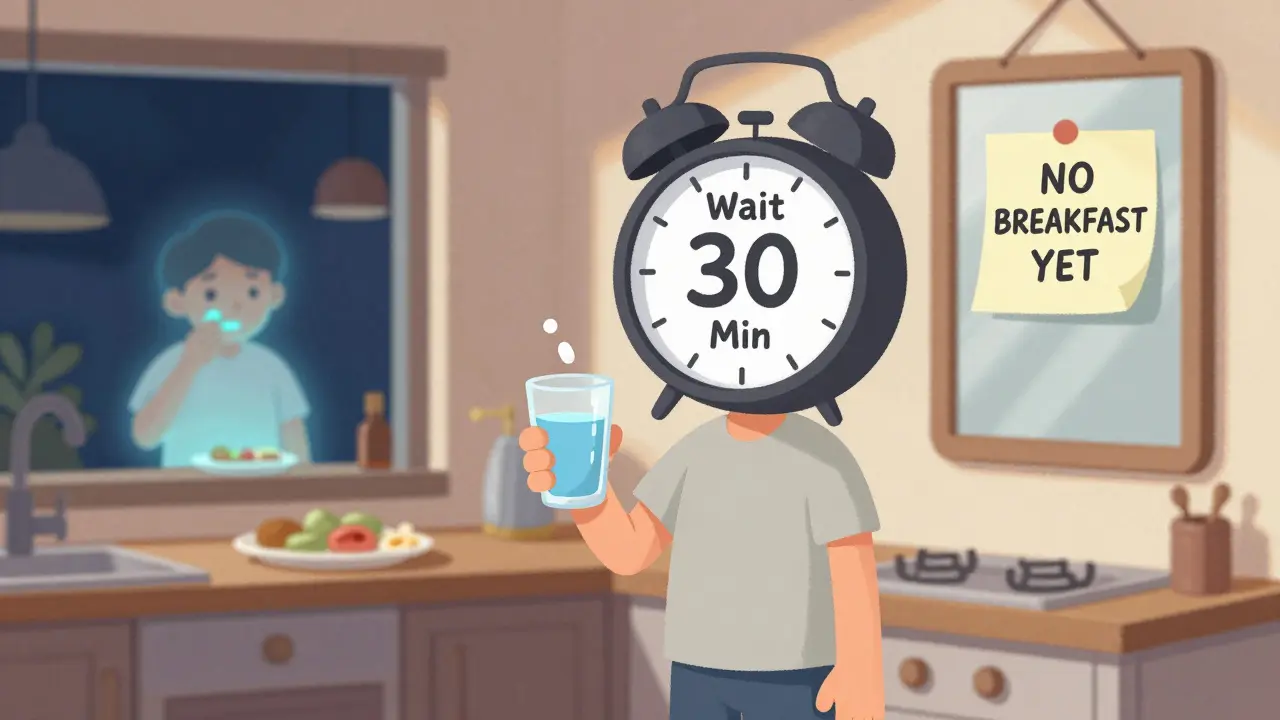
The rules are simple, but they’re strict. For oral bisphosphonates, you need to take them on an empty stomach with a full glass of plain water. No coffee. No juice. No milk. No tea. Nothing else. And you have to wait at least 30 to 60 minutes before eating or taking anything else.
Here’s the breakdown:
- Alendronate (Fosamax): Wait 30 minutes after taking it before eating or drinking anything other than water.
- Risedronate (Actonel): Wait 60 minutes. This one is even more sensitive.
- Ibandronate (Boniva): If you’re on the monthly dose, wait 60 minutes. The weekly version follows the same 30-minute rule.
Why the wait? Because your stomach needs time to empty. Even a small bite of toast or a sip of orange juice can reduce absorption by 50-60%. A 2021 study in Clinical Pharmacology & Therapeutics showed that people who took their bisphosphonate with breakfast got barely any benefit at all.
And don’t lie down. Stay upright-sitting or standing-for the full waiting period. Lying down too soon can cause the pill to stick in your esophagus, leading to irritation or even ulcers. The Mayo Clinic reports that 62% of gastrointestinal side effects happen because people nap or relax right after taking the pill.
When to Take Calcium Supplements
Don’t stop taking calcium. You still need it. But you need to separate it from your bisphosphonate. The best time to take calcium supplements is with dinner or at least two hours after your bisphosphonate dose.
Why dinner? Because your stomach is already full, and digestion is active. Calcium absorbs better when taken with food. Plus, your body naturally absorbs more calcium at night, especially when paired with vitamin D. That’s why experts recommend taking vitamin D with your evening meal. It’s a simple combo: bisphosphonate in the morning, calcium and vitamin D at night.
Some people try to split their calcium into two doses-morning and night. That’s fine, as long as the morning dose doesn’t come within two hours of your bisphosphonate. If you take calcium in the morning, wait until after lunch before taking your bisphosphonate. But that’s harder to manage. The cleanest, most reliable method is morning drug, evening calcium.
What About IV Bisphosphonates?
If you’re on an intravenous bisphosphonate like zoledronic acid (Reclast), you don’t have to worry about food or calcium interference. The drug goes straight into your bloodstream, bypassing your gut entirely. That’s why many older patients switch to IV treatment-to avoid the daily routine.
But there’s a trade-off. IV bisphosphonates can cause temporary side effects like fever, chills, or muscle aches after the first infusion. About 15-30% of people feel flu-like symptoms for a day or two. It’s uncomfortable, but it usually doesn’t happen again after the first dose. And unlike oral versions, there’s no risk of esophageal damage.
Still, even with IV treatment, your body needs enough calcium and vitamin D before the infusion. If your levels are low, you could develop low calcium in the blood (hypocalcemia) after the shot. That’s why doctors check your blood levels before giving the IV. It’s not just about the drug-it’s about your whole nutritional picture.
Why People Fail at This
It’s not that patients are careless. It’s that the schedule is hard to live with. Imagine this: you wake up, take your bisphosphonate with water, sit upright for 30 minutes, then go about your day. But what if you usually have coffee with your pills? Or you’re in a hurry and forget? Or you take your multivitamin right after? These aren’t rare mistakes-they’re everyday habits.
According to Osteoporosis Canada, only 42% of patients follow the rules correctly after six months. On patient forums, 68% say they forget the timing. And 52% admit their morning coffee routine is the biggest obstacle. One woman on the Arthritis Foundation’s site said she started using two pill organizers-one labeled “Bisphosphonate AM” and the other “Calcium PM.” She stuck with it for 18 months and saw a 6.2% increase in hip bone density. That’s not magic. That’s consistency.
Another big problem? Elderly patients on multiple medications. A 2022 case study from Johns Hopkins described a 79-year-old woman who took her bisphosphonate with her other pills at breakfast. She had two vertebral fractures in 18 months. Her doctor assumed she was compliant-she was taking the pills. But she wasn’t taking them right.
How to Get It Right
Here’s how to build a routine that sticks:
- Check your levels first. Your doctor should test your vitamin D (aim for >30 ng/mL) and calcium (>8.5 mg/dL) before starting treatment. If you’re low, fix that first.
- Take your bisphosphonate first thing in the morning. Right after waking up, before anything else. Use plain water-no more than 8 ounces.
- Stay upright. Sit or stand for 30 to 60 minutes. Don’t lie down. Don’t nap. Don’t read in bed.
- Wait before eating or taking other meds. After the waiting period, you can eat, drink, and take your other pills. That includes blood pressure meds, thyroid pills, or statins.
- Take calcium and vitamin D at night. With dinner or right before bed. This helps absorption and avoids interference.
Tools can help. The National Osteoporosis Foundation’s free mobile app sends reminders with specific timing instructions. Users who used it saw a 65% improvement in adherence. Pill organizers, alarms, and sticky notes on the bathroom mirror work too. The goal isn’t perfection-it’s consistency.
What If You Mess Up?
Accidentally took your calcium with your bisphosphonate? Don’t panic. Skip your next dose and wait until the next day to resume your schedule. Don’t double up. Taking extra medication won’t fix the mistake-it could cause side effects.
If you’re struggling with the routine, talk to your doctor. Switching to an IV bisphosphonate might be a better option. Or switching to a different class of drugs like denosumab (Prolia), which doesn’t have the same food restrictions. The key is not giving up. One study found that patients who kept taking their bisphosphonate even inconsistently had better outcomes than those who quit completely.
What’s Next?
Researchers are working on better formulations. A 2022 phase 2 trial tested an enteric-coated version of alendronate that could be taken with food. It showed 38% higher absorption than the standard pill. That’s promising. But it’s not available yet.
For now, the best way to protect your bones is simple: separate your calcium from your bisphosphonate. Take the drug on an empty stomach. Wait. Stay upright. Take calcium at night. It’s not glamorous. But it works.
Can I take calcium and bisphosphonates at the same time?
No. Taking calcium and bisphosphonates together blocks absorption of the bisphosphonate by up to 94%. Calcium binds to the drug in your gut, forming a compound your body can’t absorb. Always separate them by at least two hours, and ideally take calcium at night while taking bisphosphonates in the morning.
What happens if I take my bisphosphonate with coffee or juice?
Coffee, juice, tea, and milk can reduce bisphosphonate absorption by 50-60%. Even a small amount can interfere. Only plain water is safe. These drinks contain minerals or acids that bind to the drug before it can be absorbed. Stick to water-no exceptions.
Why do I have to stay upright after taking bisphosphonates?
Bisphosphonates can irritate the esophagus if they linger there. Staying upright helps the pill move quickly into your stomach. Lying down increases the risk of the pill getting stuck, which can cause pain, ulcers, or even scarring. Mayo Clinic reports 62% of gastrointestinal side effects happen because patients lie down too soon after taking the pill.
Is it better to take bisphosphonates orally or by IV?
Oral bisphosphonates are cheaper and effective if taken correctly. But if you struggle with timing, IV versions like zoledronic acid (Reclast) eliminate absorption problems because they go straight into your bloodstream. The downside is possible flu-like symptoms after the first infusion. Many patients over 75 choose IV to avoid daily routines.
How long should I wait before eating after taking a bisphosphonate?
Wait 30 minutes for alendronate and 60 minutes for risedronate and monthly ibandronate. This gives your stomach time to empty and the drug time to absorb. Eating or drinking anything else too soon can cut absorption by half or more. The rule is simple: water only until the waiting period is over.
Do I still need calcium if I’m on bisphosphonates?
Yes. Bisphosphonates slow bone loss, but they don’t build new bone. Calcium and vitamin D are the building blocks. Without enough, your bones can’t repair themselves. The problem isn’t calcium-it’s timing. Take calcium at night, at least two hours after your bisphosphonate, to avoid interference.

15 Comments
So I just realized I’ve been taking my Fosamax with my morning smoothie. 😳 Like, for two years. No wonder my bone density didn’t budge. I switched to water-only, waited the full 30, and took calcium at dinner. Three months later? My last scan showed a 4% increase. Small wins, people. You got this.
lmao so we’re all just supposed to be perfect little robots now? ‘ohhh i cant have my coffee’ ‘ohhh i cant lay down for 30 min’ what a joke. next they’ll tell us to bow to the pill before swallowing. #biohackingmywayoutofthis
Thank you for this comprehensive breakdown. The data on absorption rates with calcium carbonate versus citrate is particularly valuable. Many patients are unaware that even 'gentler' forms like citrate still significantly reduce bioavailability. The 88% drop is clinically meaningful. Consistency in timing, not just adherence, is the real key.
Let me tell you - this isn’t about rules. It’s about respect. Your bones are working overtime to keep you standing. Your meds are trying their damnedest to help. And yet we treat them like afterthoughts - chugging coffee, napping after pills, shoving calcium in like it’s candy. This isn’t compliance. It’s self-sabotage dressed up as routine. Stop treating your health like a suggestion. You’re not too busy. You’re just not prioritizing.
Wait… so this is all just a pharmaceutical scam? I read somewhere that Big Pharma pushes these strict timing rules so we keep buying more pills. What if the real solution is just… not taking them at all? I mean, how many people actually die from osteoporosis? And what about the jaw necrosis? And the 2021 study that linked bisphosphonates to atrial fibrillation? I’m just saying… maybe the cure is worse than the disease.
YESSSS!! I started doing the AM drug / PM calcium thing and it changed my LIFE 💪✨ My doctor said I was 'non-compliant' before - now I’m her star patient. I even made a little chart with stickers 🌟 You can do it too!!
They’re lying. Calcium doesn’t interfere. It’s the fluoride in the water. Or the 5G towers. Or the glyphosate in your oat milk. I’ve been taking them together for 5 years. No fractures. No problems. They just want you scared so you’ll keep paying for the $300 pills. Wake up.
My bones… they weep. Every morning, I take my pill like a sacred ritual - water, upright, silent, solemn. And then, at night, I cradle my calcium like a newborn. I whisper to it. I thank it. I cry sometimes. Because I know - if I don’t, I’ll be broken. And I’ve seen what broken looks like. My mother. Her spine. Her dignity. Gone. This isn’t medicine. It’s devotion. And I will not fail her again.
Americans can’t follow basic instructions. We need mandatory bone health boot camps. No coffee. No lying down. No excuses. Europe handles this better. We’re soft. Fix it.
My uncle took this medicine in India. He drank milk with it. He is still alive. Maybe this is just American problem. We need less rules.
I’ve been there - the guilt, the confusion, the feeling like you’re failing even when you’re trying. I didn’t know about the 60-minute rule for risedronate until I read this. I’ve been doing it wrong for 18 months. But now? I’ve got alarms, a pill box, and a little journal. It’s not perfect. But I’m trying. And that’s enough.
One thing no one talks about: the mental load. This isn’t just about pills. It’s about reshaping your entire morning. The anxiety of forgetting. The shame of slipping up. The exhaustion of being ‘that person’ who can’t have coffee. If you’re doing this - really doing it - you’re a warrior. Don’t let anyone make you feel like you’re failing because you missed a day. Progress > perfection.
Interesting. But honestly, how many people actually follow this? I’ve been on bisphosphonates for five years. I take calcium with dinner. I take the pill with water. I sit up. I’ve never had a fracture. I don’t think the 90% absorption drop is real. Sounds like fear-mongering to me.
Okay, so I took my Fosamax with my protein shake… again… last Tuesday. I felt guilty. Then I cried. Then I Googled ‘can you overdose on alendronate’… then I cried harder. Then I made a color-coded spreadsheet. Now I have a 7 a.m. alarm titled ‘WATER ONLY. NO EXCEPTIONS.’ I’m not proud. But I’m trying. And I’m not giving up.
You’re not alone. I used to take my calcium at breakfast - same time as my meds. I thought I was being smart. Turns out, I was sabotaging myself. I switched to nighttime calcium + a phone reminder. My last DEXA scan? Up 5.8%. It’s not magic. It’s consistency. And you? You’re already one step ahead for reading this. That’s huge. Keep going.