
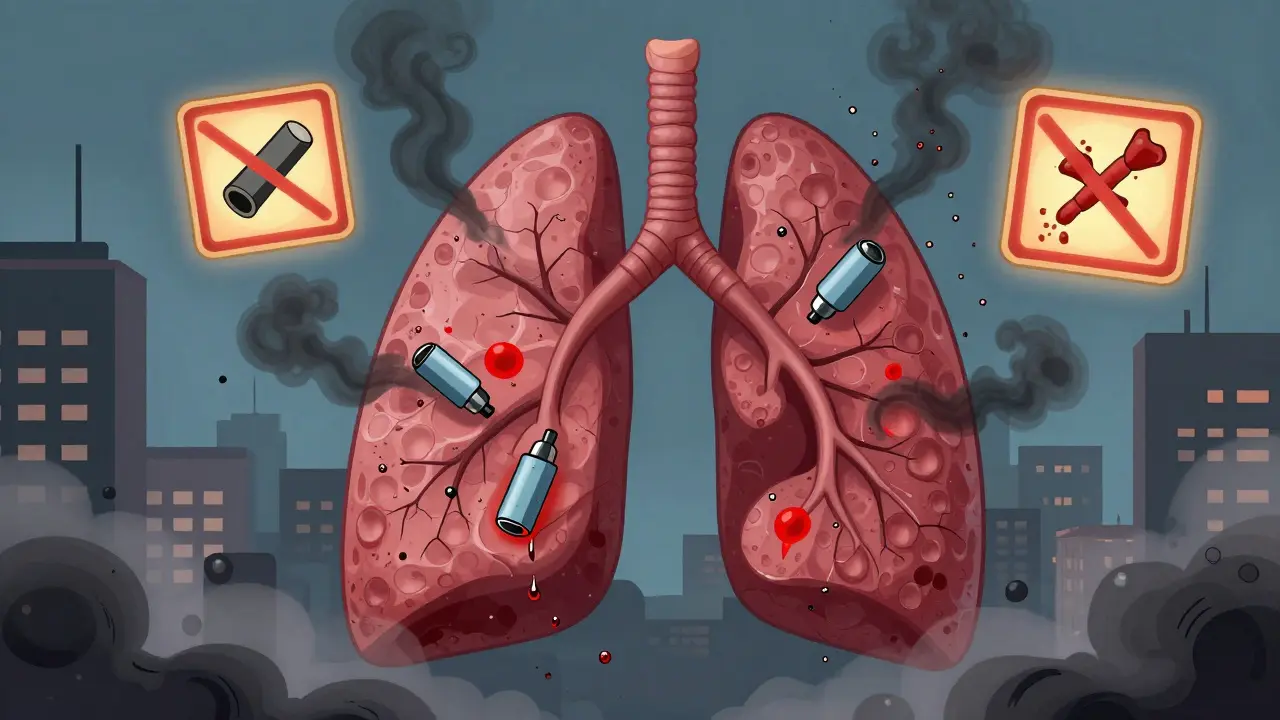
When you see someone vaping on the street, it’s easy to think it’s just water vapor-harmless, maybe even healthy compared to smoking. But the truth is more complicated. Vaping isn’t clean. It’s not safe. And your lungs are paying the price, even if you don’t feel it yet.
The Aerosol You’re Breathing Isn’t Just Flavor
E-cigarettes heat a liquid-usually made of propylene glycol, vegetable glycerin, nicotine, and flavorings-into an aerosol you inhale. What you’re not seeing are the hidden toxins. A University of North Carolina study found that these base ingredients are toxic to lung cells. The more additives in the liquid, the worse it gets. And those flavorings? Some contain chemicals like diacetyl, which was once used in microwave popcorn factories and linked to a rare but serious lung disease called bronchiolitis obliterans, or "popcorn lung."
Even though diacetyl has been banned in many countries, other harmful substances remain. Vaping aerosols carry acetaldehyde, formaldehyde, and acrolein-all known to damage lung tissue. Heavy metals like lead, nickel, and tin show up too, leaching from the device’s heating coils. Benzene, a chemical found in car exhaust, has also been detected. These aren’t accidental byproducts. They’re built into the process of heating liquids at high temperatures.
Your Lungs Are Under Constant Attack
Unlike smoking, vaping doesn’t produce tar or the same levels of cancer-causing agents. But that doesn’t mean it’s safe. Research from the American Thoracic Society shows that vaping suppresses your lung’s natural immune defenses. The cells that normally fight off bacteria and viruses become sluggish. That means you’re more likely to catch pneumonia, bronchitis, or the flu-and when you do, your body struggles to recover.
Even people with no history of lung problems report symptoms: a persistent cough, chest tightness, shortness of breath during light activity, and frequent respiratory infections. These aren’t just "annoyances." They’re signs your airways are inflamed. A 2025 report from Lyracore confirms that airway inflammation and impaired immune response are two of the four most consistent findings in vaping-related lung damage.
And it’s not just active users. Secondhand vaping exposes bystanders to nicotine, ultrafine particles, and the same toxic chemicals. There’s no such thing as harmless secondhand vapor.
EVALI: The Wake-Up Call Nobody Wanted
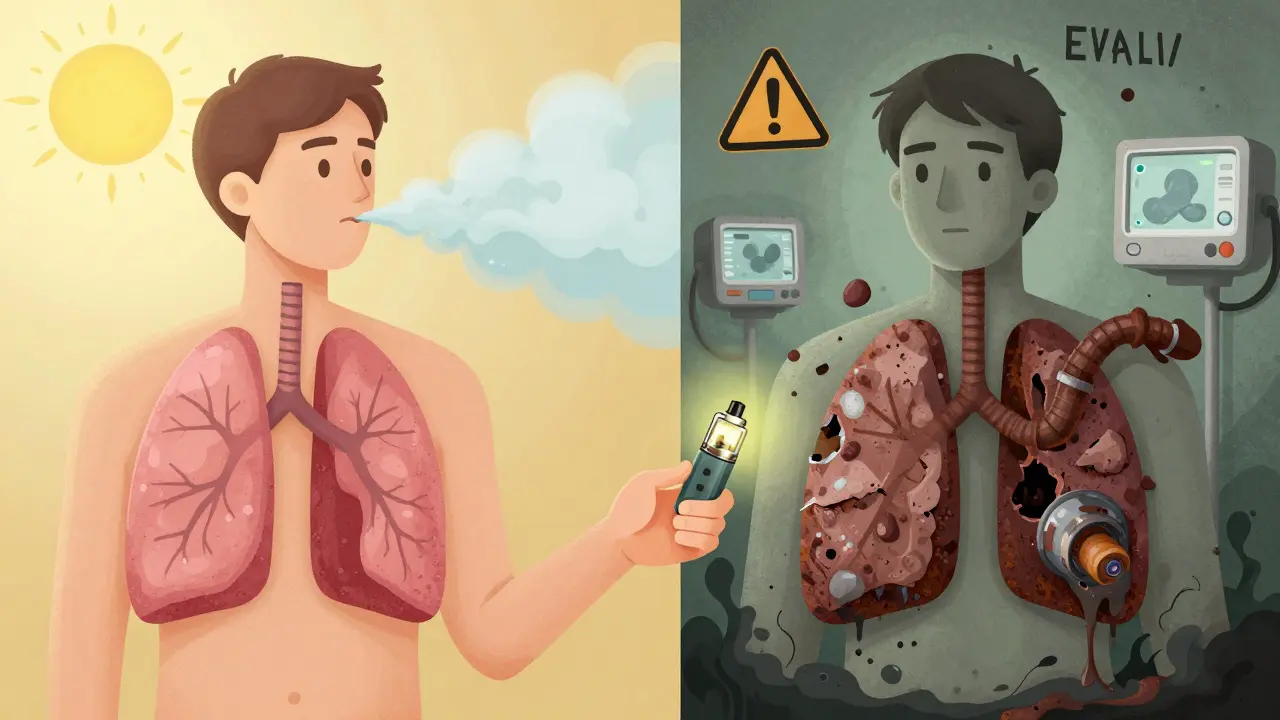
In 2019, the U.S. saw a sudden surge in severe lung injuries linked to vaping. Over 2,800 people were hospitalized. Nearly 70 died. The cause? Vitamin E acetate-a thickening agent used in black-market THC vaping cartridges. It wasn’t nicotine. It wasn’t the device. It was an unregulated additive that turned into a sticky, toxic goo when heated and inhaled.
EVALI-E-cigarette or Vaping Use-Associated Lung Injury-was a public health emergency. It showed how quickly unregulated substances could cause irreversible damage. Even though most EVALI cases were tied to illicit THC products, the outbreak exposed a bigger problem: the lack of oversight in the vaping industry. Today, many products still contain undisclosed chemicals. There’s no universal safety standard. You’re essentially guessing what’s in your vape.

Vaping and COPD: A Growing Risk
Chronic Obstructive Pulmonary Disease (COPD) used to be a smoker’s disease. Now, it’s showing up in people who’ve never lit a cigarette. A major NIH study pooled data from over 20 studies and found that current e-cigarette users had a 48% higher risk of developing COPD compared to non-users. That’s not a small increase. That’s a clear signal.
Traditional smoking still carries the highest risk-up to 10 times higher in some cases. But vaping isn’t a safe alternative. It’s a different path to the same destination: damaged lungs, narrowed airways, and permanent breathing problems. The evidence is consistent. The risk is real. And it’s growing.
What About Quitting Smoking With Vaping?
Many people turn to vaping to quit smoking. And yes, it’s true: vaping is less harmful than smoking traditional cigarettes. But that’s not the same as saying it’s safe. The American Lung Association and the U.S. Surgeon General both warn that vaping introduces its own set of risks. If you’re using e-cigarettes to quit smoking, you’re trading one set of dangers for another.
Doctors like Dr. NeSmith, cited in recent medical literature, say the best path forward isn’t switching-it’s quitting both. "No matter how you inhale nicotine-through smoke or vapor-you’re putting your lungs under stress," he says. Nicotine itself is addictive and raises blood pressure. But the real damage comes from the chemicals you breathe in every time you vape.
If you’re trying to quit smoking, proven methods like nicotine patches, gum, or counseling have a stronger track record and no known lung damage. Vaping should not be your first or only option.
Who’s Most at Risk?
Young people are the fastest-growing group of vapers. The National Academies found that teens who vape are more likely to develop coughing, wheezing, and asthma flare-ups. Many start with flavored vapes-mango, bubblegum, mint-and end up addicted to nicotine without ever intending to.
Adults with existing lung conditions like asthma or bronchitis are also at higher risk. Vaping can make symptoms worse and trigger more frequent attacks. Even people with no prior health issues aren’t immune. The damage builds slowly. You might not notice it until your lungs are already compromised.
And then there’s the long-term question: cancer. We don’t have 30 years of data yet, but early studies show vaping chemicals can alter lung cell behavior and cause chronic inflammation-two known pathways to cancer. It’s not proven, but it’s a warning sign we can’t ignore.
What Should You Do?
If you vape and have symptoms-coughing, shortness of breath, chest pain, frequent infections-see a pulmonary specialist. Don’t wait. These symptoms don’t always show up on routine X-rays. Specialized lung function tests are often needed.
If you vape but feel fine? Still talk to your doctor. The damage can be silent. Routine checkups can catch early signs of inflammation or reduced lung capacity before it becomes irreversible.
If you’re trying to quit vaping, know that withdrawal is real. Nicotine cravings, irritability, trouble sleeping-they’re normal. Support programs, behavioral therapy, and nicotine replacement therapies are proven to help. You don’t have to do it alone.
And if you’ve never vaped? Don’t start. The idea that it’s a "harmless" alternative is a myth. Your lungs are not designed to inhale heated chemicals. They’re built for clean air. Protect them.
The Bottom Line
Vaping isn’t a safe substitute for smoking. It’s not a harmless hobby. It’s a respiratory risk with real, documented consequences. The science is clear: vaping causes lung inflammation, weakens immune defenses, increases COPD risk, and can lead to serious injury-sometimes suddenly, as EVALI proved.
There’s no safe level of vaping. Even occasional use carries risk. The best way to protect your lungs is to avoid vaping altogether. If you’re already using it, quitting is the only way to stop the damage-and give your lungs a real chance to heal.




10 Comments
The aerosol from e-cigarettes contains ultrafine particulates that penetrate deep into alveolar sacs, triggering IL-8 and TNF-alpha upregulation. Studies show even short-term exposure induces oxidative stress via NADPH oxidase activation. Diacetyl analogs like acetoin and 2,3-pentanedione are still prevalent in unregulated markets-these are potent bronchiolar irritants. The heating coil leaching of nickel and chromium is dose-dependent on wattage. We’re not talking about "water vapor." We’re talking about a complex pyrolytic cocktail with no long-term safety data.
I’ve seen people vape for years and seem fine. Maybe it’s not as bad as they say? I don’t know. I just think we need more long-term studies before we panic. People change habits slowly, and fear doesn’t help.
THEY’RE HIDING THE TRUTH 🤫 Vaping is a Big Pharma plot to keep you hooked on nicotine while they sell you patches and gum. Vitamin E acetate? That was a cover-up. The real killer is the lithium-ion batteries exploding in your pocket and the 5G signals from the device frying your lung cells. 🧠💀 You think this is about health? Nah. It’s about control. Wake up.
I respect the science here. I’ve never vaped, but I know someone who did to quit cigarettes. They switched to nicotine gum after a year. It’s not perfect, but it’s better than breathing in unknown chemicals. I just hope people make informed choices, not ones based on trends.
Ugh, another anti-vape rant. My cousin vapes mango flavor and she’s 24 and runs marathons. Your lungs are fine unless you’re smoking crack or breathing factory fumes. Chill out.
My brother quit smoking after 15 years by switching to vaping. He still has a cough, but he’s breathing easier than he has in decades. I’m not saying it’s safe-but saying it’s just as bad as smoking ignores the harm reduction reality. The goal should be getting people off combustibles, not scaring them into inaction.
There is a critical error in your terminology. You repeatedly refer to "vaping" as if it is a monolithic activity. This is scientifically inaccurate. The risks vary drastically based on device type (pod-based vs. mod), nicotine concentration, e-liquid composition, and whether the product is regulated. Your conflation of illicit THC cartridges with nicotine-only devices is misleading and undermines your credibility.
I get that this is scary stuff. But if you’re someone who’s already vaping, don’t beat yourself up. The fact that you’re reading this means you care. Talk to your doctor. Try cutting back. Maybe switch to nicotine patches for a while. Healing isn’t all-or-nothing. Small steps count. You’re not alone in this.
It is an incontrovertible fact that the aerosolization of glycols under high thermal stress generates carbonyl compounds exceeding permissible exposure limits set by OSHA. The regulatory vacuum in the United States permits the sale of devices with unverified thermal profiles and unstandardized coil compositions. This constitutes a public health failure of monumental proportion. One must consider the cumulative burden on pulmonary alveolar macrophages, whose phagocytic capacity is demonstrably impaired in vitro at concentrations as low as 0.5 mg/m³.
So... vaping is bad. Got it. 😒 I mean, duh. My grandma smokes cigarettes and she’s 80 and still yelling at the TV. Maybe the real problem is we’re all just breathing dirty air anyway? 🤷♀️