
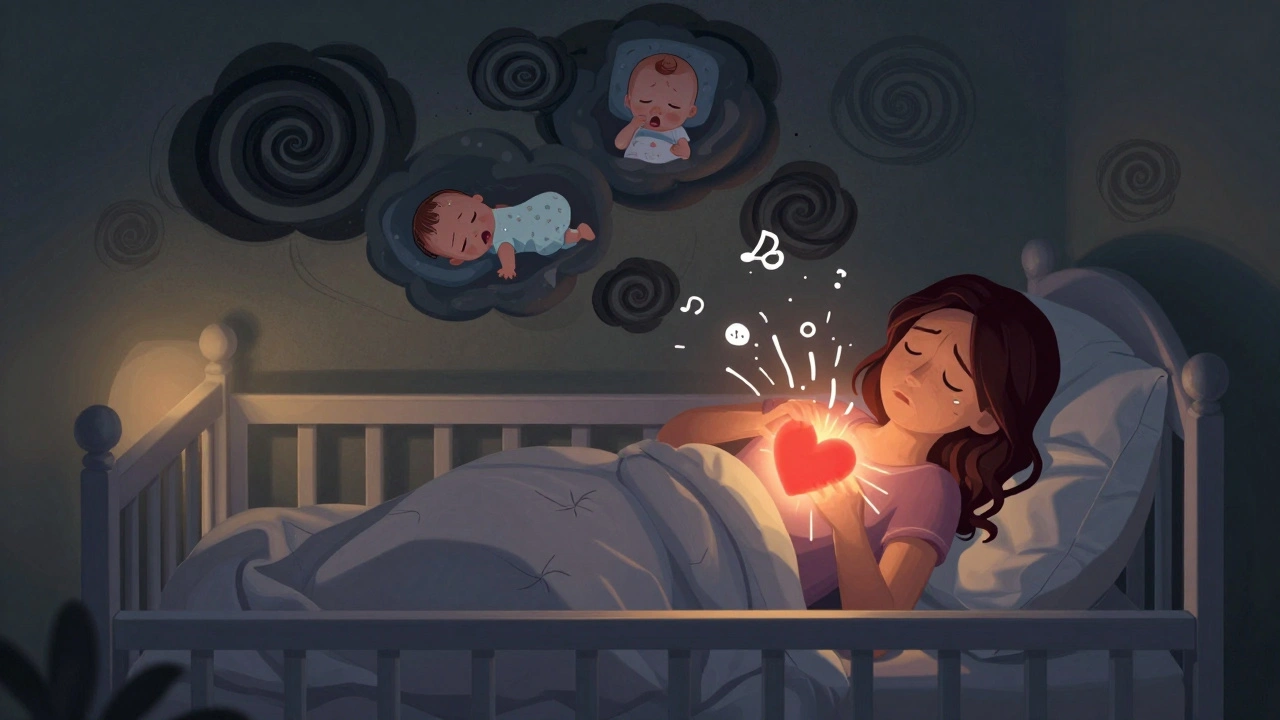
After giving birth, many women expect to feel tired, overwhelmed, or emotional. That’s normal. But what if the racing thoughts, panic attacks, and constant worry don’t fade after a few days? What if you’re lying awake at 3 a.m., heart pounding, convinced something terrible will happen to your baby-even when everything seems fine? That’s not just stress. That’s postpartum anxiety.
It’s not rare. One in five new mothers experiences it. Yet most don’t recognize it for what it is. They blame themselves. They think they’re just "not cut out for this." Some are told they’re being "too sensitive." The truth? Postpartum anxiety is a real, measurable condition-and it can be treated.
What Postpartum Anxiety Really Looks Like
Postpartum anxiety isn’t just being nervous about the baby. It’s a persistent, overwhelming sense of dread that lingers beyond two weeks. Unlike the baby blues-those fleeting mood swings that fade by day 14-this anxiety sticks around. It shows up as physical symptoms: racing heart, nausea, dizziness, loss of appetite. It shows up as mental spirals: intrusive thoughts about harm coming to the baby, even if you’d never act on them. It shows up as sleeplessness-even when the baby is sleeping.
According to clinical data from Texas Children’s Hospital (2022), 28-35% of women with postpartum anxiety have panic attacks. Over 60% report heart racing. Nearly half feel nauseous. And 39% lose their appetite entirely. These aren’t signs of weakness. They’re signs of a nervous system stuck in overdrive.
Many women also experience obsessive thoughts. A study in Women’s Mental Health (2021) found that 68% of those with postpartum anxiety had recurring, unwanted images of their baby getting hurt-things like falling, choking, or being left alone. These thoughts are terrifying, but they’re not a reflection of intent. They’re a symptom. The brain, under extreme stress, starts generating worst-case scenarios as a flawed way to "protect" the baby.
How It’s Different from Postpartum Depression
People often mix up postpartum anxiety and depression. They’re not the same, though they often show up together.
Depression looks like sadness, numbness, hopelessness. You might cry a lot, feel worthless, or lose interest in everything-even your baby. Anxiety looks like fear, tension, restlessness. You might be hyper-vigilant, checking the baby’s breathing every five minutes, or avoiding leaving the house because you’re terrified something bad will happen.
The numbers tell the story:
- 85% of postpartum anxiety cases are driven by excessive worry
- Only 31% of depression cases involve intrusive thoughts, compared to 68% in anxiety cases
- 76% of those with anxiety have physical symptoms; only 43% of those with depression do
And here’s the kicker: 47% of women with postpartum anxiety also have depression. That’s why screening tools need to catch both.
Screening: The Edinburgh Scale and Beyond
There’s no blood test. No MRI. Diagnosis is based entirely on how you feel-and how you describe it.
The most common tool is the Edinburgh Postnatal Depression Scale (EPDS). It’s not perfect. But it’s widely used. Women with no mental health issues average a score of 6.2. Those with depression-only score around 11.3. Those with anxiety-only? Around 9.8. And if you have both? You’re likely to score 14.7 or higher.
But here’s the problem: the EPDS was designed for depression. It misses anxiety. That’s why in 2023, it was updated to include a new anxiety subscale. In a study of 1,247 women, the revised version correctly identified anxiety in 89% of cases.
Another tool gaining traction is the GAD-7 (Generalized Anxiety Disorder-7). It’s shorter. More focused on worry and physical tension. It has 84% specificity for postpartum anxiety-meaning it’s less likely to falsely label normal stress as a disorder.
Still, screening isn’t universal. Only 67% of U.S. obstetric practices use any formal tool. And even when they do, 63% of anxiety cases are dismissed as "just new mom stress." That delay? On average, 11.3 weeks before proper help is offered.

What Causes It?
It’s not one thing. It’s a mix.
Women with a history of anxiety disorders are 3.2 times more likely to develop postpartum anxiety. Those who’ve had a pregnancy loss? 2.7 times more likely. A baby with medical complications at birth? 2.4 times more likely. And if you’ve had postpartum depression before? Your risk jumps to 3.8 times higher.
Hormones drop sharply after birth-estrogen, progesterone, cortisol. That sudden shift can trigger anxiety in vulnerable brains. Sleep deprivation doesn’t help. Neither does isolation, lack of support, or financial stress.
But here’s what matters most: it’s not your fault. You didn’t cause this. Your brain didn’t fail. It’s reacting to an overwhelming life change, and your nervous system is stuck in survival mode.
How It’s Treated: From Therapy to Medication
Treatment isn’t one-size-fits-all. It’s stepped, based on severity.
Mild cases (EPDS 10-12): Therapy and lifestyle changes. Daily 30-minute walks reduce anxiety scores by 28% in eight weeks. Yoga cuts symptoms by 33% in clinical trials. Mindfulness practices-just 10 minutes a day-can lower anxiety by 41% in two weeks.
Moderate cases (EPDS 13-14): Cognitive Behavioral Therapy (CBT). It’s the gold standard. Twelve to sixteen structured sessions help rewire catastrophic thinking. Studies show 57% of women see major improvement. But CBT alone isn’t enough if obsessive thoughts are strong.
Severe cases (EPDS 15+): Medication. SSRIs like sertraline are first-line. They’re not FDA-approved specifically for postpartum anxiety-but they’re the best-studied option. Sertraline has a 64% response rate by week 8. Only 0.3% of the dose passes into breastmilk. That’s considered safe for nursing babies.
And here’s something critical: if you have both anxiety and depression, combining CBT with an SSRI works better than either alone. CBT alone helps 34-41% of comorbid cases. Add the medication? That jumps to 62-68%.
There’s also new hope on the horizon. Brexanolone (Zulresso), approved for postpartum depression, is now in Phase III trials for anxiety. Early results show a 72% response rate in just 60 hours-far faster than SSRIs, which take weeks.

Barriers to Care-And How to Break Through
Despite how common it is, only 15% of women with postpartum anxiety get proper care. Why?
- Stigma. Many fear being labeled "crazy" or having their baby taken away.
- Access. Only 17% of rural hospitals offer specialized perinatal mental health services.
- Wait times. SSRIs take 4-6 weeks to work. During that time, women suffer.
- Cost. Even with improved insurance coverage (now 79% of cases), copays and therapy fees still block access.
One solution? Community support. Programs like The Women’s Place at Texas Children’s Pavilion for Women offer group sessions, medication management, and peer connection. Women in these programs are 58% more likely to stick with treatment.
Digital tools are helping too. The FDA-cleared app MoodMission uses CBT-based exercises. In a trial of 328 new mothers, it reduced anxiety by 53% in eight weeks. It’s not a replacement for therapy-but it’s a bridge when therapy isn’t available.
What You Can Do Right Now
If you’re struggling:
- Write down your thoughts. Don’t judge them. Just get them out.
- Reach out to someone you trust-even if it’s just to say, "I’m not okay."
- Ask your OB, midwife, or pediatrician for a screening. Say: "I think I might have postpartum anxiety. Can we check?"
- Start small: 10 minutes of walking, 5 minutes of breathing. You don’t need to fix everything today.
- Remember: this isn’t permanent. Treatment works. Recovery is possible.
If you’re a partner, family member, or friend: don’t say "just relax." Say: "I’m here. Let’s call your doctor together."
Postpartum anxiety doesn’t go away on its own. But with the right support, it doesn’t have to define your new life. You deserve to feel safe, calm, and present-with your baby, and with yourself.
Is postpartum anxiety the same as baby blues?
No. Baby blues are mild mood swings that start a few days after birth and fade within two weeks. Postpartum anxiety is more intense, lasts longer than two weeks, and includes physical symptoms like racing heart, panic attacks, and obsessive thoughts. It doesn’t go away on its own and often needs treatment.
Can I take medication while breastfeeding?
Yes. SSRIs like sertraline are considered safe for breastfeeding. Only about 0.3% of the maternal dose passes into breastmilk, which is well below levels shown to affect infants. Many doctors prefer sertraline because it’s been studied the most in nursing mothers. Always discuss options with your provider.
How do I know if I need therapy or medication?
Mild symptoms often respond well to therapy and lifestyle changes like walking or yoga. Moderate to severe symptoms-especially with intrusive thoughts or panic attacks-usually need medication in addition to therapy. A screening tool like the EPDS or GAD-7 can help your provider decide. If you’re not sleeping, eating, or feeling like yourself after three weeks, don’t wait-seek help.
Are intrusive thoughts a sign I’m a bad mom?
Absolutely not. Intrusive thoughts-like imagining your baby falling or choking-are common in postpartum anxiety. They’re not desires. They’re fears. In fact, the fact that you’re horrified by them means you care deeply. These thoughts are a symptom of anxiety, not a reflection of your character or parenting ability.
How long does treatment take to work?
Therapy like CBT usually shows improvement in 6-12 weeks. Medication like SSRIs take 4-6 weeks to reach full effect. But some strategies, like daily mindfulness or walking, can reduce symptoms in as little as two weeks. Recovery isn’t linear, but most women see real progress within three months with consistent care.
Is postpartum anxiety rare?
No. It affects about 1 in 5 new mothers-more than postpartum hemorrhage or infection. It’s the most common postpartum mental health issue. But because it’s often misunderstood, many women suffer in silence. You’re not alone.
Can postpartum anxiety affect my baby?
Untreated, yes. Chronic anxiety can make it harder to bond with your baby, respond to their cues, or feel present. Studies show this can impact early emotional development. But when treated, mothers regain their ability to connect-and babies thrive. Early help protects both of you.
Where can I find help?
Start with your OB, midwife, or pediatrician. Ask for a mental health screening. Many hospitals now offer perinatal mental health programs. Online resources like Postpartum Support International (PSI) provide free support groups and provider directories. Apps like MoodMission offer CBT tools you can use at home. You don’t have to figure this out alone.



10 Comments
Let’s be real-this article reads like a pharmaceutical ad disguised as clinical guidance. SSRIs are not a cure, they’re a chemical bandage. You’re telling women to medicate their way out of a systemic failure? Where’s the outrage about the lack of paid parental leave, childcare access, or social support? This isn’t mental illness-it’s capitalism with postpartum symptoms.
THIS. So many of us are suffering in silence because we’ve been told to ‘just breathe’ or ‘it’s normal.’ But it’s not normal to feel like your heart is going to explode every time the baby stirs. I started walking 10 minutes a day after my second kid and it didn’t fix everything-but it gave me back 1% of my sanity. You don’t need to be fixed. You just need to be seen. And you are. You’re not alone.
Stop romanticizing therapy. CBT is useless if you’re sleep-deprived and your partner works 80 hours a week. Numbers don’t care about your 10-minute mindfulness routine. Real help means money, time, and people who show up-not apps and pamphlets.
Good breakdown on the EPDS vs GAD-7 distinction. I’ve seen too many OBs skip the anxiety subscale because ‘she’s not crying.’ But the mom who’s checking the baby’s chest for 20 minutes straight? That’s the one who needs the screen. Also-sertraline’s 0.3% breastmilk transfer is solid. I’ve had patients on it for 18 months with zero infant issues. Data > fear.
As someone who’s been through it, I’d add one thing: the moment I stopped trying to ‘fix’ my anxiety and started naming it-‘oh, that’s the anxiety talking’-it lost some power. It didn’t disappear, but it stopped being my identity. Also, the yoga thing? It’s not magic, but the breathwork? Game changer. Not because it’s trendy. Because it forces your nervous system to recalibrate. Worth trying even if you hate yoga.
Let’s not overlook the neurobiological cascade: cortisol drop + oxytocin dysregulation + sleep fragmentation + sensory overload = perfect storm. The brain’s threat detection system goes haywire because it’s been running on emergency protocols for 9+ months. SSRIs aren’t just ‘antidepressants’-they’re neuroplasticity modulators. They help reset the amygdala’s hyperarousal loop. That’s why combo therapy (CBT + SSRI) works better-it targets both top-down cognition and bottom-up physiology. We’re not just treating mood-we’re recalibrating autonomic function.
Interesting how this article cites Texas Children’s and Women’s Mental Health journals like they’re gospel, but ignores the fact that the EPDS was developed in 1987 using a sample of 100 women in Edinburgh-none of whom were BIPOC, none were LGBTQ+, and none were on Medicaid. The entire diagnostic framework is rooted in white, middle-class, heteronormative norms. Meanwhile, the GAD-7? Developed by a pharma-funded panel. Who’s really benefiting from this ‘evidence-based’ model? The clinics? The drug companies? Or the mothers? And why is Brexanolone’s 72% response rate in Phase III being hyped when the cost is $34,000 and it requires 60 hours of IV infusion in a hospital? This isn’t care-it’s a luxury product disguised as medicine.
Also, who wrote this? A doctor? A mom? Or a PR rep for a mental health conglomerate? Because the tone is so… sanitized. Like they’re afraid to say the real truth: our society doesn’t care enough to make motherhood sustainable, so we’re medicating the symptoms instead of fixing the system.
1 in 5? That’s a fabricated statistic. I’ve worked in perinatal care for 14 years. Most women who say they have ‘postpartum anxiety’ are just overwhelmed, sleep-deprived, and haven’t learned to say no. You’re pathologizing normal human exhaustion. And now we’re telling them to take SSRIs? What’s next? Prozac for new dads who hate diaper duty? Wake up. This isn’t a medical crisis-it’s a cultural one. And you’re selling fear to make it look like a diagnosis.
Life is suffering. Motherhood amplifies it. The mind creates monsters to avoid the void. Medication silences the noise. But the void remains.
Thank you for writing this. I’m a dad. My wife went through this. I didn’t understand until she cried for 45 minutes because the baby sneezed. I thought she was being dramatic. Then I read the GAD-7 and scored her-17. We got help. She’s better now. Not cured. But present. I wish someone had told me earlier: it’s not about fixing her. It’s about holding space. And sometimes, that means sitting quietly while she breathes. No advice. Just presence. You’re not alone.