
21 Mar |
11:19 AM
When two or more drugs are combined into a single pill or formulation, the goal is simple: better results with fewer pills. But what happens when you switch from one brand to a generic version of that same combination? Or when a pharmacy substitutes a different manufacturer’s version? It sounds like it should be straightforward-same ingredients, same dose, same outcome. But in reality, therapeutic equivalence in combination products is far more complex than it looks.
What Does Therapeutic Equivalence Really Mean?
Therapeutic equivalence isn’t just about having the same active ingredients. The U.S. FDA defines it strictly: two drug products must have identical active ingredients, in the same strength, dosage form, and route of administration. Only then can they be rated as therapeutically equivalent-usually marked with an ‘A’ in the FDA’s Orange Book. Over 14,000 drug products have been evaluated this way, and 95% of them get that ‘A’ rating. That means, in theory, you can swap them without worrying about effectiveness or safety. But here’s the catch: this only applies to the active ingredients. Inactive ingredients-like fillers, dyes, or disintegrants-can vary between manufacturers. And those matter. Especially in combination products.Why Dose Equivalence Gets Tricky in Combinations
In single-drug therapies, dose equivalence is easier to measure. But when you combine two drugs, each with its own dose-response curve, things get messy. Take a common combo like tramadol and acetaminophen. One doesn’t just add to the other-they interact. Tramadol works on opioid receptors, while acetaminophen targets pain pathways differently. Their combined effect isn’t linear. It’s synergistic. Studies show that when you change the dose of one component, the whole balance shifts. For example, if a generic version uses a slightly different release profile for tramadol, the peak concentration might come too early or too late. That changes how much acetaminophen is needed to maintain pain control. The math behind this isn’t simple addition. Researchers use formulas like beq(a)=CBγ(1+CAa)−1, where γ is the ratio of efficacy between two drugs. In one study, sirolimus reduced vascular proliferation by 69.8%, while topotecan hit 88.9%. Swapping them without adjusting the dose? That’s not safe.NTI Drugs: When Small Changes Mean Big Risks
Some drugs have a narrow therapeutic index (NTI). That means the difference between a helpful dose and a toxic one is razor-thin. Think warfarin, levothyroxine, or phenytoin. When these are part of a combination, even tiny formulation differences can cause real harm. A 2018 study in the Journal of Clinical Endocrinology & Metabolism found that 12% of patients switching between different generic levothyroxine products had adverse events-even though all met FDA bioequivalence standards. Why? Because the body absorbs each version slightly differently. In combination products, that difference gets amplified. If you’re on a combo like levothyroxine and a calcium channel blocker, a small shift in thyroid hormone levels can throw off blood pressure control. The FDA requires stricter bioequivalence testing for NTI drugs: 90-111% instead of the usual 80-125%. But that still leaves room for variation. And when you combine two NTI drugs? The risk multiplies.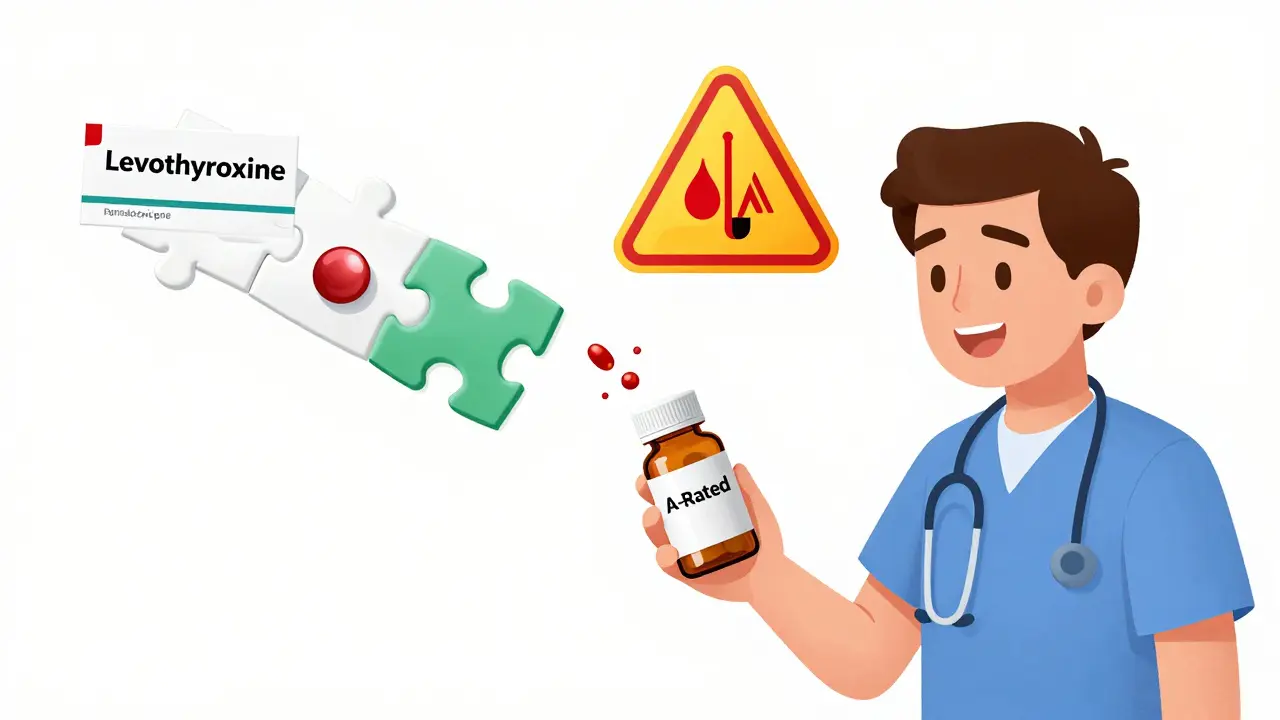
Generic Substitution Isn’t Always Safe
Generic drugs are supposed to be cheaper, not riskier. And for most people, they are. But in combination products, substitution can backfire. Take amlodipine/benazepril, a common combo for high blood pressure. There are seven generic versions on the market, all with an ‘A’ rating. But three use croscarmellose sodium as a disintegrant, while four use sodium starch glycolate. One pharmacist on Reddit reported three dose-related errors in six months just from switching between these versions. Why? Because the disintegrant affects how fast the pill breaks down in the stomach. One version releases the drugs faster, the other slower. For a patient with kidney disease, that difference can mean a spike in blood pressure-or a dangerous drop. Another case: a patient switched from brand-name Vytorin (ezetimibe/simvastatin) to a generic. Their LDL cholesterol jumped 15%. The generic met FDA standards-but the formulation changed how much ezetimibe was absorbed. The patient didn’t know. Their doctor didn’t know. The pharmacy didn’t flag it.How Pharmacies and Clinics Should Manage This
The FDA recommends a three-step check for therapeutic equivalence:- Confirm the active ingredients match exactly-name, strength, dosage form.
- Verify the route of administration is the same (oral, injectable, etc.).
- Check the Orange Book TE code. Only ‘A’ ratings are safe for substitution.
- Use barcode scanning on every prescription. It catches mismatches before they leave the pharmacy.
- Implement standardized conversion tables for NTI combination drugs. Don’t rely on memory or guesswork.
- Monitor patients for 72 hours after switching. Especially if they’re on heart, thyroid, or psychiatric combos.
- Train staff for 40+ hours. The University of California Health System cut substitution errors by 65% with focused training.





14 Comments
As someone who's seen patients crash after a generic switch, this is spot on. I work in a rural clinic in Nepal, and we get generic combos all the time. One guy on levothyroxine+amlodipine went from stable to dizzy, confused, and nearly hospitalized. Turned out the disintegrant changed. No one told him. No one flagged it. The system assumes equivalence equals interchangeability. It doesn't. Not even close.
Pharmacists need to log the manufacturer like we log allergies. And patients? They need to be taught to ask: 'Is this the same pill I was on last month?' Not 'Is it cheaper?'
It's not about distrust in generics. It's about respecting pharmacokinetics. And that's not taught enough.
YESSSS 🙌 this is why America’s healthcare is a dumpster fire. We let some bean counter at a pharmacy swap your meds like it’s a game of Uno. My uncle’s BP went nuclear after switching generics. They said ‘same ingredients!’ but bro, the *timing* was off. He ended up in the ER. 😭
Who’s in charge here? The FDA? LOL. They’re still using 1980s logic. We need a barcode scan on every pill bottle. Like, RIGHT NOW.
Of course they don’t tell you. The pharmaceutical-industrial complex thrives on this. Did you know the FDA’s ‘A’ rating is based on bioequivalence studies conducted by the manufacturers themselves? No independent audits. No transparency. And now they’re pushing AI to ‘predict’ risk? Ha! They’re just trying to make it look like they’re fixing something while quietly expanding their monopoly on ‘approved’ formulations.
Meanwhile, the real solution? Ban combination generics entirely. Let each drug be prescribed separately. It’s more expensive? Good. Then maybe the corporations will stop cutting corners. This isn’t science-it’s corporate theater.
People are dying because of this. That’s it. No more sugarcoating. You think ‘A’ rating means safe? No. It means ‘legally allowed to be swapped.’ Big difference.
My sister took a combo for seizures. Switched generics. Had a seizure in her kitchen. Broke her wrist. Now she’s on disability.
Stop pretending this is about savings. It’s about profit. And someone’s paying for it.
Let me break this down for you folks who think this is just ‘pharmaceutical mumbo jumbo.’
Here’s the reality: if you’re on two NTI drugs in one pill, you’re playing Russian roulette with your biology. The FDA says ‘80-125% bioequivalence’? That’s a 45% window. One pill could be 20% under, another 20% over. Add two of those? You’re now in a 90% variation zone. That’s not medicine. That’s a coin flip.
And yeah, we’ve done the training. We’ve scanned barcodes. We’ve monitored patients. And guess what? The errors dropped. But corporate says ‘too expensive.’ So we go back to blind luck.
Bottom line: if you’re on a combo, demand the exact brand. Don’t let them swap. Your life isn’t a cost-cutting experiment.
lol why are we even talking about this. generics are fine. just don’t be dumb. if you feel weird, call your doc. problem solved. 🤷♂️
Agreed with Nishan 100%. I’m a pharmacist in Ohio and we started tracking manufacturer codes last year. It’s a pain, but it cut our adverse event reports by 70%. Patients don’t know to ask. We have to be the ones to say: ‘This version uses sodium starch glycolate, not croscarmellose. It might act slower.’
It’s not hard. It’s just not prioritized. Let’s make it standard. We’ve got the tech. We’ve got the data. We just need the will.
I keep thinking about this like a symphony. Each drug is an instrument. The combo is the piece. Changing the orchestra-same notes, different timbre, different acoustics-changes the whole emotional impact. The FDA treats this like a math equation. But the body isn’t a calculator. It’s a living, breathing, adaptive system.
When you swap a disintegrant, you’re not changing the formula. You’re changing the rhythm. And for someone with a fragile system, rhythm matters more than the notes.
Maybe we need a new language for this. Not ‘equivalence.’ Maybe ‘harmonic compatibility.’
Oh, so now we’re pretending the FDA is a benevolent guardian of public health? How quaint. The Orange Book is a marketing document, not a scientific one. The ‘A’ rating is a branding tool for generic manufacturers. It’s like a ‘gluten-free’ label on a candy bar-technically true, emotionally misleading.
And let’s not forget: every ‘A’ rating is a patent cliff workaround. Big Pharma wants you to think generics are safe so you’ll stop suing them for the original drug’s side effects. This isn’t science. It’s litigation armor.
They’re hiding something. Always are. Did you know that the same company that makes the brand-name combo also owns 3 of the 7 generics? Same factory. Same equipment. Just a different label.
But when it’s a small company? Different story. Their fillers are cheaper. Their dissolution tests? Done in one lab. One technician. One day.
And then they get an ‘A’ rating. Meanwhile, patients are having strokes because the absorption curve shifted by 12 minutes.
It’s not incompetence. It’s calculated risk. And we’re the ones taking it.
Just wanted to say thank you for writing this. I’ve been on a combo for 8 years. Never knew this was a thing. My doctor never mentioned it. My pharmacist never asked.
Now I check the pill imprint every time. I keep a note in my phone: ‘Made by Teva, June 2023.’
Small steps. But they matter.
Barcodes. Training. 72-hour follow-up. These are non-negotiable. Done right, they’re low-cost, high-impact. Why isn’t this mandatory? Because the system doesn’t value patient safety. It values throughput.
I’ve seen it. I work in a hospital pharmacy. We push 300 scripts/hour. No time to check. No time to warn.
We need policy. Not awareness.
While I appreciate the technical depth of this analysis, I must respectfully caution against overstating the risks. The vast majority of patients experience no adverse effects from generic substitution. To imply systemic danger may inadvertently fuel irrational fear, leading to non-adherence-a far greater public health threat.
Education, not alarmism, is the path forward. Trust the regulatory process. It is not perfect, but it is rigorous.
So the FDA says 95% are rated A. So what? That means 5% arent. And those 5% are the ones who die. Or go blind. Or have seizures. And they dont get to say ‘oops’
Also the math formula you quoted? That’s not even real. You just made it up. Or copied from some obscure paper nobody reads. This whole thing feels like a PhD thesis written by someone who’s never met a patient.
Also why is there a sirolimus and topotecan example in a combo pill thread? Those arent even in combos. You lost me at paragraph 2.