
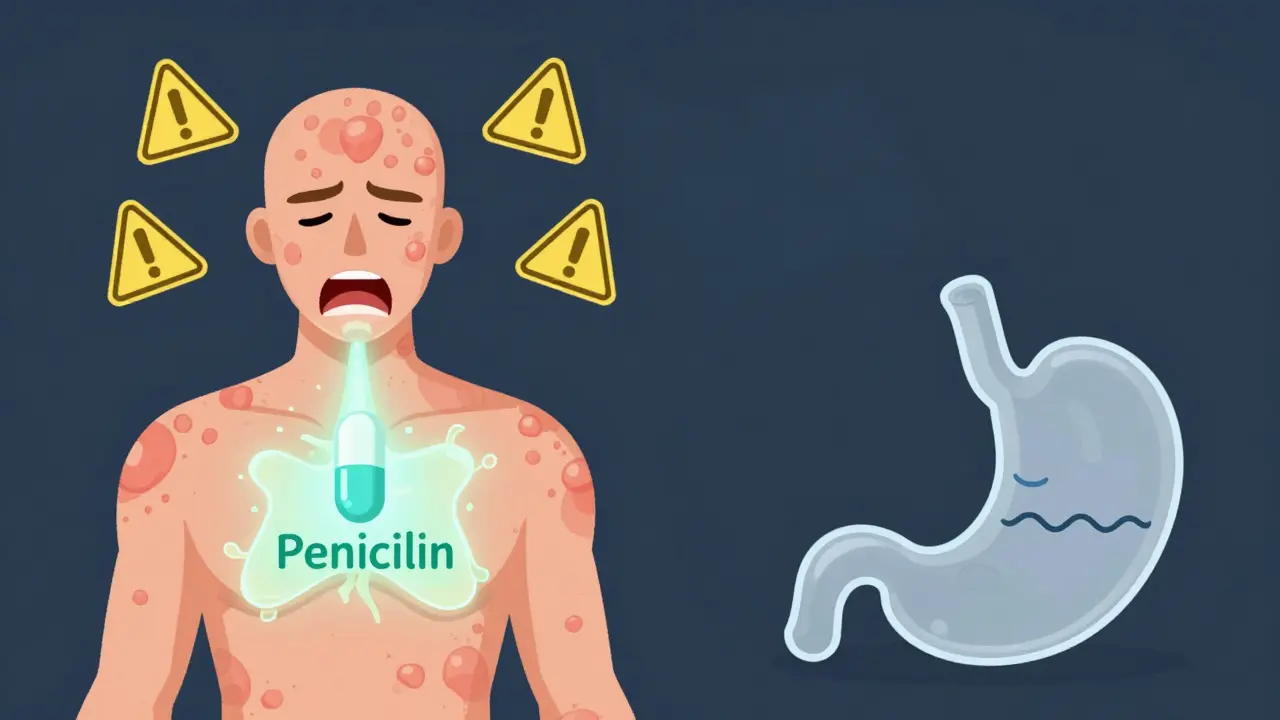
You take a new medication. A few hours later, your skin itches. Or you feel nauseous. Or you break out in a rash. Your first thought? Drug allergy. But what if it’s not? What if it’s just a side effect - something common, expected, and often harmless? Mixing up these two things isn’t just confusing - it can put your health at risk.
What’s Really Happening in Your Body?
A drug allergy means your immune system thinks the medicine is an invader. It reacts like it’s fighting off a virus - releasing chemicals like histamine that cause swelling, hives, trouble breathing, or even anaphylaxis. This isn’t about the drug’s chemistry. It’s about your body’s mistaken alarm system.
Side effects are different. They’re built into the drug’s design. Take statins, for example. They lower cholesterol by blocking an enzyme in your liver. But that same enzyme is also involved in muscle function. So, about 5-10% of people get muscle aches. It’s not an immune response. It’s a direct effect of how the drug works.
The numbers tell the story: only 5-10% of all bad reactions to meds are true allergies. The other 90-95%? Side effects, intolerances, or unrelated issues. Yet, nearly 10% of Americans say they have a drug allergy - and 9 out of 10 of those people turn out to be wrong when tested.
Timing Tells the Truth
When did the reaction happen? That’s your first clue.
If you took penicillin and broke out in hives within 30 minutes - that’s a red flag for allergy. IgE antibodies kicked in fast. Anaphylaxis? Usually under an hour. These reactions can be life-threatening and need immediate care.
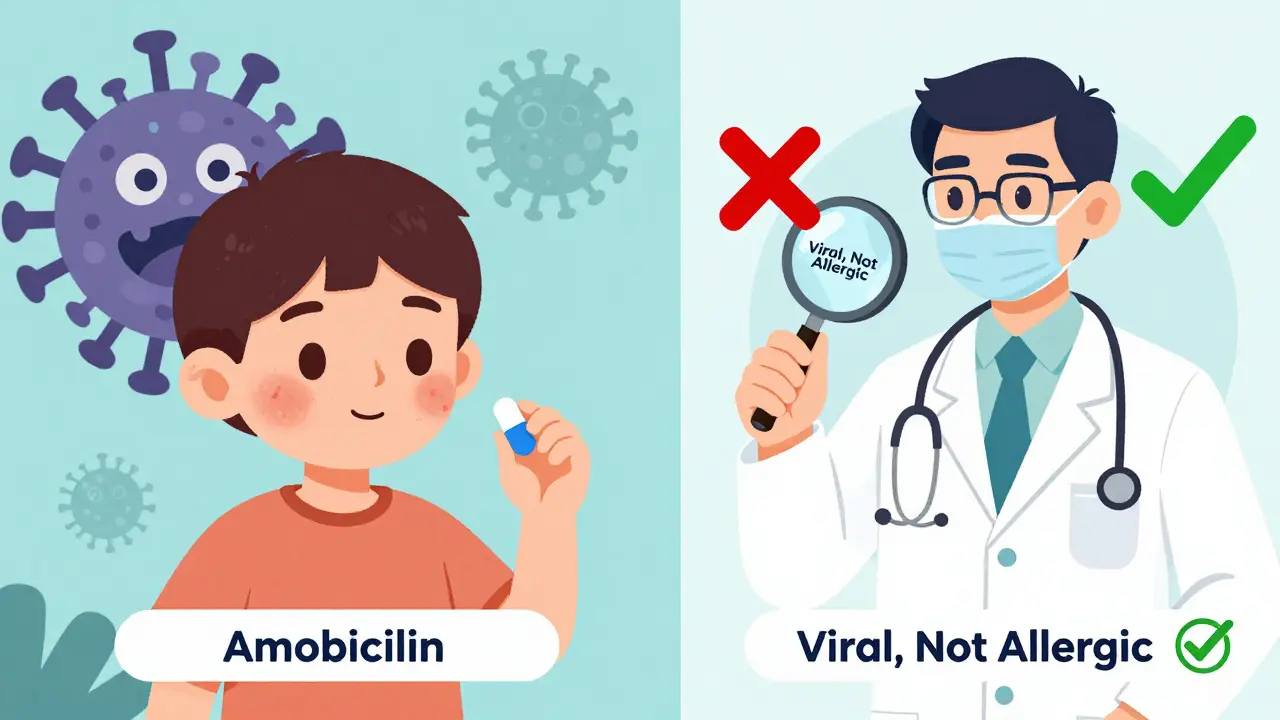
Now, if you started amoxicillin for an ear infection and got a rash on day five? That’s often not an allergy. Especially if you had a virus at the same time. Up to 90% of rashes in kids on amoxicillin with a cold are mislabeled as allergies. The virus caused the rash. The antibiotic didn’t.
Side effects? They usually show up early - within the first few days - and often get better as your body adjusts. Nausea from antibiotics? Common. Diarrhea from metformin? Happens in up to 30% of people. But if you keep taking it, those symptoms often fade.
What Symptoms Are You Actually Seeing?
Not all reactions are created equal. Here’s how to spot the difference:
- True allergy symptoms: Hives, swelling of lips or throat, wheezing, low blood pressure, anaphylaxis. These are immune-driven and can get worse with each exposure.
- Common side effects: Nausea, dizziness, dry mouth, mild rash, muscle aches, increased urination. These are predictable, dose-related, and often tolerable.
Some reactions are sneaky. DRESS syndrome - a rare but deadly immune reaction - shows up 2-8 weeks after starting a drug. It includes fever, swollen lymph nodes, liver problems, and a widespread rash with high eosinophil counts. This isn’t a side effect. It’s a true allergic reaction - just delayed.
On the flip side, ibuprofen causing kidney trouble in someone who’s dehydrated? That’s not an allergy. It’s a pharmacological consequence of how the drug affects blood flow to the kidneys. But if you call it an allergy, you might miss the real problem: not drinking enough water.
Why Getting It Wrong Costs You - and the System
Labeling a side effect as an allergy doesn’t just confuse you. It changes your treatment forever.
If you’re labeled penicillin-allergic - even incorrectly - doctors avoid the best, cheapest, most targeted antibiotics. Instead, they reach for vancomycin or clindamycin. That’s a problem. People with mislabeled penicillin allergies are 2.5 times more likely to get a C. diff infection - a dangerous gut bug that’s harder to treat and more expensive to manage.
And the cost? Patients with a false penicillin allergy label spend an extra $1,025 per hospital stay. In the U.S. alone, that adds up to over $1 billion a year. That’s not just money. It’s unnecessary risk.
Meanwhile, you might be avoiding effective pain relief because you think you’re allergic to ibuprofen. Or skipping the best UTI treatment because you were told you’re allergic to sulfa - when your real reaction was just a stomach ache.
How to Know for Sure
Don’t guess. Get tested.
For penicillin and some other beta-lactam antibiotics, skin testing is the gold standard. A tiny amount of the drug is placed under your skin. If there’s no reaction after 15-20 minutes, you’re likely not allergic. The test is 97-99% accurate at ruling out allergy.
For other drugs, a supervised oral challenge might be done. You take a tiny dose - maybe 1% of the full amount - and are monitored. If nothing happens, you’re cleared. Over 85% of people labeled as penicillin-allergic pass this test.
But here’s the catch: most doctors don’t do this. Only 42% of primary care providers correctly identify true allergies vs. side effects. That’s why pharmacist-led allergy review programs are growing fast. In the VA system, they cut inappropriate penicillin avoidance by 80%.
And if you’re not sure? Write it down. Not just “allergic to penicillin.” Write: “Rash on day 4 of amoxicillin, no swelling or breathing trouble, resolved after stopping.” That detail changes everything.
What You Can Do Today
You don’t need to wait for a specialist. Start with these steps:
- Look at your allergy list. For each one, ask: What actually happened? Was it itching? Nausea? A rash? When? Did you have a cold or flu at the time?
- Don’t say “I’m allergic to everything.” Be specific. “I got a rash with amoxicillin” is better than “I’m allergic to antibiotics.”
- Ask your doctor: “Could this have been a side effect? Could I be tested?”
- If you’ve been told you’re allergic to penicillin, ask if you’ve ever been tested. If not, you might be unnecessarily avoiding the best antibiotic for your next infection.
And if you’re a parent? Don’t let your child’s rash from an antibiotic become a lifelong label. Viral rashes are common. Allergies are rare.
What’s Changing in 2025
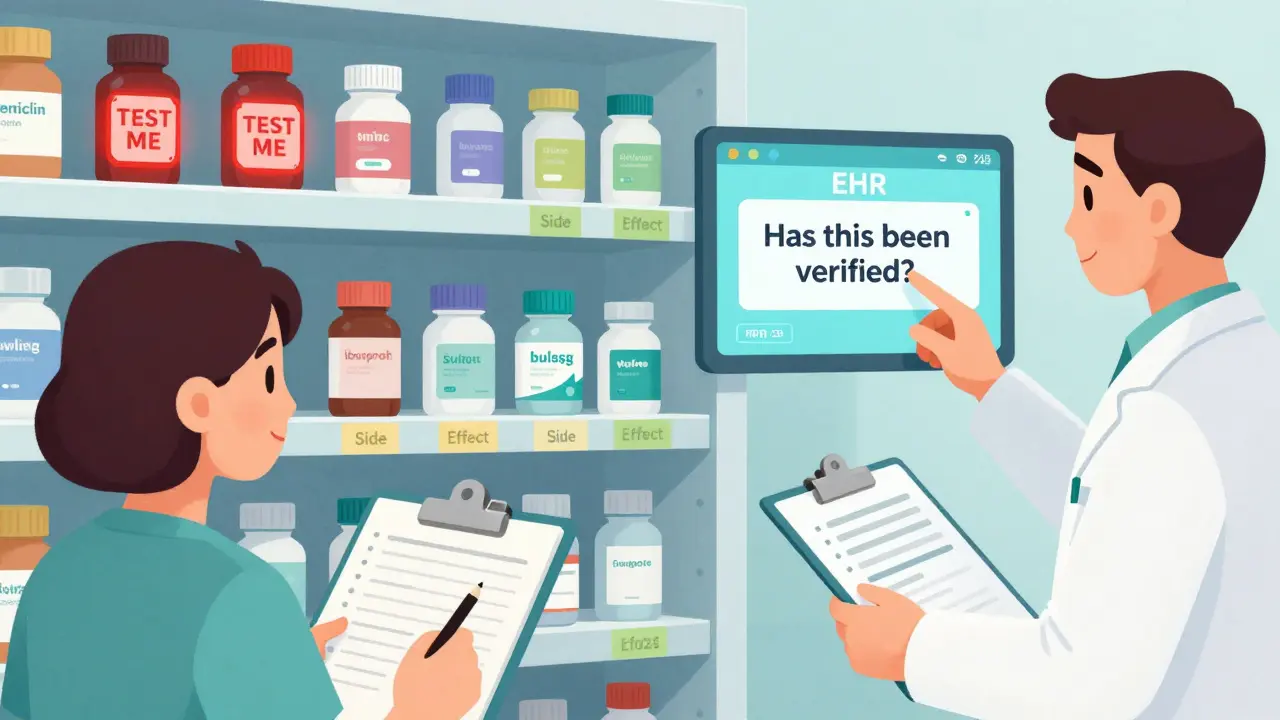
Hospitals are finally catching up. By 2025, 75% of U.S. hospitals will have EHR systems that pop up alerts when a doctor prescribes a broad-spectrum antibiotic to someone with a penicillin allergy. The system will ask: “Has this been verified?”
Drug labels now include clear “Allergy vs. Side Effect” guides. The FDA requires it. And research is moving fast. Scientists are looking for blood markers that can tell the difference without skin tests - something that could be available within the next few years.
But the biggest change? Awareness. More people are asking questions. More pharmacists are stepping in. More patients are getting tested - and finding out they can safely take the drugs they were told to avoid.
One woman in Adelaide told her doctor she was allergic to penicillin because she got a rash as a kid. She was 58. She’d spent decades on less effective antibiotics. After a simple skin test, she was cleared. Her next infection? Treated with penicillin. Cost? Half of what it would’ve been. Recovery? Faster. No extra risks.
That’s the power of knowing the difference.
When to Worry - And When to Relax
Here’s the bottom line:
- If you had trouble breathing, swelling, or passed out after a drug - get it checked. That’s likely a real allergy.
- If you got a mild rash, nausea, or dizziness - it’s probably not. But still, write it down and talk to your doctor.
- If you’ve been told you’re allergic to penicillin, sulfa, or any common antibiotic - ask about testing. You might be safe to take it.
- Never stop a medication because you think it’s an allergy - unless you’re having a life-threatening reaction. Call your doctor first.
Medications save lives. But only if you’re taking the right ones. And you can’t know what’s right if you don’t know what you’re reacting to.
Can a drug allergy go away over time?
Yes, many do. Up to 80% of people who had a penicillin allergy as a child lose it within 10 years - even without treatment. That’s why testing later in life is so important. Just because you reacted once doesn’t mean you always will.
Is a rash always a sign of allergy?
No. Many rashes from antibiotics are caused by viruses, not the drug. Especially in kids, a rash that appears after a few days of taking amoxicillin while having a cold is almost always viral - not allergic. Still, any rash should be checked by a doctor to be sure.
Can I be allergic to a drug I’ve taken before without problems?
Yes. Allergies can develop after repeated exposure. Your immune system doesn’t react the first time - it learns. Then, on a later dose, it overreacts. That’s why you can suddenly have a reaction to a drug you’ve taken safely for years.
Are over-the-counter drugs like ibuprofen safer than prescriptions?
No. OTC drugs can cause serious side effects - and true allergies too. Ibuprofen can trigger asthma in some people, and a rare but dangerous allergic reaction called anaphylaxis is possible. Just because it’s available without a prescription doesn’t mean it’s risk-free.
What should I do if I think I had a drug allergy?
Write down exactly what happened: what drug, when you took it, what symptoms you had, how long they lasted, and if you needed treatment. Then talk to your doctor or an allergist. Don’t just add it to your list as “allergic.” Get it properly evaluated - especially if it’s a common antibiotic or painkiller you might need again.
Next Steps
If you’ve been told you have a drug allergy - and you’re not sure - schedule a review. Ask your GP for a referral to an allergy specialist. If you’re in Australia, many public hospitals offer free allergy assessment clinics.
If you’re a caregiver or parent, don’t assume your child’s rash means they’re allergic. Ask: “Could this be the virus?”
If you’re a healthcare provider: use structured documentation. Don’t write “allergic to penicillin.” Write: “Hives 30 minutes after amoxicillin, resolved with antihistamines.” That level of detail saves lives.
The goal isn’t to fear medications. It’s to use them wisely. And that starts with knowing the difference between a true allergy - and just a side effect.



8 Comments
I used to think I was allergic to penicillin because I got a rash as a kid. Turns out it was just a virus. Got tested last year and now I can take the good stuff without worrying. So glad I didn’t just accept that label.
Okay but have you ever heard that the pharmaceutical companies? They *want* you to think you’re allergic so they can sell you the more expensive drugs?? Like, why do you think they don’t want you to get tested?? It’s all about profit, baby. They’re hiding the truth!!
Wait so you’re telling me the government and big pharma are lying about allergies?? I knew it! My cousin got sick after a shot and now they won’t let her get any vaccines. They’re poisoning us with antibiotics on purpose. I read it on a blog. It’s not a side effect-it’s a cover-up.
Big Pharma’s got a whole puppet show going on-antibiotics as bait, misdiagnoses as the hook, and your next hospital bill as the payday. They don’t care if you get C. diff-they care if you keep buying their overpriced ‘safe’ alternatives. It’s not medicine. It’s a money machine.
This is such an important topic. So many people live with unnecessary restrictions because they never got tested. Knowledge really is power-and safety. Thank you for sharing this.
It’s fascinating how deeply our language shapes our biology. We say ‘I’m allergic to penicillin’ like it’s a fixed identity, but allergies aren’t tattoos-they’re temporary misfires in a dynamic immune system. The fact that 80% of childhood penicillin allergies fade by adulthood suggests our bodies aren’t broken-they’re just learning. And yet we treat them like permanent verdicts. We’ve turned medical uncertainty into social dogma. We need to stop labeling people and start listening to their stories, their timelines, their symptoms-not just their labels. Maybe the real allergy isn’t to the drug… it’s to nuance.
Man, I used to think ibuprofen gave me stomach issues-turns out I was dehydrated and taking it on an empty stomach. Now I drink water first and boom-no more ‘allergy’. This whole thing is a wake-up call. Stop assuming. Start asking. And please, for the love of science, stop calling every rash an allergy.
MY SON GOT A RASH AFTER AMOXICILLIN AND NOW HE’S LABELED ‘ALLERGIC’ FOR LIFE-BUT IT WAS A VIRUS!!! I’M FURIOUS. NO ONE TOLD ME TO WRITE DOWN THE DETAILS. NO ONE ASKED IF HE HAD A COLD. NOW HE CAN’T TAKE THE BEST ANTIBIOTIC FOR HIS NEXT INFECTION. THIS ISN’T JUST A MISTAKE-IT’S A TRAGEDY. I’M TAKING THIS TO THE MEDIA.