
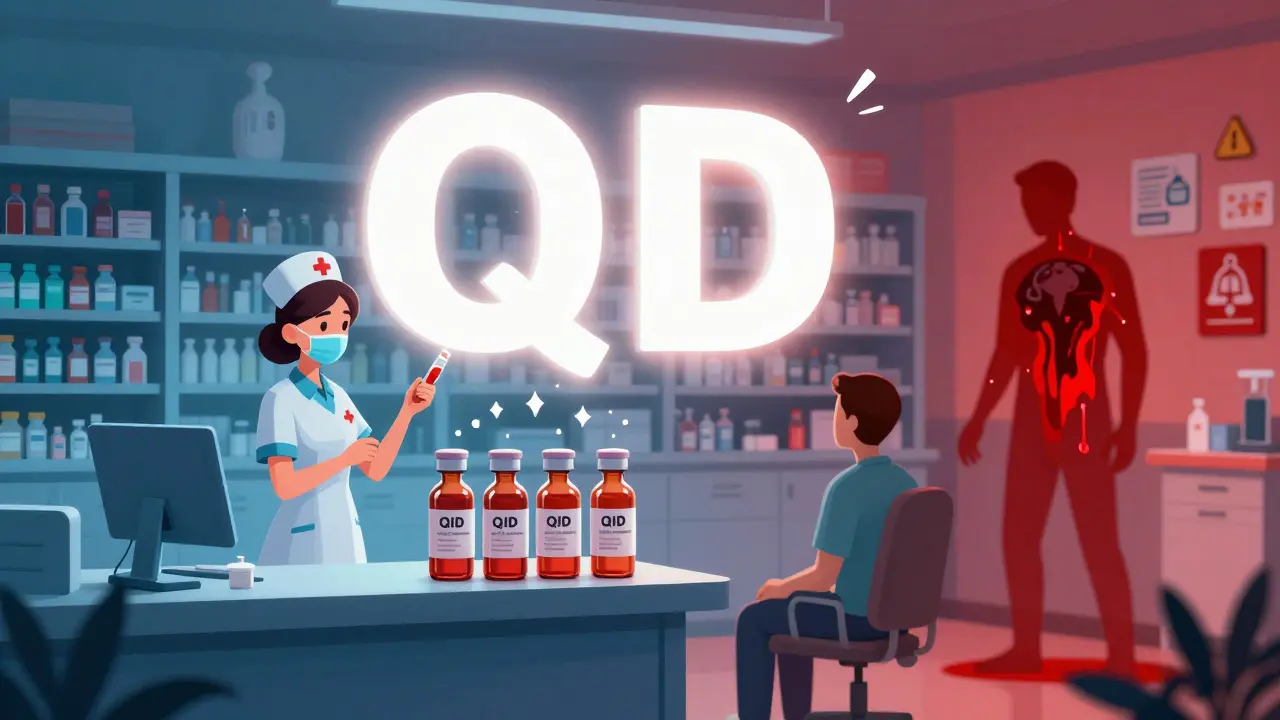
One wrong letter on a prescription can kill. It’s not a scare tactic-it’s fact. In hospitals and pharmacies across Australia and beyond, dangerous medical abbreviations are still slipping through cracks, leading to mix-ups that send patients to the ER-or worse. You might think handwritten notes are the main problem, but even digital systems aren’t safe if someone types QD instead of writing out "once daily."
Why These Abbreviations Are So Dangerous
Medical abbreviations were once shortcuts for busy clinicians. But over time, they became shortcuts to disaster. The Joint Commission and the Institute for Safe Medication Practices (ISMP) have been warning about this for over 20 years. Their "Do Not Use" list exists because real people have died from simple mistakes.Take QD. It’s meant to mean "once daily." But when a nurse sees it, they might read it as QID-four times a day. That’s a 400% overdose risk. A 2018 analysis of nearly 5,000 medication errors found that QD was involved in 43% of all abbreviation-related mistakes. One patient got a daily blood thinner dose four times a day. They bled internally. They didn’t survive.
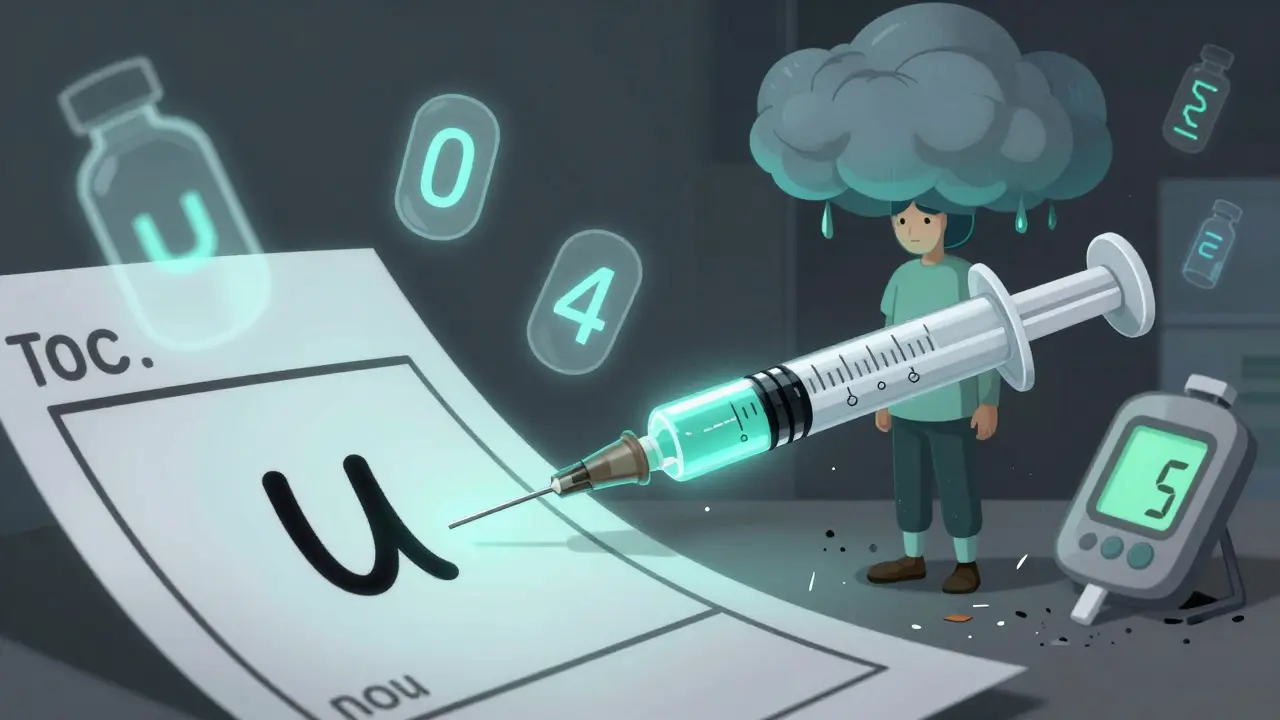
Then there’s U for units. Looks harmless, right? But in messy handwriting or on a blurry screen, it can look like a zero (0), a four (4), or even "cc" (cubic centimeters). A diabetic patient was given 100 U of insulin instead of 10 U because the "U" was misread as "100." They went into a coma. Another patient got morphine labeled as "MS," but the pharmacist thought it was magnesium sulfate (MgSO4). Magnesium sulfate is used for seizures, not pain. Giving it instead of morphine can be fatal.
The Most Common Killer Abbreviations
Some abbreviations are so dangerous they’ve been banned in every accredited hospital in Australia since 2022. Here are the top offenders:- QD - means "once daily," but looks like QID (four times daily)
- QOD - "every other day" - often confused with QD or qid
- BIW - "twice weekly" - mistaken for "twice daily," leading to dangerous overdoses
- U - "units" - easily mistaken for "0," "4," or "cc"
- MS or MSO4 - morphine sulfate - confused with MgSO4 (magnesium sulfate)
- SC or SQ - subcutaneous - misread as "5 every" or "SL" (sublingual)
- cc - cubic centimeters - replaced by "mL" to avoid confusion with "U"
- IU - international unit - mistaken for "IV" (intravenous) or "10"
- TAC - triamcinolone cream - misread as "Tazorac," a different skin drug
- DTO - diluted tincture of opium - confused with morphine sulfate
These aren’t just "bad habits." They’re documented causes of death. In 2020, a pharmacist in Adelaide caught an order for "TAC 0.1% cream" that was handwritten so poorly, it looked like "Tazorac." The patient had eczema, not psoriasis. Giving Tazorac could’ve burned their skin. That’s the kind of error that happens daily-and gets caught only because someone was paying attention.
How EHRs Made Things Worse (and Better)
You’d think electronic health records (EHRs) fixed this. They did-partly. A 2021 study showed EHRs cut abbreviation errors by 68%. But 12.7% of errors still happened because doctors typed free-text notes like "give MS 10 mg SC" instead of selecting from a dropdown menu.Here’s the problem: EHRs let you type anything. If you type "QD," the system doesn’t always stop you. Some hospitals use "hard stops"-they won’t let you submit the order unless you write out "once daily." Others just show a warning. That’s not enough. A 2021 study found that hard stops reduced errors by 84.6%. Warning messages? Only 52.3% reduction.
And then there’s voice dictation. More doctors are using Siri-like tools to write prescriptions. But if the AI hears "MS" and thinks it’s "MgSO4," it might auto-correct it wrong. That’s why ISMP added 17 new abbreviations to their list in January 2024-mostly for HIV drugs like DOR, TAF, TDF-because voice systems kept misreading them.
Who’s Still Using These Abbreviations-and Why
You’d think after 20+ years of warnings, everyone would’ve stopped. But they haven’t. A 2022 survey found that 43.7% of doctors over 50 still use banned abbreviations. Why? Because they learned them in medical school in the 1980s. They’ve used them for decades. Changing feels like giving up part of their identity.Younger doctors? Only 18.2% still use them. They were trained on EHRs with hard stops. They grew up with safety protocols. But in rural clinics, small practices, and aged care homes? The old habits stick. A 2023 FDA report found that 63.8% of outpatient errors still involve dangerous abbreviations. That’s where most people get their meds-and where the system is weakest.
Pharmacists are the last line of defense. In 2022, the American Society of Health-System Pharmacists surveyed 1,843 pharmacists. Over 63% had intercepted a dangerous abbreviation error in the past year. The top three? QD, U, and MS. That means in Australia, every pharmacist has likely stopped at least one near-fatal mistake.
What Works: How Hospitals Actually Fix This
It’s not enough to say "don’t use these." You have to build systems that make it impossible to mess up.Mayo Clinic did it right. They didn’t just send out a memo. They:
- Updated their EHR to block all banned abbreviations (hard stops)
- Required all staff to complete a 90-minute safety training
- Added real-time alerts when someone typed "U" or "QD"
- Created posters in every pharmacy and nursing station
Within 18 months, abbreviation-related errors dropped by 92.3%.
Other hospitals used training alone. Error rates dropped by only half. That’s the difference between hoping people change and forcing the system to protect them.

What You Can Do-Even If You’re Not a Doctor
You don’t need a medical degree to help prevent these errors. If you’re picking up a prescription:- Ask: "Can you write out the dose? Like, is it once daily or four times a day?"
- If you see "U" on the label, ask if it means "units."
- If the drug is "MS," ask if it’s morphine or magnesium sulfate.
- If the instructions say "SC," ask if it’s subcutaneous injection or something else.
That’s your right. That’s your safety. Don’t be shy. A pharmacist would rather answer a hundred questions than see you hurt.
And if you’re a caregiver for an elderly parent? Double-check every script. Write down the full name, dose, and frequency. Don’t trust the label. Don’t trust the doctor’s handwriting. Don’t trust the system. Trust yourself.
The Bigger Picture: This Isn’t Just About Letters
This isn’t really about abbreviations. It’s about culture. For decades, medicine rewarded speed over safety. "Good doctors write fast." That mindset got people killed. The fix isn’t technology. It’s changing how we think.Every time you write out "once daily" instead of "QD," you’re saying: "I value this person’s life more than my convenience." Every time you ask a pharmacist to confirm a drug name, you’re saying: "I won’t assume. I’ll verify."
That’s the real lesson here. Safety isn’t a policy. It’s a habit. And habits change when people choose to be careful-even when no one’s watching.
What’s the most dangerous medical abbreviation?
The most dangerous abbreviation is "QD" (once daily). It’s frequently misread as "QID" (four times daily), leading to massive overdoses. In one analysis, QD was involved in 43% of all abbreviation-related medication errors. Other top killers include "U" (units), which looks like "0" or "4," and "MS," which is often confused with "MgSO4" (magnesium sulfate).
Are electronic prescriptions safer than handwritten ones?
Yes, but not always. EHRs reduced abbreviation errors by 68% compared to handwritten orders. But if doctors type free-text notes like "MS 10 mg SC," errors still happen. The safest systems block banned abbreviations completely (hard stops) and require full words. Just warning users isn’t enough.
Why is "U" for units so risky?
"U" looks too much like "0," "4," or even "cc." A diabetic patient once got 100 units of insulin instead of 10 because the "U" was misread as "100." That’s a life-threatening overdose. That’s why the "Do Not Use" list bans "U"-you must write "units" in full.
What’s the difference between MS and MgSO4?
"MS" stands for morphine sulfate, a powerful painkiller. "MgSO4" is magnesium sulfate, used to treat seizures or pre-eclampsia. They sound similar, look similar in handwriting, and even look similar in digital systems. Giving magnesium sulfate instead of morphine won’t relieve pain-it can stop breathing. That’s why "MS" is banned and must be written out as "morphine sulfate."
Do Australian hospitals follow these rules?
Yes. Since 2022, all Australian hospitals accredited by the Australian Commission on Safety and Quality in Health Care must follow the same "Do Not Use" list as the U.S. Joint Commission. Pharmacists and nurses are trained to intercept these errors. But outside hospitals-in clinics and aged care-compliance is still inconsistent.
Can I get my doctor to avoid abbreviations?
Absolutely. Ask your doctor to write out "once daily," "subcutaneous," or "units" instead of using "QD," "SC," or "U." Most doctors will agree-especially if you explain you’re trying to avoid mistakes. Your safety matters more than their habit.
What should I do if I see a dangerous abbreviation on my prescription?
Don’t fill it. Take it back to the pharmacy and ask them to confirm the medication, dose, and frequency with the prescriber. Pharmacists are trained to catch these errors. If they don’t catch it, you might be the only one who does.


11 Comments
Man, I never realized how many lives are hanging on whether someone writes 'QD' or 'once daily.' I work in a clinic and we had a near-miss last month with 'U' being read as '100.' We've switched to full words now and it's crazy how much calmer things feel. Safety isn't sexy, but it's everything.
My grandma almost got killed by a QD mistake last year. She’s 82 and on blood thinners. The pharmacy didn’t catch it. I had to call the doctor myself. Never trust a label. Always ask. Always.
Ugh. Doctors are lazy. They still use MS and U like it's 1998. No wonder people die. It's not rocket science to type out 'units' or 'morphine sulfate.' Stop being cheap with patients' lives.
They banned these abbreviations in Australia? That’s because they’re too soft on safety. In the US we need hard stops, mandatory training, and GPS trackers on every doctor’s keyboard. This isn’t just negligence-it’s a systemic betrayal by the medical-industrial complex. And don’t get me started on how AI voice assistants are making it worse.
I'm a nurse and we had a pharmacist call us out on 'BIW' last week. Turns out the doctor meant twice weekly but typed it like twice daily. We almost gave the patient double the dose. Now we have a checklist. It's annoying but it saved someone. We're all just trying not to kill people here.
Thank you for this detailed and vital reminder. The shift from convenience to conscientiousness in clinical communication is not merely procedural-it is profoundly ethical. When we choose to write 'once daily' instead of 'QD,' we affirm the inherent dignity of the patient. This is not administrative reform. This is moral practice. Let us not underestimate the weight of a single letter.
Been in this game 25 years. Saw the handwriting era, the EHR transition, and now the voice-to-text chaos. The real issue isn't the tech-it's the culture. Some docs still think typing fast = being good. But the ones who slow down? They’re the ones who keep people alive. Respect the pause.
Just had a friend ask me if 'SC' meant 'subcutaneous' or 'sublingual' on her pain med. I said 'ask your pharmacist' and she did. They caught it. 😌
Too much drama. People die from everything. Why focus on letters?
It's not just abbreviations-it's the globalist medical elite pushing this 'standardization' to erase American medical autonomy. Why are we copying Australia's rules? We used to be the best. Now we're letting bureaucrats and AI dictate how we prescribe. 'QD' is a patriotic abbreviation! They're coming for your right to write 'U' next. Wake up.
It is imperative to underscore the profound systemic inadequacies inherent in the current clinical documentation paradigm. The persistence of non-standardized, non-validated, and non-audited abbreviations within electronic health record interfaces constitutes a critical failure of both governance and human factors engineering. The Joint Commission’s Do Not Use list, while commendable, remains insufficiently enforced due to the absence of mandatory compliance audits, real-time linguistic validation engines, and institutional accountability metrics tied to reimbursement structures. Furthermore, the reliance on human vigilance as the final safeguard against linguistic ambiguity is not merely archaic-it is ethically indefensible. A truly robust solution demands algorithmic pre-validation of all prescriptive inputs against a dynamically updated lexicon of prohibited terms, coupled with mandatory cognitive load reduction protocols for prescribers during peak workflow hours. Without such comprehensive, multi-layered, technologically embedded interventions, the continued use of 'QD,' 'U,' and 'MS' will remain not merely a habit-but a structural vulnerability with lethal consequences.