
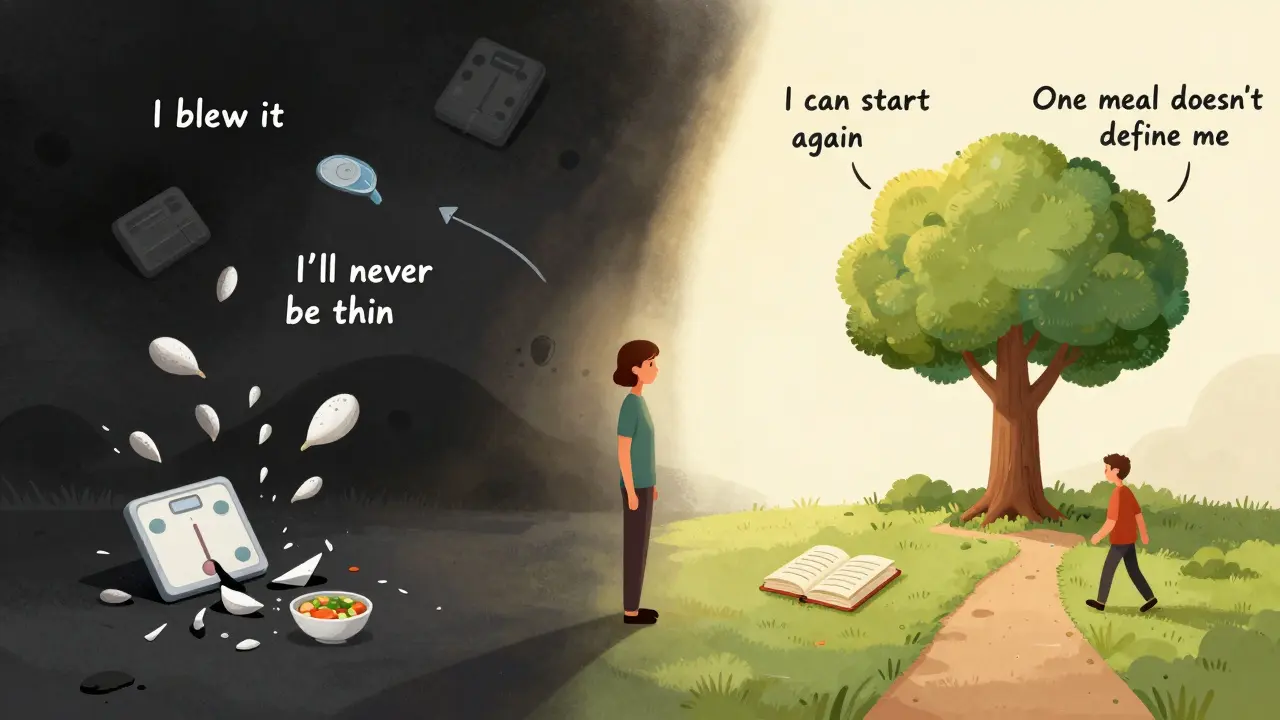
Most people who lose weight gain it back. Not because they lack willpower, but because their thoughts keep sabotaging them. You might think, "I blew it today, so I might as well eat everything" or "It’s not fair-I work out and still don’t lose weight". These aren’t just excuses. They’re cognitive traps. And they’re exactly what behavioral weight loss therapy, or CBT, is designed to break.
Why Thinking Matters More Than Diets
Diets fail because they only change what you eat, not how you think about food. Behavioral weight loss therapy flips the script. Instead of counting calories or cutting carbs, it tackles the mental patterns that lead to overeating, emotional eating, and giving up. Research from a 2023 meta-analysis in Scientific Reports shows people using CBT lost an average of 5-8% of their body weight-double what standard diet plans achieve. But the real win? They kept it off longer. Why? Because CBT doesn’t just teach you to eat less. It teaches you to think differently about eating.The 6 Cognitive Strategies That Actually Work
Not all therapy is the same. The most effective CBT programs for weight loss use six proven cognitive tools. These aren’t vague affirmations. They’re structured, research-backed techniques used in clinics across the U.S., Australia, and Europe.- Cognitive Restructuring: This is the core. It’s about catching thoughts like "I’ll never be thin" or "One cookie ruins everything" and replacing them with more realistic ones: "I had a tough day, but I can start again tomorrow". Studies show this alone cuts emotional eating by 63%.
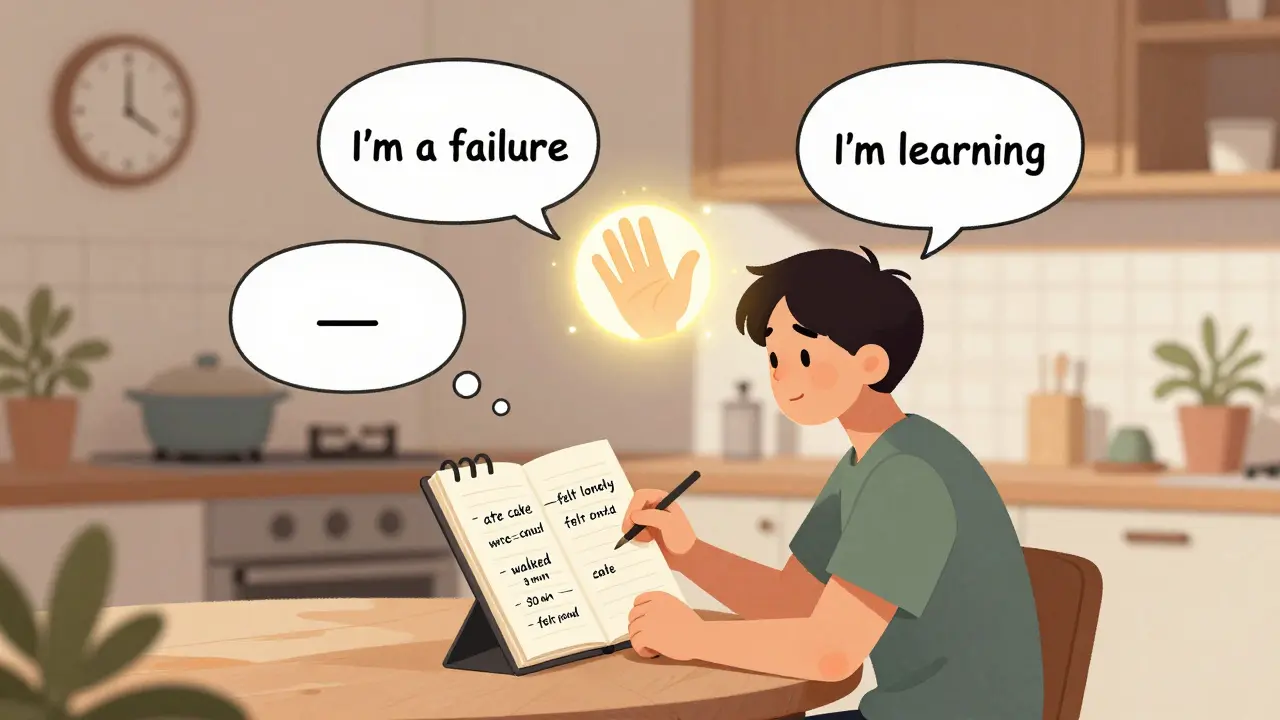
- Self-Monitoring: Writing down what you eat and how you feel isn’t just for therapists. People who track their meals and moods lose 5-10% more weight than those who don’t. You don’t need a fancy app. A notebook works. The key? Be honest. If you ate cake, write it. Not "just a bite," but "I ate two slices because I felt lonely."
- Stimulus Control: Your environment is wired to trigger overeating. Keep chips off the counter. Don’t shop hungry. Avoid eating in front of the TV. These aren’t tips-they’re science-backed changes that reduce mindless eating by up to 40%.
- Goal Setting (SMART Goals): "I want to lose weight" doesn’t work. "I will walk 30 minutes, 4 days a week, starting Monday" does. Specific, measurable, achievable, relevant, time-bound goals keep you moving forward. People who set SMART goals are 3x more likely to stick with CBT.
- Problem-Solving for High-Risk Situations: What do you do when your boss takes the team to dinner? When your kid begs for ice cream? CBT trains you to plan ahead. You don’t wait for temptation to hit-you prepare. "I’ll order grilled chicken, drink water, and leave room for dessert if I really want it."
- Relapse Prevention: Slip-ups aren’t failures. They’re data. CBT teaches you to treat them like experiments: "What triggered this? What could I do differently next time?" This mindset cuts dropout rates by 30% compared to traditional diet programs.
CBT vs. Diet Plans: The Numbers Don’t Lie
A 2018 study by Jacobs and colleagues compared CBT to standard behavioral weight loss programs. Both groups got nutrition advice and exercise plans. But only the CBT group got cognitive training. At six months:- CBT group: 8.2% average weight loss
- Standard group: 5.1% average weight loss
Who Benefits the Most?
CBT isn’t for everyone. But it’s especially powerful for people who:- Struggle with binge eating disorder (BED)
- Feel guilty after eating
- Use food to cope with stress or sadness
- Have tried diets repeatedly and feel hopeless
What About Online Apps and AI Tools?
Apps like Noom and WeightWatchers Beyond the Scale use CBT-style prompts. They’re better than nothing. But here’s the catch: therapist-led CBT leads to 6.8% average weight loss. AI apps? Around 3.2%. Why? Because human connection matters. A therapist notices when you say, "I’m a failure," and helps you unpack it. An app just sends a reminder: "You’ve got this!" That doesn’t mean apps are useless. For people who can’t access a therapist, they’re a good start. But if you’re serious about lasting change, working with a trained professional makes a real difference.The Hidden Barrier: Access and Cost
Here’s the ugly truth: CBT for weight loss is hard to find. In the U.S., there’s only one certified CBT specialist for every 125,000 people who could benefit. In rural areas, it’s worse. Insurance rarely covers more than 12 sessions-even though research shows 20+ sessions deliver 27% better results. Group CBT is a smart workaround. A 2022 study found group sessions matched individual therapy outcomes-while costing one-third as much. If you can’t find a private therapist, look for a local hospital, university clinic, or community health center offering group CBT programs. Many run on sliding scales.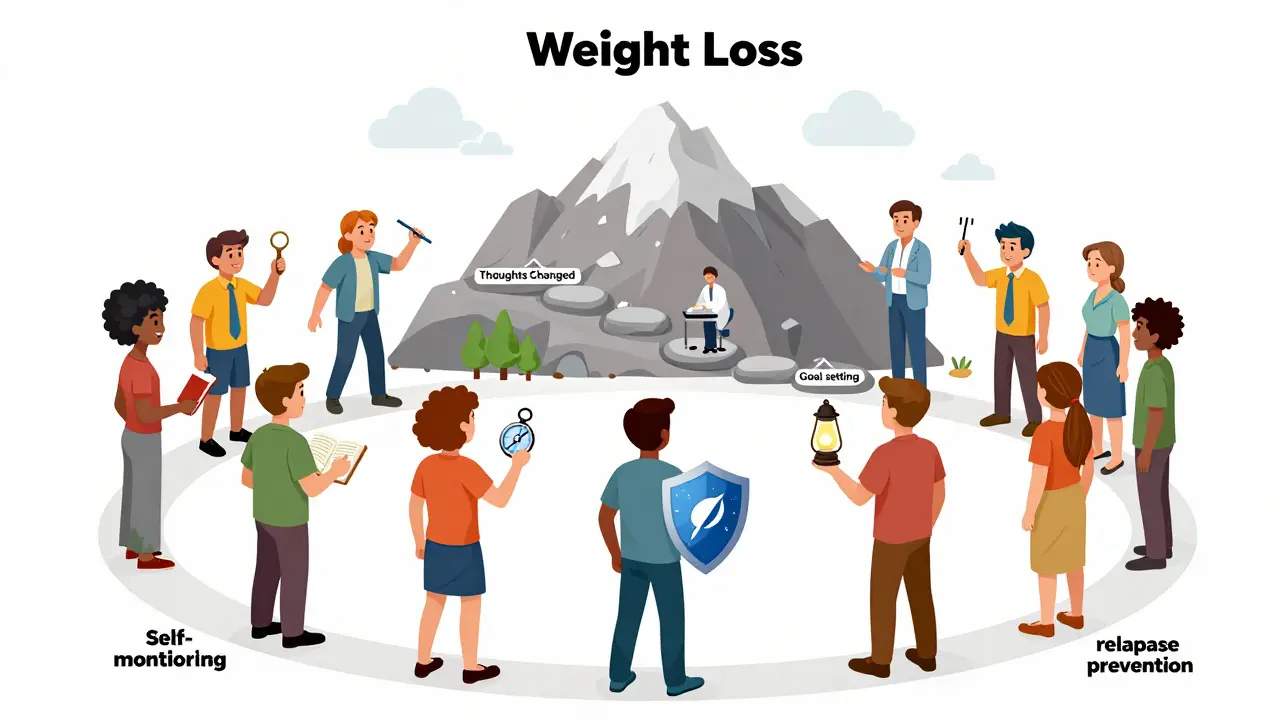
Why You Might Still Regain Weight (And How to Prevent It)
Even with CBT, 30-35% of people regain weight within a year. That’s not failure. It’s normal. The body fights to return to its old weight. That’s biology. But CBT gives you tools to fight back. The biggest reason people regain weight? They stop using the tools. Cognitive restructuring, self-monitoring, problem-solving-these aren’t one-time fixes. They’re lifelong skills. Think of them like brushing your teeth. You don’t stop after a month. To prevent regain:- Keep your food and mood journal-even just once a week
- Check in with a friend who also did CBT
- Revisit your relapse prevention plan every 3 months
- Don’t wait for a slip-up to use your skills. Use them daily.
What’s Next? CBT Is Evolving
The future of weight loss isn’t just pills or surgery. It’s combining CBT with medicine. The NIH is now funding trials that pair CBT with GLP-1 agonists like semaglutide. Why? Because even powerful drugs don’t fix the thoughts that lead to overeating. CBT does. In Australia, new programs are starting to integrate CBT into public health clinics. It’s slow. But it’s happening. Because the evidence is clear: if you want to lose weight and keep it off, you need to change your mind-not just your meals.Where to Start Today
You don’t need to wait for a referral. Start small:- Get a notebook. Write down three times this week you ate when you weren’t hungry. What were you feeling?
- Write down one thought you have about food that feels extreme. Is it true? Can you rephrase it?
- Set one SMART goal: "I will eat dinner at the table without screens, 4 nights this week."
Can CBT help me lose weight without dieting?
Yes. CBT doesn’t require strict diets. Instead, it helps you understand why you eat the way you do and build healthier habits naturally. Many people lose weight simply by reducing emotional eating, improving portion awareness, and learning to respond to hunger cues-without counting calories or cutting out food groups.
How long does CBT for weight loss take?
Most programs run 12 to 26 weekly sessions. People start seeing changes in 4-6 weeks, especially with self-monitoring and cognitive restructuring. But real, lasting change takes time-usually 6 months or more. The best results come from sticking with it beyond the initial program, even if just with occasional check-ins.
Is CBT effective for binge eating?
Yes-CBT is the most researched and recommended treatment for binge eating disorder (BED). Studies show over 50% of people with BED who complete CBT no longer meet diagnostic criteria five years later. It helps break the cycle of restriction, bingeing, guilt, and repeat.
Can I do CBT on my own with books or apps?
You can start with self-help books or apps, and many people benefit. But research shows therapist-led CBT produces nearly double the weight loss compared to self-guided tools. Human support helps you catch hidden thought patterns and stay accountable. If possible, combine self-study with even one session with a trained therapist to get personalized feedback.
Will CBT help me feel better emotionally, not just lose weight?
Absolutely. In clinical trials, people using CBT for weight loss report 40% reductions in symptoms of depression and anxiety. That’s because CBT doesn’t just change eating habits-it changes how you relate to yourself. Many people say they feel more in control, less ashamed, and more confident-not just thinner.
What if I can’t afford a therapist?
Look for community health centers, university psychology clinics, or nonprofit programs that offer sliding-scale fees. Group CBT is often much cheaper than individual sessions and just as effective. Some online platforms offer low-cost CBT-based programs led by licensed therapists. Don’t assume it’s out of reach-many options exist if you ask around.






14 Comments
I've been doing CBT-style journaling for 8 months now and honestly? It's the only thing that stuck. I used to think if I ate one cookie, the whole day was ruined. Now I catch that thought before it spirals. I write it down: 'I had a cookie because I was stressed about work.' Then I ask: 'Would I say that to my best friend?' No. So why say it to myself? That tiny shift changed everything. I lost 12 lbs without ever counting calories. Not because I was 'disciplined'-because I stopped fighting myself.
Also, the idea that weight loss = willpower is pure nonsense. It’s cognitive flexibility. You’re rewiring your brain’s autopilot. It’s not about resisting food-it’s about understanding why you reach for it. The body doesn’t care about willpower. It cares about safety, comfort, and predictability. CBT gives you new ways to feel safe without food.
And yeah, apps help-but they can’t read between the lines when you say 'I just can’t stop.' A human therapist hears the shame underneath that. An app just sends a heart emoji.
CBT my ass. You're just repackaging common sense with fancy jargon. Everyone knows eating junk when you're sad is dumb. You don't need a therapist to tell you to write stuff down or set goals. I lost 30 lbs in 6 months on a keto diet. No journaling. No cognitive restructuring. Just cut carbs. The real problem is people want magic pills and therapy bills instead of doing the hard thing. Stop overcomplicating food. Eat less. Move more. Done.
And that 8.2% vs 5.1%? Small sample sizes. Publication bias. And where's the long term data beyond 2 years? I'll believe it when I see it. Also 'relapse prevention' is just another way to say 'you failed.'
Ugh. Another ‘therapy is the answer’ post. I’ve been in therapy for 5 years. I’ve journaled. I’ve done CBT. I’ve done mindfulness. I’ve done everything. And I’m still overweight. So what? What’s the point of all this ‘thinking differently’ when my body still looks the same? You’re just giving people permission to feel bad about themselves while they eat chips. ‘Oh I had a thought that ruined my day’-no, you just ate the chips. Own it. Stop making excuses with psychology.
And don’t get me started on ‘self-monitoring.’ I wrote down everything. I was so honest. I cried every night. And then I ate another bag of chips. What did that accomplish? Nothing. Just guilt with a thesaurus.
People don’t need to ‘restructure thoughts.’ They need to stop eating. Period. No more therapy. No more apps. Just stop. You’re not broken. You’re lazy. And I’m tired of this emotional whining disguised as science.
Y’all are missing the forest for the trees. CBT isn’t about weight. It’s about freedom. I was a binge eater for 18 years. I’d eat entire pizzas at 2am while crying. I thought I was weak. Turns out I was terrified. Terrified of being invisible. Terrified of being seen. Food was my armor.
CBT didn’t make me eat less. It made me feel less alone. When I wrote ‘I ate because I felt worthless’ instead of ‘I’m a failure,’ something shifted. Not magically. Not overnight. But slowly. Like peeling an onion. Each layer hurt. But I didn’t die.
And yes, apps are trash compared to real human connection. I had a therapist who looked me in the eye and said, ‘You’re not broken. You’re grieving.’ That’s not in any algorithm. That’s soul work.
Also-group CBT saved my life. I met a woman who’d been hiding her weight for 30 years. We cried together. We ate tacos together. We didn’t fix each other. We just showed up. That’s the real magic. Not the numbers. Not the scales. The human stuff.
And if you think this is ‘emotional whining’-you’ve never been trapped in your own mind. Try sitting with your thoughts for 10 minutes without food, TV, or distraction. Then come back and tell me it’s easy.
What’s interesting here is how CBT mirrors existential philosophy. The idea that we are not our thoughts-that we can observe them, detach, reframe-is straight out of Viktor Frankl and Epictetus. You don’t control your cravings. You control your relationship to them. That’s not psychology. That’s ancient wisdom repackaged.
And the real tragedy? We’ve outsourced self-awareness to apps and diets. We think if we just get the right plan, we’ll be fixed. But the problem isn’t the food. It’s the silence we fill with it. We’re afraid of stillness. So we eat to avoid feeling. CBT forces you to sit in the discomfort. That’s why it works. Not because it’s science. Because it’s brave.
And let’s be real-no one ever lost weight because they were told to ‘eat less.’ They lost weight because they stopped running from themselves. That’s the real intervention. The rest is just scaffolding.
People need to stop using ‘mental health’ as an excuse to be lazy. If you’re overweight, it’s because you eat too much. No amount of journaling changes biology. Your body doesn’t care about your trauma. It cares about calories in vs calories out. Period.
And don’t give me this ‘it’s not about willpower’ nonsense. Willpower is just discipline. And discipline is a choice. You choose to eat the cake. You choose not to go for a walk. You choose to blame your childhood instead of taking responsibility.
Therapy is great for people who want to feel validated. But it doesn’t burn fat. Movement and nutrition do. Stop romanticizing obesity as a ‘mental illness.’ It’s a behavioral one. And behavior can be changed-with grit, not gratitude.
Also, if you’re spending $200/hour on CBT, you’ve got bigger problems than your weight.
I’m a primary care doc. I’ve seen hundreds of patients try diets. Only two groups succeed: those who do CBT and those who get bariatric surgery. The rest? They cycle. Over and over. The body adapts. The mind doesn’t.
What nobody talks about is how shame fuels the cycle. You eat because you’re sad. You feel guilty. You eat more to numb the guilt. It’s a loop. CBT breaks it by removing the shame. Not by telling you you’re bad. By telling you you’re human.
And yeah, apps are better than nothing. But they’re like a Band-Aid on a broken leg. You need structure. You need feedback. You need someone who notices when you say ‘I’m a failure’ and says, ‘Tell me more about that.’ That’s therapy.
Also-group CBT works because you realize you’re not alone. You think you’re the only one who eats in the car? Nope. We’ve all been there.
Bro in India we dont have CBT therapists like in US. But we have chai, family, and silence. I lost 15kg by just sitting with my thoughts after dinner. No journal. No app. Just 10 minutes. No phone. No TV. Just me and my mind.
Turns out I was eating because I was lonely. Not hungry. My family didn’t talk much. So I filled the quiet with samosas.
CBT is cool but we’ve always had this. We call it ‘dheere dheere’-slowly slowly. You don’t fight the craving. You watch it. Like a cloud. It passes.
Also-no one here says ‘SMART goals.’ We say ‘karo, phir socho’-do it, then think. Simple. Works.
And yeah, therapy is expensive. But silence? Free. And it’s the real therapist.
Let me tell you what no one says: CBT doesn’t make you lose weight. It makes you want to live. I was 320 lbs. I didn’t care. I was numb. Then I did CBT and realized I hated my life-not my body. I was afraid of being seen. Afraid of being loved. Afraid of being left.
One day my therapist asked, ‘What would your 8-year-old self say if she saw you now?’ I cried for an hour. Not because I was fat. Because I’d forgotten how to be soft.
Weight loss came later. After I stopped hating myself. After I started feeding myself with kindness instead of guilt.
You don’t need to ‘fix’ your eating. You need to fix your relationship with yourself. The scale just follows.
And if you think this is ‘fluffy’-try sitting with your pain for 6 months without food as a crutch. Then come back and tell me it’s easy.
CBT is just cognitive behavioral *narrative therapy* with a fancy acronym. We’ve been doing this since the Greeks. The real innovation? Marketing. They packaged it in bullet points and sold it as a ‘system.’
Also-why is everyone obsessed with ‘weight loss’? Why not ‘body peace’? Why not ‘freedom from food guilt’? We’re reducing human experience to a BMI number. That’s not healing. That’s capitalism.
And AI apps? 😒 They’re like a robot saying ‘you’ve got this!’ while you’re sobbing in the pantry. No. Just no.
Human connection isn’t a ‘bonus.’ It’s the *core*. You can’t algorithm empathy. You can’t code compassion.
Also-emoji isn’t therapy. 🥲
cbt is legit. i did it for 6 months. lost 22lbs. not because i ate less but because i stopped hating myself. no more ‘i blew it’ just ‘ok i ate it now what’
also journaling is dumb if you fake it. if you write ‘just a bite’ when you ate the whole cake you’re just lying to yourself. be brutal. be honest. then the change happens.
apps are for people who wanna feel like they’re doing something without actually doing it. real work is messy. real work is crying in your journal at 2am. but it works.
ps: stop calling it ‘weight loss.’ call it ‘getting your life back.’
It is imperative to note that the efficacy of cognitive behavioral therapy in the context of weight management is contingent upon a rigorous adherence to protocol, as well as the presence of a certified clinical practitioner, without which the therapeutic outcome may be significantly attenuated. Furthermore, the longitudinal sustainability of behavioral change is not guaranteed without continued reinforcement, and the conflation of correlation with causation remains a persistent methodological flaw in many published studies. One must exercise epistemological caution when interpreting self-reported data, particularly when affective states are involved. The reliance upon anecdotal testimony as evidence constitutes a logical fallacy, and thus, the generalizability of these findings remains questionable.
My uncle did CBT. He lost 40 kg. Now he walks 10 km every morning. He says the therapy didn’t make him eat less. It made him stop running from his brother’s death. He used to eat because he missed him.
He didn’t need apps. He didn’t need pills. He needed to cry. And someone let him.
That’s what CBT is. Not a diet. Not a trick. Just someone saying: ‘I hear you.’
That’s why group CBT works. You don’t need a therapist to say ‘I hear you.’ Sometimes, just hearing someone else say ‘me too’ is enough. I had a woman in my group say, ‘I eat when I’m afraid of being alone.’ I cried. Because that was me. No one had ever said it out loud before.
That’s the real magic. Not the journal. Not the SMART goals. Just being seen.