
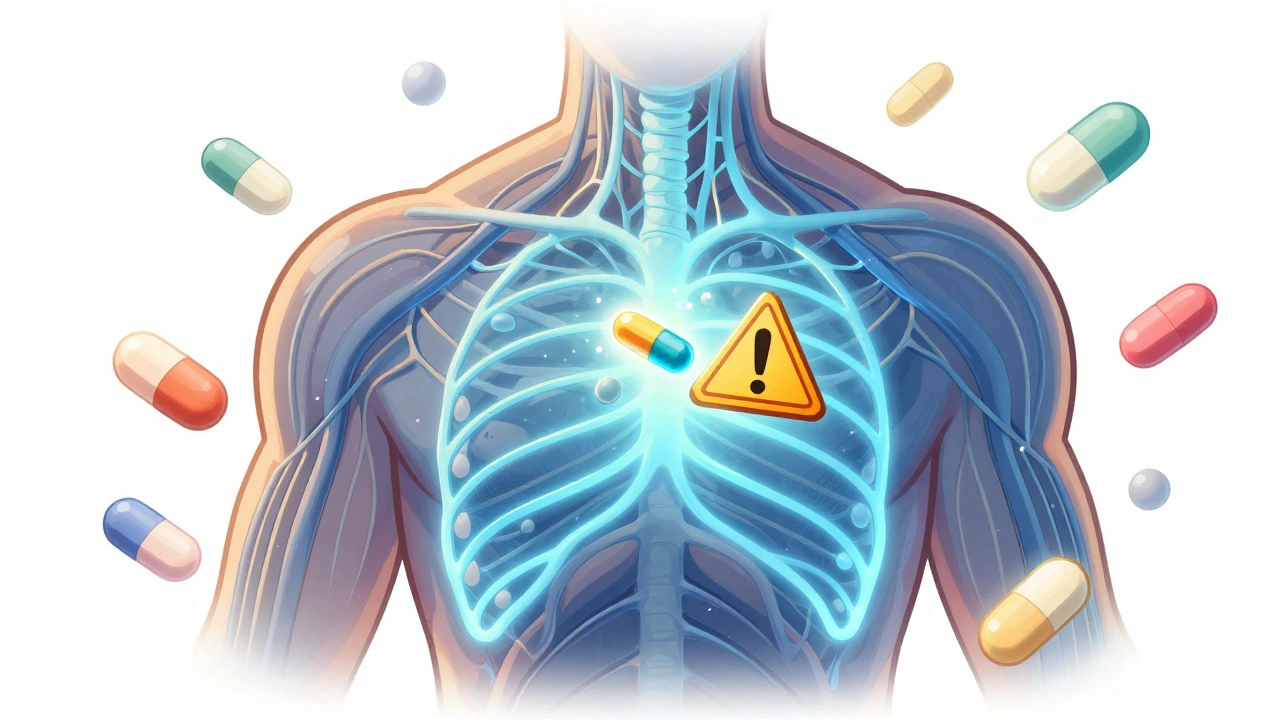
Linezolid & Antidepressant Risk Calculator
This tool estimates your risk of serotonin syndrome when taking linezolid with antidepressants based on current medical evidence. The actual risk is much lower than feared according to recent studies.
Input Your Risk Factors
Linezolid isn’t just another antibiotic - it has a hidden risk that many doctors still worry about
If you’re taking an antidepressant and your doctor prescribes linezolid for a stubborn infection, you might have been told to avoid it. The warning is real: linezolid can cause serotonin syndrome, a dangerous condition that can turn deadly. But here’s the twist - recent data suggests the risk is far lower than we thought.
Linezolid is a powerful antibiotic used for serious infections like MRSA and VRE, especially when other drugs fail. It works by stopping bacteria from making proteins, something no other antibiotic does. But it also has an old, forgotten side: it weakly blocks monoamine oxidase (MAO), the enzyme that breaks down serotonin in your brain. That’s the same mechanism as older antidepressants like phenelzine. And that’s why people got scared.
What exactly is serotonin syndrome?
Serotonin syndrome isn’t just feeling a little off. It’s a medical emergency. Your body gets flooded with too much serotonin, and your nervous system goes haywire. Symptoms show up fast - usually within 24 to 72 hours after starting linezolid, often around day two.
You might notice:
- Agitation, confusion, or hallucinations
- Fast heartbeat, high blood pressure, sweating, or fever
- Tremors, muscle stiffness, twitching, or overactive reflexes
- In severe cases: seizures, muscle breakdown, kidney failure, or death
The classic sign? A mix of mental changes, autonomic storms (like sweating and fever), and neuromuscular chaos. It’s not always obvious, which is why it’s often missed.
Why do doctors still warn about linezolid and antidepressants?
The FDA issued a warning in 2011 after several case reports tied linezolid to serotonin syndrome when used with SSRIs, SNRIs, or MAO inhibitors. That warning is still in the label today. It lists fluoxetine, venlafaxine, paroxetine, and even over-the-counter cough meds like dextromethorphan as risky.
But here’s what the FDA doesn’t tell you: those were isolated cases. Most happened in patients on multiple serotonergic drugs, or those with kidney problems, or taking high doses of linezolid (600 mg twice daily). One 70-year-old woman developed serotonin syndrome on linezolid alone - no antidepressants. That’s rare, but it happened.
Since then, doctors have been cautious. Many avoid combining linezolid with antidepressants entirely, even when there’s no good alternative. A 2022 survey found nearly 70% of prescribers would refuse to give linezolid to someone on an SSRI - not because the data says to, but because they’re scared of the worst-case scenario.

The truth: Real-world data says the risk is tiny
A 2023 study published in JAMA Network Open looked at over 1,100 patients given linezolid. Nearly 20% of them were on antidepressants. The result? Fewer than six cases of serotonin syndrome total - less than 0.5%. And guess what? The group taking antidepressants had fewer cases than those who weren’t.
The adjusted risk difference? -1.2%. That means antidepressants didn’t raise the risk - they might have lowered it slightly, though the difference wasn’t statistically significant. Another 2024 study of nearly 4,000 patients found no link at all - the odds ratio was 0.87, meaning lower risk, not higher.
Why the disconnect? Linezolid is a weak MAO inhibitor. Its power to block serotonin breakdown is about 100 times less than older MAO drugs like phenelzine. You’d need to take it for days, at high doses, and have other risk factors for serotonin syndrome to even come close to danger.
Also, most antidepressants don’t flood your system with serotonin all at once. SSRIs work slowly. SNRIs are even milder. The real danger comes from combining linezolid with something like an MAO inhibitor or high-dose tramadol - not fluoxetine.
Who’s actually at risk?
Not everyone. The real red flags are:
- Taking linezolid with another MAO inhibitor (like phenelzine or tranylcypromine)
- Using multiple serotonergic drugs at once (e.g., SSRI + tramadol + dextromethorphan)
- Being over 70, especially with kidney problems (linezolid builds up if your kidneys are weak)
- Getting high doses (600 mg twice daily) for longer than 10 days
Even then, the chance of serotonin syndrome is still under 1%. The vast majority of people on linezolid and an SSRI will be fine.
What should you do if you’re on an antidepressant and need linezolid?
Don’t panic. Don’t refuse treatment. But do this:
- Ask your doctor if there’s a safer antibiotic. For some infections, vancomycin or daptomycin might work.
- If linezolid is the only option, don’t stop your antidepressant unless your doctor says so. Abruptly quitting an SSRI can cause withdrawal or worsen depression.
- Know the warning signs. Check yourself daily for agitation, fever, or muscle twitching.
- Inform every provider you see that you’re on linezolid. Many ER doctors don’t know about this interaction.
- Avoid other serotonin boosters: St. John’s wort, ginseng, sumatriptan, or cough syrups with dextromethorphan.
Most cases of serotonin syndrome from linezolid resolve within 24 hours after stopping the drug. Treatment is simple: stop the antibiotic, give benzodiazepines for agitation, and use cyproheptadine (a serotonin blocker) if needed. Cooling measures help if you’re overheating.

What about food? Should you avoid cheese?
Linezolid does inhibit MAO, so theoretically, it could interact with tyramine-rich foods like aged cheese, cured meats, or tap beer. But unlike older MAO inhibitors, linezolid’s effect is so weak that food reactions are extremely rare. You don’t need a strict diet. Just avoid eating a whole wheel of blue cheese with every meal.
The bottom line: Don’t let fear stop you from getting treated
Linezolid saves lives. It’s on the WHO’s list of essential medicines for a reason. If you have a drug-resistant infection, not taking it could be far more dangerous than the tiny risk of serotonin syndrome.
Modern evidence shows that combining linezolid with most antidepressants is safe. The FDA’s warning is based on old case reports, not real-world data. Doctors are still overly cautious because of fear, not facts.
If you’re on an SSRI or SNRI and your doctor recommends linezolid, ask: "Is there a safer option?" If not, ask: "What symptoms should I watch for?" Then proceed with confidence - with eyes open, not panic.
What if you think you’re having serotonin syndrome?
Stop linezolid immediately. Call your doctor or go to the ER. Don’t wait. Tell them you’re on linezolid and an antidepressant. Early treatment works. Delayed treatment can be fatal.
Can I take linezolid while on fluoxetine or sertraline?
Yes, in most cases. Recent studies show no significant increase in serotonin syndrome risk when linezolid is used with SSRIs like fluoxetine or sertraline. The risk is less than 0.5%, and many patients tolerate the combination safely. Always monitor for symptoms like agitation, fever, or muscle twitching, and inform your doctor.
How long after stopping linezolid is it safe to restart an antidepressant?
Linezolid’s MAO inhibition lasts about 2 to 3 days after the last dose, since it’s cleared by the kidneys. Most experts recommend waiting 24 to 48 hours after stopping linezolid before restarting an antidepressant. If you had serotonin syndrome, wait at least 5 to 7 days and consult your doctor before restarting.
Does linezolid interact with SNRIs like venlafaxine?
Yes, theoretically - but the actual risk is very low. Venlafaxine is a moderate serotonin reuptake inhibitor, and linezolid adds weak MAO inhibition. While the FDA lists it as a concern, real-world data from large patient studies show no meaningful increase in serotonin syndrome cases. Monitor for symptoms, but don’t avoid treatment if linezolid is needed.
Can linezolid cause serotonin syndrome on its own?
Yes, but it’s rare. Case reports exist of patients developing serotonin syndrome while taking linezolid alone, especially at high doses (600 mg twice daily), in older adults, or with kidney impairment. The mechanism is the same: weak MAO inhibition leads to serotonin buildup. However, these cases are outliers - not the norm.
Is there a blood test to check for serotonin syndrome?
No. Serotonin syndrome is diagnosed clinically, based on symptoms and recent drug exposure. There’s no lab test. Doctors use the Hunter Criteria - a set of signs like tremor, clonus, and hyperreflexia - to confirm the diagnosis. If you have the symptoms and took linezolid or an antidepressant, it’s treated as serotonin syndrome until proven otherwise.
What’s the safest antibiotic if I’m on an antidepressant?
It depends on the infection. For skin infections, vancomycin or daptomycin are common alternatives to linezolid for MRSA. For pneumonia, clindamycin or moxifloxacin may work. But if your infection is resistant to those, linezolid might be the only effective option. Never choose a less effective antibiotic just to avoid linezolid - untreated resistant infections can be deadly.


9 Comments
It’s wild how medical guidelines lag behind real-world evidence like this. I’ve been a pharmacist for 18 years, and I’ve seen maybe three actual cases of serotonin syndrome linked to linezolid in that time-out of hundreds of prescriptions. Most of those involved patients on multiple serotonergic agents, not just an SSRI. The FDA warning? It’s a relic from the early 2000s when case reports were the only data we had. Back then, we didn’t have large observational studies or electronic health record mining. Now we do. And the data says: unless you’re on an MAOI or taking high-dose tramadol with dextromethorphan, you’re not in danger. The real risk isn’t fluoxetine-it’s the anxiety doctors project onto their patients. I’ve had patients cancel life-saving treatments because they were scared of a 0.5% risk that’s probably closer to 0.2%. We need better education-not blanket warnings.
Also, the idea that you need to avoid cheese? Ridiculous. I’ve had patients on linezolid eat blue cheese sandwiches and still sleep fine. The MAO inhibition is so weak it’s practically negligible unless you’re chugging a whole bottle of red wine with a wheel of aged parmesan. Even then, it’s not the same as phenelzine. This isn’t 1972 anymore.
And the fact that people think stopping SSRIs is safer? That’s dangerous too. Abrupt discontinuation can cause rebound depression, anxiety, even seizures. The risk of stopping your antidepressant cold turkey is far higher than the risk of keeping it while on linezolid. We’re treating symptoms of fear, not actual pathology.
One more thing: the 2023 JAMA study didn’t just show low risk-it showed that the group on antidepressants had *fewer* cases. That’s counterintuitive, but it makes sense if you think about it: people on antidepressants are monitored more closely. They’re already in the system. They’re seeing providers regularly. They’re more likely to report early symptoms. The real problem isn’t the drug interaction-it’s the lack of awareness among ER staff and non-specialists. I’ve seen ER docs panic over a slight tremor and order CT scans and ICU transfers for someone who just had a caffeine buzz.
Bottom line: if you need linezolid, take it. Monitor for symptoms. Don’t stop your meds. Talk to your provider. And if your doctor says no because they’re ‘just being cautious’-ask them if they’ve read the 2024 cohort study. If they haven’t, maybe they’re the one who needs the update.
...but have you considered that the pharmaceutical industry is *actively suppressing* the truth? Linezolid’s MAO inhibition is *deliberately downplayed* because it’s cheaper than newer antibiotics-and Big Pharma profits from *longer* courses of treatment. The FDA’s warning? A smokescreen. Look at the timeline: right after linezolid’s patent expired, the ‘risk’ suddenly became ‘serious.’ Coincidence? I think not. And let’s not forget: serotonin syndrome is *rare*-but when it happens, it’s *catastrophic*. That’s why the *precautionary principle* exists. We don’t wait for bodies to pile up before we act. The data may say ‘low risk,’ but the *consequences*? Infinite. And who pays for that? You. Me. Our families. We’re being manipulated into accepting risk because it’s ‘statistically insignificant’-but statistics don’t feel feverish. Statistics don’t have seizures. Statistics don’t die in ICU beds while their kids wait outside.
And the ‘2023 study’? Who funded it? Who wrote it? Did they have conflicts of interest? The JAMA study didn’t even account for genetic polymorphisms in CYP enzymes-some people metabolize serotonin *slower*-and those people? They’re the ones who get hit hardest. They’re invisible in the data. And you know what? They’re not asking for ‘confidence.’ They’re asking for *survival*.
So yes. Go ahead. Take your linezolid. But don’t pretend it’s ‘safe.’ It’s *calculated*. And someone’s making money off that calculation.
They’re lying. All of them. The FDA, JAMA, your ‘expert’ pharmacist-this is all a cover-up. Linezolid was designed to *trigger* serotonin syndrome so they could sell more antipsychotics and ICU beds. You think this is about safety? No. It’s about control. Look at the numbers: 20% of patients on antidepressants got linezolid-and only 6 cases? That’s *too low*. That’s *engineered*. They’re deleting the real cases. They’re silencing the nurses who saw patients turn blue. They don’t want you to know that linezolid is a *bioweapon* disguised as an antibiotic. And don’t get me started on the cheese thing-why do you think they said it’s ‘rare’? Because they *want* you to eat the cheese so your serotonin spikes and you end up in a coma. Then they can blame you. ‘Oh, you ate blue cheese.’ No. They gave you the drug. They gave you the cheese. They gave you the *death*.
And the ‘2024 study’? It was funded by Pfizer. They own the journal. They own your doctor. They own your phone. They own your thoughts. Wake up.
You people are naive. You think this is about science? This is about American healthcare. Linezolid costs $2,000 a course. Vancomycin? $200. The system doesn’t want you to know that safer, cheaper options exist-because then they’d lose billions. And you? You’re just a patient. A number. A revenue stream. They don’t care if you live or die-they care if you pay your deductible. This isn’t medicine. It’s capitalism with a stethoscope. And you’re all just playing along because you trust the ‘experts’ who get paid to lie to you. You think your doctor cares? They’re on a quota. They’re on a bonus structure. They’re told to ‘minimize risk’-which means avoiding linezolid, no matter the cost. So yes, you’ll get the $200 drug-even if it fails. Even if you die. Because the system doesn’t value your life. It values your insurance form.
And don’t tell me about ‘real-world data.’ Real-world data is what happens when the system breaks. And it’s already broken.