
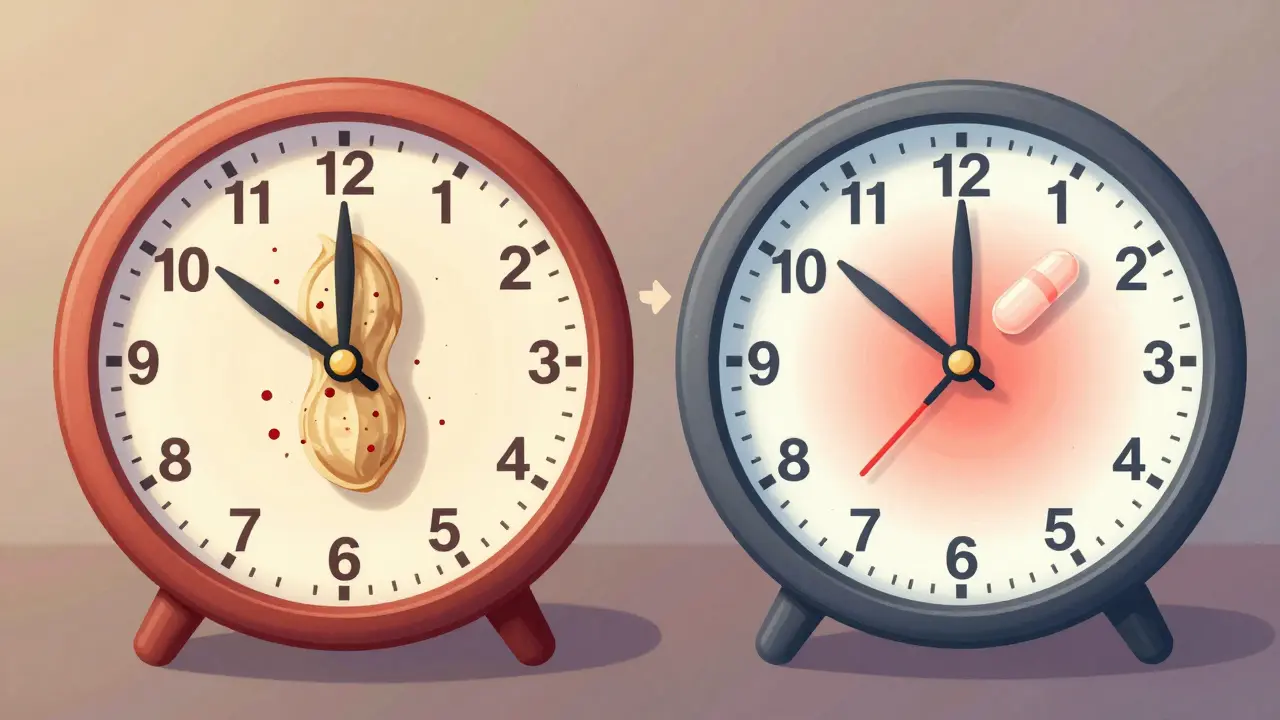
Knowing whether your reaction came from food or medicine isn’t just about avoiding discomfort-it’s about staying alive. A rash after eating peanuts? Could be life-threatening. A rash after taking amoxicillin? Might be a virus, not an allergy. Mistaking one for the other can lead to dangerous choices: avoiding life-saving antibiotics or accidentally eating something that triggers anaphylaxis. The good news? There are clear, measurable differences between these two types of reactions-if you know what to look for.
Timing Is Everything
When symptoms show up tells you more than almost anything else. Food allergies usually strike fast. If you eat something you’re allergic to, symptoms like itching in the mouth, hives, or swelling often appear within minutes. In 95% of cases, they happen within two hours. The average time? About 20 minutes. That’s why someone can go from eating a peanut butter sandwich to needing an EpiPen in under half an hour.
Medication allergies don’t follow that same clock. Immediate reactions-like hives or trouble breathing after a penicillin shot-can happen within minutes, just like food. But here’s where it gets tricky: many drug reactions are delayed. A rash from an antibiotic might not show up for two or three days. Even later, conditions like DRESS syndrome or Stevens-Johnson syndrome can take weeks to develop. If you got a rash five days after starting a new pill, it’s far more likely to be a drug reaction than a food allergy.
Symptoms Don’t Always Match
Both food and medication allergies can cause hives, swelling, or trouble breathing. But the full picture looks different.
Food allergies almost always involve the gut. Vomiting, diarrhea, stomach cramps-these are common, especially in kids. Oral allergy syndrome is another clue: tingling or swelling in the lips, tongue, or throat right after eating raw fruits or nuts. That’s often tied to pollen allergies and happens almost instantly.
Medication allergies rarely cause vomiting or diarrhea as the main symptom. Instead, they’re more likely to trigger fever, joint pain, or widespread rashes that spread across the body. A flat, red, blotchy rash that appears days after taking a drug? That’s a classic sign of a delayed drug reaction. If you’re running a fever and your skin is covered in bumps after starting a new antibiotic, it’s probably not food.
How the Body Reacts Is Different
Under the hood, your immune system works differently with food versus medicine. About 90% of food allergies are IgE-mediated. That means your body makes specific antibodies that trigger immediate reactions-hives, swelling, anaphylaxis. The rest are non-IgE reactions, like FPIES, which cause severe vomiting and diarrhea hours later, but no hives or breathing trouble.
Medication allergies are more complex. Only about 80% of immediate reactions are IgE-driven. The other 20% involve T-cells, which take time to activate. That’s why some drug reactions show up days or weeks later. These delayed reactions can affect your liver, kidneys, or blood cells. They’re harder to test for and often require a specialist to diagnose.

Testing Isn’t the Same
If you think you have a food allergy, skin prick tests or blood tests for IgE antibodies are reliable. A positive result, combined with a history of symptoms after eating the food, is usually enough to confirm it. The gold standard? An oral food challenge-eating small, controlled amounts of the suspected food under medical supervision. It’s safe, accurate, and often reveals that people don’t have the allergy they thought they did.
For medications, testing is trickier. Penicillin is the exception: skin testing followed by an oral challenge can confirm or rule out a true allergy with 99% accuracy. For most other drugs, there’s no reliable blood or skin test. Doctors often have to do a drug provocation test-giving a small dose under close watch-to see if the reaction repeats. That’s risky, so it’s only done when necessary.
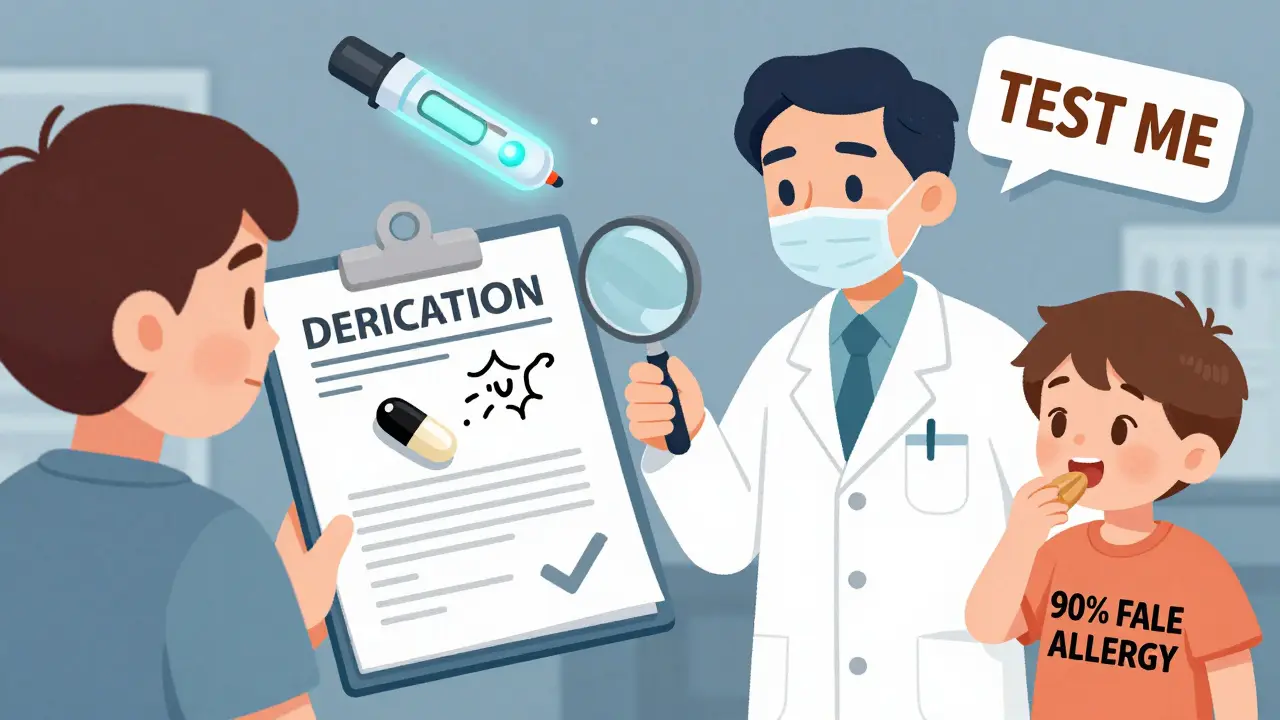
Here’s the shocking part: up to 90% of people who say they’re allergic to penicillin aren’t. They had a rash as a kid, were told to avoid it, and never got tested. That leads to doctors prescribing broader, more expensive antibiotics-and increases the risk of dangerous infections like C. diff.
Who Outgrows What?
One of the biggest differences? Children often outgrow food allergies. About 80% of kids with milk or egg allergies outgrow them by age 5. Peanut allergies are tougher, but even those can resolve in up to 20% of cases by adolescence.
Medication allergies? Almost never. Once you’ve had a true allergic reaction to a drug, you’re likely to react again if exposed. That’s why accurate diagnosis matters so much. If you were labeled allergic to penicillin as a child based on a vague rash, you might be avoiding it for life-even though you’re probably not allergic anymore.
Real-Life Confusions
People mix these up all the time. A parent sees their child break out in hives after eating a new food and assumes it’s an allergy. But what if the child was also taking antibiotics at the same time? The drug might be the real culprit. In fact, viral rashes that happen while taking amoxicillin are often mistaken for allergies. That’s why doctors now recommend waiting until the virus is gone before testing for penicillin allergy.
Another common mix-up: lactose intolerance. Someone gets bloated or has diarrhea after taking a pill and thinks it’s an allergy to the medicine. But the reaction could be from the filler-lactose-in the tablet, not the drug itself. That’s not an allergy. That’s a digestive issue. And it doesn’t mean you can’t take other pills.
On the flip side, people dismiss food allergy symptoms as indigestion. A child vomits after eating peanuts? “Must be a stomach bug.” A teen gets swollen lips after eating cashews? “Too much spice.” These delays in diagnosis can be deadly. About 150 to 200 people in the U.S. die each year from food-induced anaphylaxis-and many of those deaths happen because epinephrine wasn’t given fast enough.
What You Can Do
If you suspect an allergy, keep a detailed record. For food: write down exactly what you ate, when you ate it, and when symptoms started. Include how it was prepared-raw, roasted, fried-because that can change the reaction. For medication: note the drug name, dose, time taken, and when symptoms appeared. Did it happen after the first dose or the fifth?
Don’t assume. If you’ve been told you’re allergic to penicillin, ask for a test. If you’ve avoided milk or eggs since childhood, ask if you’ve outgrown it. Most allergists will do a simple blood test or skin prick to check. You might be surprised.
Carry an epinephrine auto-injector if you’ve had a serious reaction to food. It’s not usually needed for medication allergies unless you’ve had anaphylaxis. But if you have, make sure your doctor knows-and make sure your family and coworkers know how to use it.
Why This Matters
Misdiagnosing a food allergy as a drug reaction-or vice versa-has real costs. Hospitals spend more money on broad-spectrum antibiotics when people avoid penicillin unnecessarily. Patients get sicker from C. diff infections. Kids miss out on nutritious foods because they’re wrongly labeled allergic.
On the flip side, people who avoid foods they’re not allergic to may become malnourished. Those who think they’re safe with a drug they’re actually allergic to risk going into shock.
Accurate diagnosis saves lives. It saves money. It gives people back their freedom-to eat, to be treated, to live without fear.
Don’t guess. Get tested. Ask questions. And if you’ve been told you have an allergy-whether to food or medicine-ask if it’s been confirmed. Because in many cases, it hasn’t.


12 Comments
Man, this post is a lifesaver 🙌 I used to think my rash after amoxicillin was a food allergy until my allergist called me out. Turns out I was one of those 90% who weren’t actually allergic. Got tested last year and now I can take penicillin without sweating bullets. Also, my kid used to throw up every time he ate eggs-turns out it was just FPIES, not IgE. So much relief.
Also, if you’ve been told you’re allergic to penicillin and you’re over 30? Get tested. Seriously. It’s like finding out you’re not allergic to gluten but just hate sourdough.
Look, I appreciate the attempt at clarity, but this whole thing is still a mess of oversimplification. You say timing is everything-fine. But what about cross-reactivity? Like, someone with birch pollen allergy gets oral itching from apples-that’s not a food allergy in the traditional sense, it’s a protein mimicry thing, and you didn’t even touch on that. And then you talk about IgE vs T-cell mediated responses like they’re mutually exclusive categories, but in reality, the immune system doesn’t care about your neat little boxes. It’s a chaotic, overlapping mess of signaling pathways, cytokine storms, and epigenetic noise that we barely understand. And yet we’re handing out ‘allergy diagnoses’ like candy based on a skin prick and a 20-minute observation window? That’s not medicine, that’s guesswork dressed up in lab coats. And don’t even get me started on how the pharmaceutical industry profits from overdiagnosis and fear-based avoidance. You think people are avoiding penicillin because they’re cautious? No. They’re avoiding it because they were told to, and no one ever bothered to correct them because it’s easier to prescribe azithromycin than to do a provocation test. And now we’ve got a whole generation of people with C. diff because we’re scared of a word: penicillin. So yeah. Timing matters. But so does humility. And you didn’t show any.
Wow. So if you get a rash after a pill it’s definitely the drug and never the virus? And if you throw up after peanuts it’s definitely anaphylaxis and never just a bad taco? 🤡
Also, 90% of people aren’t allergic to penicillin? Cool. So why are all the ER forms still asking if I’m allergic? Maybe because doctors are too lazy to check? Or maybe because they’d rather have you die slowly from a resistant infection than admit they were wrong 10 years ago? I’m not mad. I’m just disappointed.
This is why America is dying. People think they’re ‘allergic’ to everything because they got a rash once and Google told them it was anaphylaxis. You think you’re allergic to penicillin? You probably just had a virus. You think you’re allergic to dairy? You’re lactose intolerant, you lazy sack of carbs. Stop blaming your poor diet on allergies. You don’t need an EpiPen-you need a gym membership and a therapist. And if you’re letting your kid avoid eggs because you’re scared of a rash? You’re raising a fragile, malnourished zombie. Wake up. This isn’t medicine. It’s performative fear.
Let’s talk about the immunological architecture here. The IgE-mediated pathway is the classical Type I hypersensitivity-mast cell degranulation, histamine release, anaphylactic cascade. But the delayed drug reactions? That’s Type IV-T-cell-driven, cytokine-mediated, often with organ-specific damage. The key differentiator isn’t just timing-it’s the cellular players. Food allergies? Mostly dendritic cells in the gut-associated lymphoid tissue priming Th2 responses. Drug reactions? Often keratinocyte stress signals activating dermal dendritic cells and CD8+ T-cells. That’s why DRESS syndrome presents with eosinophilia, hepatitis, and lymphadenopathy-it’s systemic T-cell activation, not localized mast cell explosion. And here’s the kicker: no commercial test captures this. We’re still using IgE ELISAs for drugs that don’t even work that way. We need functional T-cell assays. We need flow cytometry panels for CD69, CD137, and IFN-γ. Until then, we’re flying blind with a flashlight made of duct tape.
Hey everyone-just wanted to say thank you for this post. I’ve been trying to explain to my sister why her daughter’s rash after antibiotics isn’t necessarily a peanut allergy, and this is the clearest breakdown I’ve seen.
My niece had a fever and red spots after amoxicillin, and everyone freaked out. We waited until the virus cleared, got her tested, and turns out-no allergy. She’s now eating peanut butter like a champ. I just wish more doctors did this kind of follow-up. So many kids are unnecessarily restricted, and so many adults are stuck with inferior meds because no one asked, ‘Wait, when did this start?’
Also, if you’re scared to eat eggs or milk because you were told you’re allergic as a kid-go get tested. You might be surprised. Your body remembers, but it also forgives.
Peace and good health to all 💙
Interesting. But let’s not pretend this is a scientific breakthrough. It’s just a well-structured summary of textbook knowledge. The real issue isn’t misdiagnosis-it’s the commodification of medical anxiety. People don’t want to be told ‘you’re fine.’ They want to be told ‘you have a condition.’ It gives them identity. It gives them legitimacy. And the medical-industrial complex? It loves that. Allergies are marketable. ‘Gluten-free’ is a $15 billion industry. ‘Penicillin-allergic’ is a $2 billion annual cost in overprescribed antibiotics. So who benefits from keeping people scared? Not the patient. Not the doctor. The pharmaceutical companies. The test kits. The specialty clinics. The ‘allergy diet’ influencers. This post is informative. But it’s also a perfectly packaged product. And you’re buying it.
So let me get this straight-you’re telling me that if I got a rash after eating shrimp AND taking amoxicillin, I should just assume it’s the drug? What if it’s both? What if I’m allergic to shellfish AND the drug? What if the virus I had made me more sensitive? What if my immune system is just broken? You act like medicine is a flowchart. It’s not. It’s a minefield with a blindfold on. And now you want me to trust a blog post over my own trauma? I’ve been in the ER three times. I’ve watched my best friend die because no one believed her. So don’t give me your ‘90%’ stats. Give me answers. Or shut up.
my cousin ate a peanut and threw up. mom said allergy. 10 yrs later she still avoids nuts. turns out she had a stomach bug. lol. also penicillin? nope. just a rash. never tested. now she gets azithromycin every time. cost? 3x. side effects? worse. dumb.
While the content of this article is broadly accurate, it suffers from a critical deficiency in terminological precision. The term 'allergy' is misapplied in numerous contexts where 'intolerance' or 'adverse drug reaction' is the correct diagnosis. Furthermore, the casual use of phrases like 'you're probably not allergic' undermines the gravity of true IgE-mediated anaphylaxis. Medical terminology must be used with rigor, not colloquialism. The public's misunderstanding stems not from lack of information, but from linguistic sloppiness in medical communication. Precision saves lives. Vagueness kills.
Okay but I just had to cry reading this 😭 I’m a mom of a kid with a peanut allergy and I’ve been terrified for 5 years. But then I read about the 90% penicillin thing and I thought-wait, what if we’re wrong about other things too? So I took my kid to an allergist and guess what? He’s not allergic to eggs. Not at all. We’re eating scrambled eggs for breakfast tomorrow. I didn’t think I’d ever feel this free again. Thank you for writing this. I needed to hear it.
Also, I got my penicillin test done last year. Negative. I’m not scared anymore. 🙏💛
Let’s be honest: this is just glorified patient education content wrapped in jargon to make it sound authoritative. You cite statistics like they’re gospel, but you ignore the systemic failures that enable misdiagnosis in the first place. Primary care physicians have 7-minute appointments. Allergists are overbooked for 18 months. Tests cost $500. Insurance denies coverage. So who actually gets tested? The privileged. The rest? They’re told to avoid everything and live in fear. This article doesn’t solve the problem-it just makes people feel smarter while the system stays broken. You’re not a hero. You’re a symptom.