
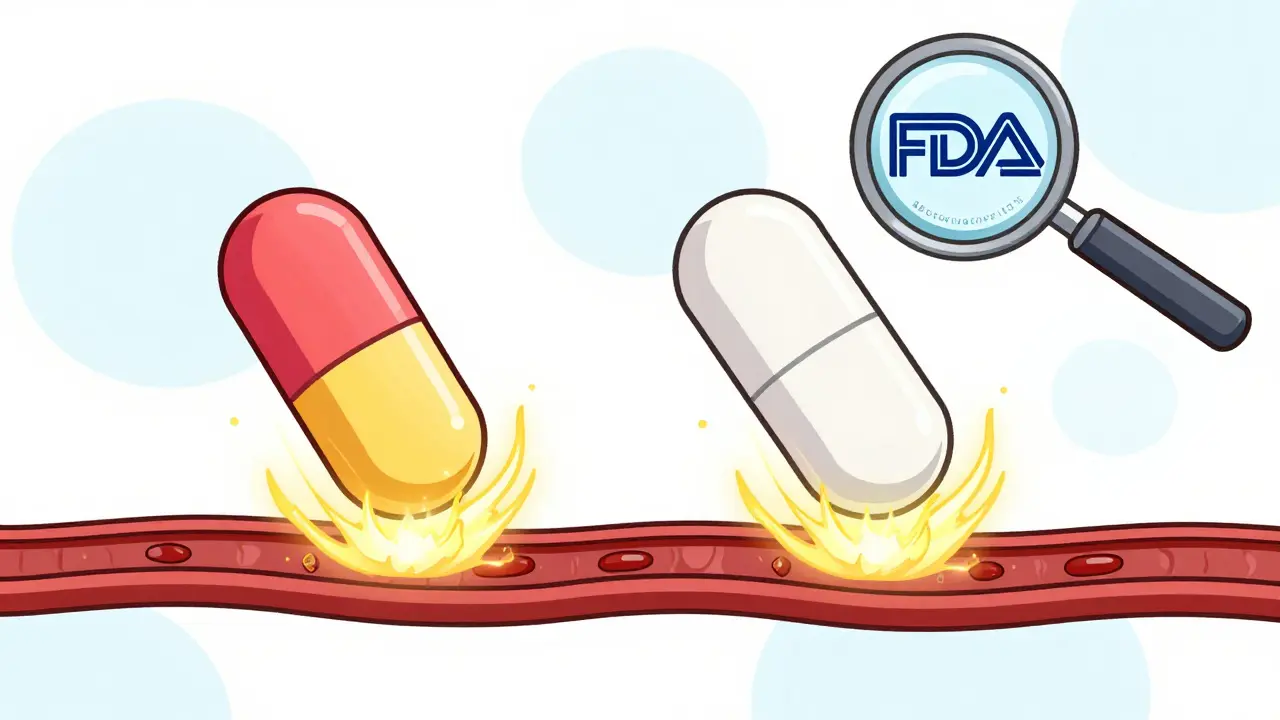
When you pick up a prescription, you might see two pills that look completely different-one with a colorful logo, the other plain and white. One costs $15. The other costs $685. You might wonder: is the cheap one just as good? The answer isn’t just yes-it’s generic drugs are held to the exact same standards as brand-name drugs by the FDA. And the data backs it up.
Same Active Ingredient, Same Results
Generic drugs contain the exact same active ingredient as their brand-name counterparts. That means if you’re taking lisinopril for high blood pressure, whether it’s sold as Zestril or a generic version, your body gets the same molecule. The FDA requires this. No exceptions. The active ingredient must be identical in strength, dosage form, and how it’s delivered-whether it’s a pill, injection, or inhaler. But what about how your body absorbs it? That’s where bioequivalence comes in. Before a generic drug can be approved, manufacturers must prove it behaves the same way in your bloodstream as the brand-name version. They test this by giving it to 24-36 healthy volunteers and measuring how quickly and how much of the drug enters the blood. The results have to fall within 80% to 125% of the brand-name drug’s absorption rate. That’s not a guess. That’s a strict, science-based rule. For most drugs, that range works fine. But for drugs with a narrow therapeutic index-like warfarin, levothyroxine, or phenytoin-the FDA tightens the rules. Here, the acceptable range shrinks to 90% to 111.11%. That means even small differences in absorption matter. Even then, studies show most patients do just fine on generics.Why Do They Look Different?
If the active ingredient is the same, why do generic pills look different? Because trademark laws force them to. The brand-name company owns the color, shape, and imprint of their pill. So generics have to look different-even if they work the same. That’s why your generic amoxicillin might be a white oval instead of a blue capsule. The difference isn’t in the medicine. It’s in the fillers. Inactive ingredients like lactose, dyes, or preservatives can vary. For most people, that’s no problem. But if you’re allergic to a specific dye or have a rare sensitivity to lactose, you might notice a reaction. That’s rare, but it happens. If you switch from brand to generic and feel different, talk to your pharmacist. They can check the inactive ingredients and help you find a version that matches your needs.Real-World Evidence: Do They Work?
A 2019 study in JAMA Internal Medicine looked at 3.5 million patients across 13 conditions-diabetes, high blood pressure, depression, osteoporosis. The researchers compared brand-name drugs to generics. The results? No difference in effectiveness. No increase in hospital visits. No rise in complications. The generics worked just as well. Even more surprising? A 2020 study in Austria found patients on generic blood pressure meds had lower death rates than those on brand-name versions. At first, that seemed to suggest generics were better. But the researchers dug deeper. They found it wasn’t the drugs. It was the patients. People on generics were more likely to stick with their treatment because it was cheaper. That’s not magic. That’s adherence. When you can afford your medicine, you take it. That’s the real win. For drugs like levothyroxine, a small number of patients-5% to 10%-do report changes in how they feel after switching. That’s why some endocrinologists recommend sticking with one brand if you’ve been stable on it. But that’s not because generics are inferior. It’s because thyroid levels are so sensitive that even tiny shifts in absorption can affect how you feel. Consistency matters. If you’re doing well on a generic, don’t switch. If you switch and feel off, go back to what worked.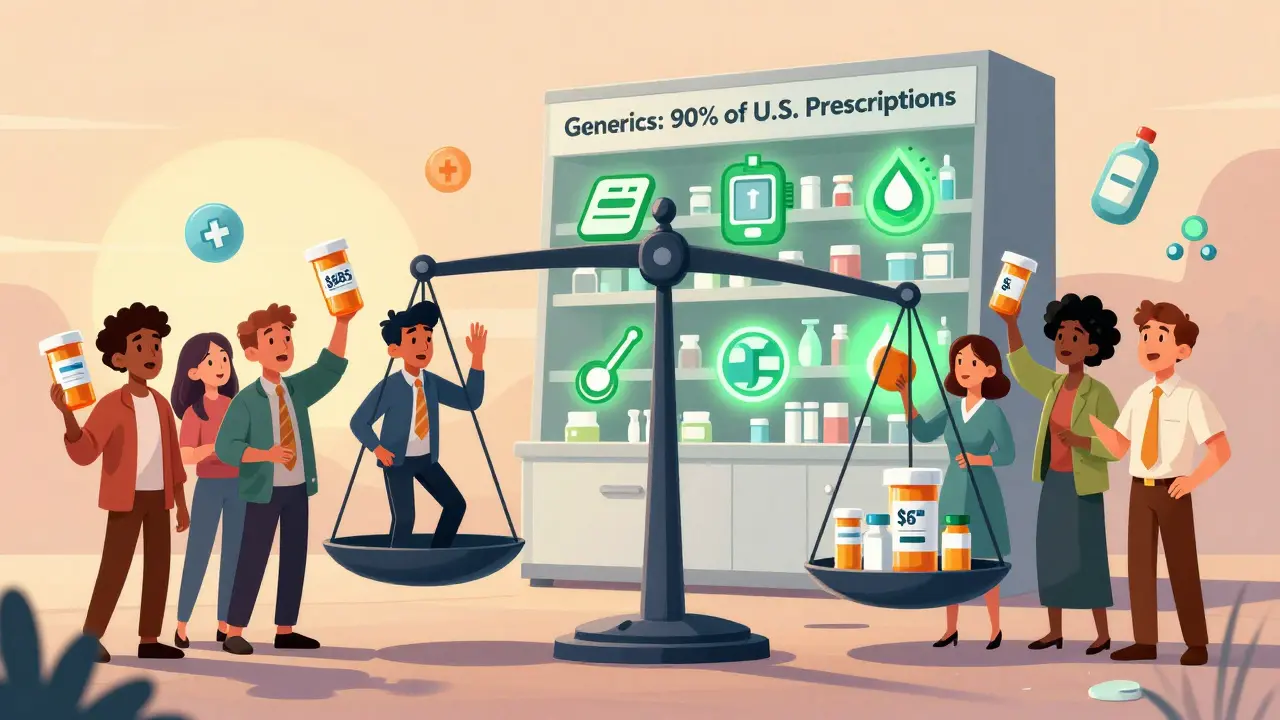
Cost Isn’t Just a Number-It’s a Lifeline
Brand-name drugs can cost hundreds, even thousands, per month. Generics? Often $5 to $15. In 2022, generics saved the U.S. healthcare system $373 billion. That’s not a rounding error. That’s money that keeps people alive. One in five Americans can’t afford their prescriptions. Generics keep them from choosing between medicine and groceries. Medicare Part D plans push for generic use because it lowers premiums for everyone. Most plans charge $5 for a generic and $50-$100 for a brand. That’s not a trick. That’s how insurance works. And it works. In 2022, 90% of all prescriptions filled in the U.S. were generics. That’s 8.8 billion prescriptions. And yet, generics make up only 23% of total drug spending. The math is simple: more people get treated, and it costs less.Why Do Some People Think Generics Don’t Work?
A 2022 Consumer Reports survey found 42% of Americans believe generics are less effective. Why? Because they look different. Because they cost less. Because someone told them so. One Reddit user shared that after switching from Synthroid to generic levothyroxine, their mom’s TSH levels jumped. Another user, a nurse, said she’s seen dozens switch without issue. Both are real experiences. But correlation isn’t causation. That TSH spike could’ve been caused by stress, a new diet, missed doses, or even a different pharmacy’s batch. The key is consistency. If you switch generics, stick with the same one. Don’t bounce between brands and generics every refill. The FDA’s It’s the Same Medicine campaign was launched to fight this myth. They show side-by-side images of brand and generic pills. Same active ingredient. Same effect. Different color. That’s it.What About Quality and Supply?
Most generic drugs are made in the same factories as brand-name drugs. The FDA inspects them all. In fact, many brand-name companies make their own generics after the patent expires. Teva, Sandoz, and Mylan produce both. The difference? The brand gets a fancy label. The generic gets a lower price. But there’s a risk. About 78% of active ingredients come from China and India. That’s not a secret. It’s just how global manufacturing works. And when one factory has a problem-like the 2022 shortage of metformin-supply chains get tight. That’s why the FDA increased inspections and is pushing to cut approval times from 14 months to 10. Quality isn’t slipping. But the system is under pressure.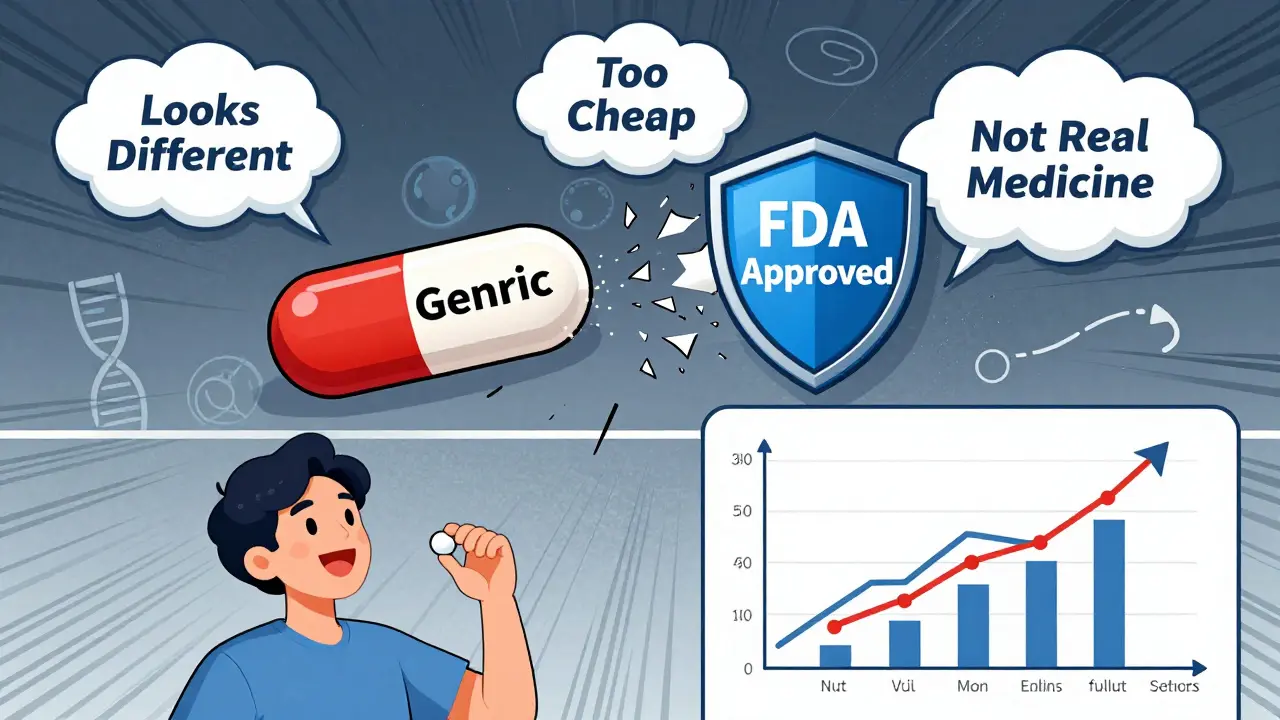
What Should You Do?
If your doctor prescribes a brand-name drug and you’re worried about cost, ask: “Is there a generic?” Most of the time, the answer is yes. And if your insurance pushes you to the generic, don’t panic. You’re not getting a second-rate drug. You’re getting the same drug at a fair price. If you’ve switched and feel different, don’t assume the generic is bad. Talk to your pharmacist. Check the pill identifier on the FDA’s Drugs@FDA site. Make sure you’re taking the same dose. Track your symptoms. If you’re still uneasy, ask your doctor about switching back. For most people, the choice is simple: save money, get the same medicine, stay healthy.When to Be Extra Careful
Some drugs need extra attention:- Thyroid meds (levothyroxine): Stick with one brand or generic. Don’t switch back and forth.
- Blood thinners (warfarin): Consistency is critical. Your doctor may monitor your INR more closely after a switch.
- Seizure meds (phenytoin, carbamazepine): If you’ve had seizures under control, don’t switch unless your neurologist says it’s safe.
- Immunosuppressants (cyclosporine, tacrolimus): These are complex. Talk to your transplant team before switching.
Bottom Line
Generic drugs aren’t a compromise. They’re the standard. The FDA doesn’t cut corners. The science doesn’t lie. The billions of prescriptions filled every year prove it. You’re not getting less. You’re getting the same medicine-without the marketing markup. The real question isn’t whether generics work. It’s whether you can afford not to use them.Are generic drugs as safe as brand-name drugs?
Yes. Generic drugs must meet the same strict safety and quality standards as brand-name drugs. The FDA requires them to have the same active ingredient, strength, dosage form, and route of administration. They’re tested in the same way, inspected in the same facilities, and held to the same approval rules. There’s no difference in safety.
Why are generic drugs so much cheaper?
Generic drugs don’t have to repeat the expensive clinical trials that brand-name drugs do. Once a patent expires, other companies can make the same drug without paying for the original research and marketing. That saves them billions. Those savings get passed to you. The FDA doesn’t allow generic manufacturers to cut corners on quality-just on advertising and development costs.
Can inactive ingredients in generics cause side effects?
Yes, but it’s rare. Inactive ingredients like dyes, fillers, or preservatives can trigger allergies or sensitivities in some people. For example, someone allergic to lactose might react to a generic version that uses it as a filler. If you notice new side effects after switching, check the ingredient list with your pharmacist. Most people have no issues, but if you’re sensitive, ask for a version without the problematic ingredient.
Should I avoid generics for chronic conditions like high blood pressure or diabetes?
No. Large studies involving millions of patients show no difference in outcomes between brand-name and generic versions for conditions like hypertension, diabetes, and depression. The key is consistency-stick with one version and don’t switch frequently. If you’re doing well on a generic, there’s no reason to change.
How do I know if my pharmacy switched my generic?
Pills can look different even if they’re the same drug. Check the imprint code on the pill (like “L484”) and compare it to the FDA’s Drugs@FDA database. Your pharmacist can also tell you if the manufacturer changed. If you’re unsure, ask them to confirm it’s still the same medication. Don’t assume a different shape or color means it’s not working.
Is it okay to switch between different generic brands?
For most drugs, yes. But for narrow therapeutic index drugs-like levothyroxine, warfarin, or seizure meds-it’s better to stick with one manufacturer. Small differences in absorption can matter. If you’re stable on one generic, keep using it. If you’re switched unexpectedly and feel off, contact your doctor. Don’t assume the new version is worse-just check with a professional.




13 Comments
Generics saved my life when I was on disability. I chose between insulin and rent. I chose insulin. No regrets.
Same pill. Different price. That’s it.
Let’s be real-FDA inspections are a joke. You think they’re checking every batch from China? Nah. They’re rubber-stamping because Big Pharma lobbies them into submission.
Ever heard of the 2018 Ranbaxy scandal? That was just the tip. The system’s rigged. You’re not getting the same medicine-you’re getting a gamble.
And don’t even get me started on fillers. Lactose? Titanium dioxide? That’s not medicine, that’s chemical soup.
They call it ‘bioequivalence’-but bioequivalence doesn’t mean biological identity. Your body’s not a lab rat. It’s a living system. And they’re treating it like a spreadsheet.
In India, we’ve used generics for decades. My grandfather took generic metformin for 20 years. No problems. The real issue isn’t the drug-it’s trust.
We don’t trust systems. We trust people. If your pharmacist recommends it, and your body feels fine, then it’s fine.
Money talks. And in poor countries, generics aren’t a choice-they’re survival.
I switched from Synthroid to generic levothyroxine last year. My TSH went from 2.1 to 4.8. I felt exhausted, cold, foggy.
Went back to brand. Back to normal.
It’s not about being paranoid. It’s about listening to your body.
There’s a fascinating statistical nuance here that’s often overlooked. The 80–125% bioequivalence window is based on Cmax and AUC metrics derived from healthy volunteers under fasting conditions. But real-world patients are elderly, comorbid, on polypharmacy, with altered GI motility, renal impairment, or hepatic metabolism. The pharmacokinetic variability in these populations can push absorption beyond the acceptable range even if the drug passed FDA bioequivalence trials.
Moreover, the FDA’s acceptance criteria assume normal distribution of pharmacokinetic parameters, which is rarely the case in heterogeneous populations. So while the data is robust on a population level, individual responses can deviate significantly. This isn’t a flaw in generics-it’s a flaw in assuming uniformity in human biology. The system works statistically, but not always clinically for every single person.
That’s why consistency matters. Not because generics are inferior-but because human physiology is messy.
Of course generics work. They’re just as good as brand-name drugs. Just like how a knockoff Rolex runs just as well as the real one.
Oh wait-it doesn’t. It breaks in six months. And you’re not gonna find a Rolex made in a factory that got shut down for violating safety regulations.
So why are we pretending this is different?
It’s not about science. It’s about capitalism pretending to care about you.
They don’t care if you live. They care if you pay.
YOU’RE ALL IGNORANT. I’ve been a nurse for 22 years. I’ve seen patients crash after switching generics. I’ve seen TSH levels go off the charts. I’ve seen seizures return because someone got a different filler.
And now you’re all sitting here like it’s a TED Talk about ‘cost savings’?
Some people aren’t ‘most people.’ Some of us are the 5% who get screwed because the system doesn’t care about individual biology.
Don’t tell me to ‘just take it’ when your ‘just take it’ almost killed someone I loved.
Generics are fine for your diabetes meds. But for thyroid? For seizures? For warfarin? That’s not saving money. That’s gambling with lives.
People in America act like generics are some new invention. In India, we’ve been using them since the 1970s. We call them ‘generic’ because they’re not branded. Not because they’re fake.
My uncle took generic antihypertensives for 30 years. Never had a stroke. Never went to hospital.
But you Americans think if it’s cheap, it’s trash. That’s your problem, not the drug’s.
Also, why do you think your brand-name drugs are so expensive? Because you pay for the ads on TV, not the medicine.
China makes 80% of our pills. You really think they care if your blood pressure drops? They care about profit.
And now you’re telling me to trust a pill made in a factory with no oversight?
Our country used to make medicine. Now we import it from places that don’t even speak English.
This isn’t science. This is surrender.
Hey, if you switched and felt weird-don’t panic. Talk to your pharmacist. They can check the filler ingredients. Most people are fine. But if you’re not, your feelings matter.
You’re not crazy. You’re just paying attention.
And that’s okay.
It’s not about generics being bad. It’s about control.
Big Pharma wants you dependent on their branded version because they profit from your fear.
They tell you ‘stick with the brand’ not because it’s better-but because they own the narrative.
Generics are the rebellion. The quiet protest against corporate greed.
And if you’re afraid of them? That’s the fear they want you to feel.
Thank you for this thorough breakdown. I’ve always assumed generics were equivalent, but reading the bioequivalence criteria and the real-world studies helped me understand why.
It’s also sobering to realize how much of our health outcomes depend on adherence-and cost is the biggest barrier.
Thank you for not just stating facts, but framing them in human terms.
One thing I’ve learned from working with patients in rural clinics: the real magic isn’t in the pill. It’s in the person who hands it to them.
A pharmacist who takes five minutes to explain the difference between brands and generics? That’s the real healthcare.
Not the FDA. Not the cost. Not the color of the pill.
But the human who says, ‘I’ve got you.’